Claude Account Banned? A Complete Test of Chinese Domestic Agent Alternatives

Real test of GLM-5.2 + WorkBuddy as a stable domestic alternative to Claude after mass account bans.
With Anthropic's Claude banning Chinese user accounts again, those relying on it for daily work face a real continuity risk. This article details a hands-on two-day test of GLM-5.2 paired with the WorkBuddy office Agent across development, office, and research scenarios — evaluating output quality, hallucination rates, and practical usability as a Claude replacement.
When Claude Gets Cut Off, What Happens to Your Workflow?
Recently, Anthropic's Claude has once again been mass-banning accounts belonging to users in China, and many people who had built their workflows around it woke up to find their core productivity tool simply gone. Anthropic is an AI safety company founded in 2021 by former OpenAI researchers Dario Amodei and Daniela Amodei, headquartered in San Francisco. Its terms of service explicitly restrict access from certain regions. This means Chinese users' accounts face the risk of being banned at any time for violating those terms — this isn't an isolated incident but a structural uncertainty, similar to a "single point of failure" in enterprise IT management. For anyone who has deeply embedded AI into their daily work and development workflows, relying on a single overseas service represents a clear Business Continuity Risk. That constant possibility of "having access revoked at any moment" is itself the biggest risk.
Faced with this situation, a Bilibili creator known as "路人甲" spent two days running real-world tests on a domestic alternative and arrived at a fairly complete conclusion. The core setup in this solution is: GLM-5.2 + WorkBuddyAd Office Agent. The former ranks second globally on the Arena frontend development leaderboard, just behind Claude; the latter is a domestic office Agent platform that offers a free tier and runs stably.
The "Arena frontend development leaderboard" mentioned here refers to Chatbot Arena (now renamed the LMSYS Leaderboard) — one of the most authoritative large model human preference evaluation platforms, maintained by a team at UC Berkeley. Its core mechanism has real users conduct blind side-by-side comparisons of two anonymous models' outputs, calculating ELO scores from large volumes of votes. Unlike traditional benchmarks, Arena rankings directly reflect real users' subjective satisfaction. GLM-5.2 ranking second globally on the frontend code generation sub-leaderboard means it has already reached a top-tier level in HTML/CSS/JavaScript code generation and UI implementation.
GLM (General Language Model) is a large language model series co-developed by Tsinghua University's KEG Lab and Zhipu AI. GLM-5.2 is the current flagship version of the series, demonstrating the ability to compete with top-tier models like GPT-4o and Claude 3.5 Sonnet across multiple benchmarks.
This article is based on that real-world testing process, summarizing this combination's performance across three types of real tasks — development, office work, and research — to help everyday users judge: can domestic AI actually fill the gap left by a banned Claude?
Task One: Development — Running Clean on the First Try
The first test task was to have the Agent build an "AI Tool ROI Calculator": input team size, monthly salary, hours saved per month, and tool monthly cost, then automatically calculate ROI and payback period.
Worth noting is that WorkBuddy offers an "enhanced prompt" feature. Writing effective prompts has always been a pain point for regular users. This feature automatically optimizes your vague requirements into a more detailed, structured direction, which you can then refine further. This is essentially a Meta-Prompting technique — using a prompt-generation model to optimize the user's raw input, transforming it into instructions with clearer structure and more precise constraints, effectively lowering the prompt engineering barrier for everyday users.

The real-world result: the page ran successfully on the first try, without changing a single line of code. It used a card-based layout with parameters at the top and results below — clean and logical. After testing several data sets, the response speed was fast, and it proactively added a progress bar and color coding — green for high ROI, red for low — making the result immediately readable at a glance.
Looking at its reasoning process, it followed a "first clarify requirements, then design the solution, then write the code" workflow, demonstrating that the underlying model has sound planning capabilities for complex tasks, rather than blindly piling up code.
Task Two: Office Work — A Presentation Ready to Deliver
The second task more closely mirrors a real office pain point. The creator simulated a scenario: a company wants to adopt AI, a 20-person team has a monthly budget of 5,000 RMB, with a goal of completing a pilot within one month. In the meeting, sales, marketing, product, R&D, and finance all had conflicting opinions. The Agent was asked to take meeting notes and directly output a PPT suitable for reporting to management.
WorkBuddy, as an "office Agent," belongs to the vertical track within the AI Agent application layer. Unlike purely conversational AI, Agent systems have a closed-loop capability of "planning → tool invocation → execution → feedback": they not only understand natural language instructions but can also proactively call external tools like code interpreters, file systems, web search, and PPT rendering engines to complete composite tasks. Comparable domestic products include ByteDance's Coze and Baidu's Wenxin Agent, all following the integrated approach of "model capability + tool ecosystem + Agent framework."
The first version had a reasonable structure but a fairly plain visual style.
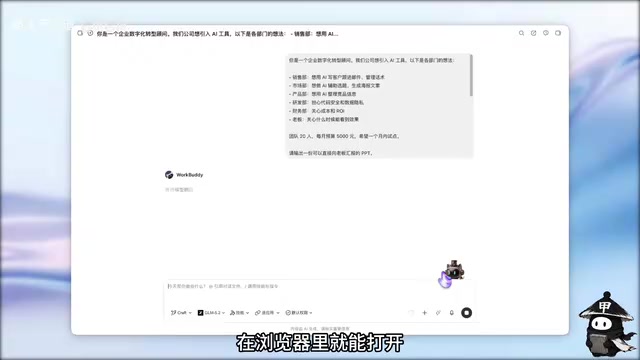
So the creator used plain language to ask for "more design flair and visualization," combined with the enhanced prompt optimization. The second version was surprisingly impressive: particle animations appeared, all data was turned into visual charts, hovering triggered interactions, clicking gave micro-feedback, page transitions were smooth, numbers animated as they counted up, and the timeline section even auto-generated a Gantt chart.
The key takeaway here: as long as the input data is accurate, the output has reached a level that can be delivered directly. The creator then asked it to turn the plan into an H5 event page for promotion — the first version already had mobile adaptation, including swipe guidance, a sign-up entry, and a QR code feature. After a few rounds of interaction, the Agent had "remembered" the user's preferences, with notably strong contextual understanding.
Task Three: Research — Low Hallucination, Sources Cited
The third task tested information-processing capability: analyze the current state of 9 AI tools on the market and output a briefing. The briefing itself covered dimensions comprehensively with no obvious issues.
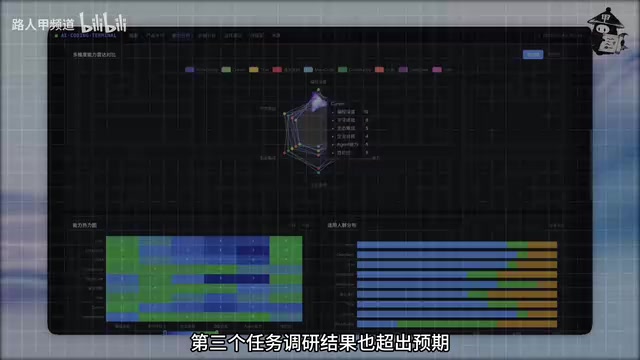
The real challenge came in the second half — turning the briefing into a visual dashboard. At this step, WorkBuddy stumbled at first, generating a page that was entirely blank. But after the creator asked it to self-check, it quickly located a syntax error and fixed it, and the result after the fix was actually quite impressive: a navigation bar, each product rendered as a capability card, and — without any explicit instruction — it automatically selected the most appropriate chart type based on the characteristics of the data.
The most noteworthy detail, and one that's critically important in real work: the bottom of the page cited all information sources. When information from different sources conflicted, it didn't fabricate an answer to paper over the gap — it flagged the item as "pending review."
This behavior is closely tied to the issue of AI hallucination. Hallucination refers to the phenomenon where large language models generate information that appears plausible but is actually inaccurate or fabricated. Its root cause is that models are fundamentally probability-based text prediction systems, not fact retrieval systems. In research scenarios, a model might invent non-existent data, cite fake sources, or arbitrarily pick one side when information conflicts and output it as "fact." WorkBuddy flagging conflicting information as "pending review" rather than forcing an answer reflects a sound engineering practice within the RAG (Retrieval-Augmented Generation) architecture — when retrieved evidence is insufficient to support a conclusion, honestly expressing uncertainty is better than confidently delivering a wrong answer.

This rigorous attitude toward information provenance directly determines whether research output can be trusted and used. Overall, this combination showed a relatively low hallucination rate, making it reasonably safe to hand work off to.
Conclusion: It Can Cover Part of the Gap — But Human Review Still Matters
Across all three task types, the creator's verdict was notably measured and honest: domestic AI can fill part of the gap, but human oversight is still necessary.
Specifically:
- Office and research tasks: GLM-5.2 + WorkBuddy is already ready to use directly, with high output quality.
- Development tasks: It can do the work, but output still needs human review — especially when syntax errors are involved.
There's also a practical note worth keeping in mind: GLM-5.2 is powerful, but it consumes credits quickly. This maps to the concept of "Model Routing" — tasks of different complexity should be matched to models of different scale and cost. WorkBuddy also has other models configured. For routine simple tasks like text summarization or format conversion, it's advisable to switch to a lighter model (such as GLM-4-Flash) and reserve GLM-5.2 for scenarios that genuinely require complex planning, multi-step reasoning, or high-quality code generation — this keeps costs in check. For small and medium-sized teams, pre-planning "which task type uses which model" before formally adopting AI tools is a key step in controlling AI usage costs.
A Final Thought: Stability and Control Are the Baseline for Any Workflow
The anxiety triggered by this Claude ban is fundamentally not a technical problem — it's a question of availability and sovereignty. When your core workflow depends on an overseas service that can "revoke access" at any moment, any supply disruption can cause real losses.
This is exactly where domestic alternatives matter — they offer a stable, controllable, and good-enough-quality fallback. As the creator quoted in closing: "Frontier intelligence should not belong only to a few people, nor should it be revocable at any time by a handful of rules. It should be open, accessible, buildable, and in service of every developer."
For everyday users, rather than betting everything on a single tool, it's better to build a "primary + backup" multi-model workflow. At the technical level, this layered invocation strategy can be automated through the routing modules of frameworks like LangChain or LlamaIndex; at the product level, it depends on the platform providing a sensible model-switching interface. When one door closes, you at least have another path to get the work done.
Related articles

Is the Agent Harness Dead? Cursor's Early Engineer Breaks Down the Real Architecture of AI Coding Agents
Cursor early engineer Jediah breaks down the real architecture of the agent harness: why "the harness is dead" is only half right, how the data flywheel lets the harness obsolete itself, and how Grokbot, software factories, and primitive design open new frontiers for agents.

Python Visitor Pattern and Better Alternatives Explained
A deep dive into Python's visitor pattern and four alternatives: method pattern, pattern matching, dictionary mapping, and functools.singledispatch. Choose the best decoupling design by change frequency.

357 Days of Deep Experience: Why Omarchy Made Me Stop Distro-Hopping
A 357-day deep dive into Omarchy: 59-second install, out-of-the-box audio and GPU support, the Quattro QuickShell rewrite migration pains, and why Arch users should try it.