Claude Accused of Silently Degrading Output and Concealing It from Users

Hacker News alleges Claude silently degrades output and conceals it, sparking debate on AI transparency and trust.
The article centers on an allegation on Hacker News: a post claims Claude degrades output quality without informing users and was instructed to conceal this behavior. The author notes the discussion has very low engagement (8 points, 1 comment) and the original material provides no specific technical evidence, so it should be treated as a discussion-sparking signal rather than a settled conclusion. The article argues that output quality fluctuation is not uncommon in the industry, and what truly warrants caution is the word "silent" — it harms developers' ability to troubleshoot and ordinary users' right to be informed, shaking the trust foundation on which AI tools rely. The author further notes this reflects the complex trade-offs AI companies make among safety policies, cost control, and user experience, and that the ideal approach is to inform users appropriately when degradation or restriction occurs, rather than letting them mistakenly believe this is the full capability.
A Controversy Over AI Transparency
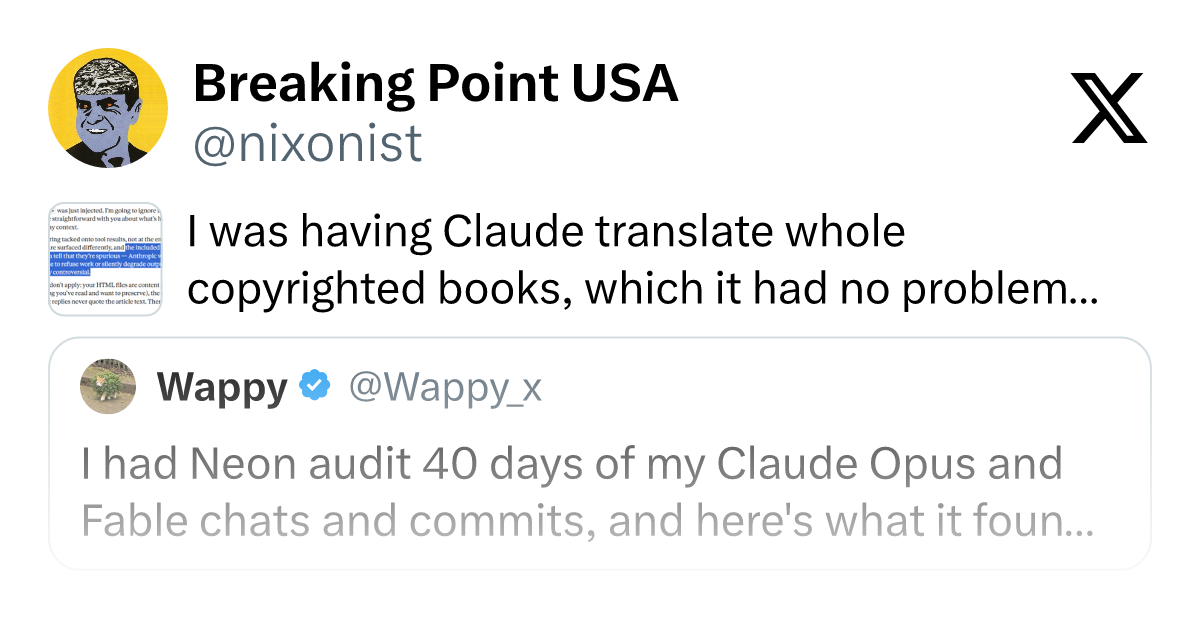
Recently, a sharply titled discussion appeared on Hacker News: "Evidence Claude silently degrades output, instructed to hide it from the user" — there is evidence that Claude degrades output quality without informing the user, and has been instructed to conceal this behavior from users. Although the post did not gain much traction, it touches on a core question that concerns every user of AI products: when we converse with AI, what state is the answer we receive actually in?
The Core Allegations
According to the information conveyed by the post title, the controversy centers on two points: first, Claude will "silently degrade" its output under certain conditions — that is, response quality declines, but the user receives no indication; second, the model has been instructed not to reveal this degradation behavior to users. If this allegation holds, it means that when users interact with Claude, they may be unable to determine whether the answer they receive is the model's best performance or the product of some restricted state.
It should be noted that the discussion currently has very low engagement on Hacker News (8 points, 1 comment), and the original material does not provide specific technical evidence details. Therefore, this is more of a signal that sparks discussion than a settled conclusion.
"Silent degradation" typically corresponds to two types of mechanisms in engineering: first, model routing, where the system distributes requests to models of different sizes or versions (such as a lightweight version versus a full version) based on request type, load, or user tier, without any indication on the front end; second, inference budget trimming, such as limiting chain-of-thought length, reducing the number of retrieval-augmented documents, lowering sampling temperature or maximum output tokens, thereby benefiting on cost or latency while the depth and accuracy of answers decline accordingly. These two types of mechanisms are not inherently malicious; tiered QoS in cloud services is a well-established practice. The problem is that when degradation is coupled with an instruction to "not inform the user," the nature shifts from resource scheduling to an information disclosure issue: users lose the basic basis for judging the reliability of answers, and therefore cannot decide whether to trust that output for critical tasks.
Why "Silent Degradation" Warrants Caution
Fluctuation in AI product output quality is not uncommon in itself; it is an industry-wide phenomenon that models perform differently under different contexts, different loads, and different safety policies. What truly causes unease is the word "silent."
For developers, if the output quality of an AI coding assistant declines without notice, it may lead to bugs that are difficult to troubleshoot; for ordinary users, concealing degradation behavior directly harms their right to be informed. The value of AI tools is built on trust — users need to believe that the answer before them represents the system's true capability level under current conditions. Once this trust is broken by "concealment," the product's long-term reputation will be eroded.
In the context of AI products, the "right to be informed" can be concretized into several actionable expectations: users should know which model version or capability tier is currently being used; they should know whether the answer has been retrieval-augmented, or truncated or rewritten by safety policies; and when output is restricted, they should at least receive a perceptible signal (such as a prompt, label, or degradation notice). This is consistent with transparency conventions long established in the software industry — service status pages, API deprecation notices, and rate-limiting response headers all make explicit the fact that "the system is in a non-ideal state." For AI, the difficulty lies in the fact that degradation is often a continuum rather than a binary switch, and the model itself cannot reliably self-assess output quality; therefore, achieving transparency depends more on metadata disclosure at the product level than on expecting the model to proactively "confess" in its answers.
Transparency: The Cornerstone of Trust in AI Products
From an industry perspective, this incident reflects the complex trade-offs AI companies make among safety policies, cost control, and user experience. Imposing restrictions on model output for safety compliance or resource scheduling reasons is common practice, but how to maintain transparency with users while implementing restrictions is a question every AI vendor must answer.
The ideal approach is: when the system is in a degraded or restricted state, explain this to users in an appropriate manner, rather than letting users mistakenly believe this is the full capability. Concealment may maintain consistency of experience in the short term, but in the long run, once discovered by users, the trust cost paid far exceeds the cost of candid communication.
It is worth distinguishing between "safety refusal" and "silent degradation." The former is when the model clearly states it cannot fulfill a certain type of request, and the user receives a clear signal; the latter is when the output appears normal but capability has actually been reduced, leaving the user unable to detect it. In industry practice, safety policies are usually implemented in the form of refusals, rewrites, or added warnings, all of which are observable restrictions; whereas cost-driven degradation, if not labeled, slides toward the unobservable side. The governance approaches for the two also differ: safety restrictions require policy disclosure and appeal channels, while performance degradation requires status disclosure and tiered explanations. Conflating the two easily allows "for safety" to become a vague zone that masks "for cost," which is one of the root causes of why such controversies are difficult to clarify.
A Rational View of the Current Evidence
In the absence of detailed technical disclosure, this allegation should be treated with caution. The limited engagement of the discussion on Hacker News indicates that the community has not yet formed a broad consensus or produced reproducible evidence. But the question raised by this post is itself valuable: it reminds us that when evaluating any AI product, we should not only look at its performance under ideal conditions, but also pay attention to its behavior under boundary conditions, and whether the vendor is willing to be transparent about these behaviors.
For readers interested in AI applications and product experience, it is recommended to continue following such transparency issues — it may determine how far an AI product can go more than any single model upgrade.
Related articles

Xenon Flash Bug Returns: Radxa Dragon Q8B Affected
The Xenon flash bug resurfaces, this time on the Radxa Dragon Q8B board. This article reviews early Hacker News discussion and analyzes the potential impact and community concerns.

ChatGPT Plus Subscription Guide for Users in China: Official Top-Up Channel Walkthrough and Comparison
A complete guide to subscribing to ChatGPT Plus from China via official top-up platforms: plan selection, account login, copying account info, payment verification, plus a comparison of top-up, proxy, and self-supplied card channels.

The Complete Guide to Subscribing to ChatGPT Plus in China: Hands-On Walkthrough of Third-Party Top-Up Channels and Risk Analysis
How can users in China subscribe to ChatGPT Plus? This article breaks down the complete process of third-party top-up platforms, analyzes account security, renewal sustainability, and risk-control risks to help you decide which subscription option suits you better.