Prank Script 'Ram Altman' Emails Sam Altman Daily to Report Idle RAM
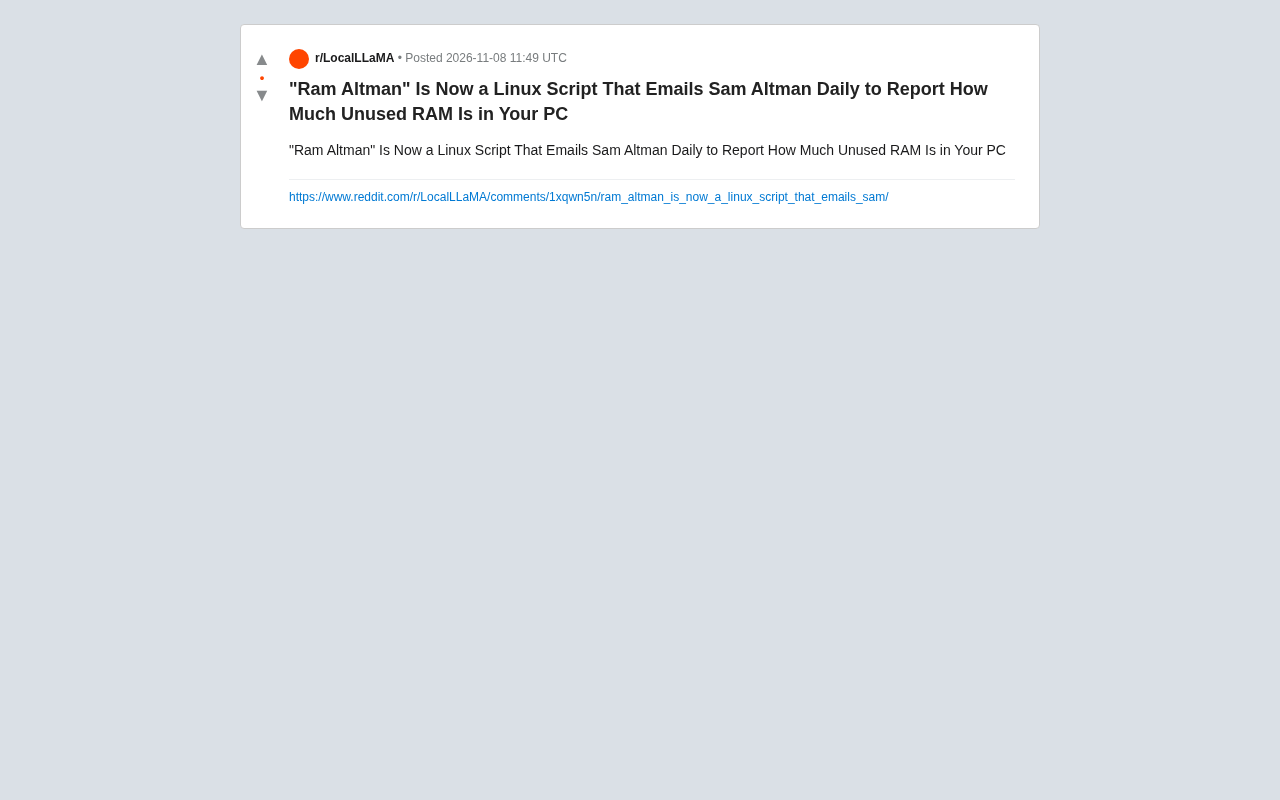
Linux script Ram Altman emails Sam Altman daily to report idle RAM, humorously mocking AI compute anxiety.
Ram Altman is a prank script circulating in the Linux community that puns on Sam Altman's name by pairing it with RAM, automatically emailing the OpenAI CEO every day to report how much idle memory the user's computer has. Technically simple, it reads memory data via /proc/meminfo or the free command, sends it through SMTP or a local mail command, and schedules it with cron. This performance-art-style idea resonated on Reddit not only for its absurd contrast but also because it reflects ordinary developers' subtle feelings about tech giants hoarding compute resources amid the AI boom. The article sees it as a continuation of geek culture expressing attitudes through code—and a mirror of resource anxiety in the AI era.
The Birth of a Script: When Idle RAM Meets a Tech Mogul
The Linux community has never lacked for prank ideas, but a recent script called "Ram Altman" still brings a knowing smile. Its function is simple: every day it automatically sends an email to OpenAI CEO Sam Altman telling him how much idle memory (RAM) is left on the user's computer. According to a Reddit user's share, the name is obviously a pun on Sam Altman—swapping "Sam" for "Ram," which refers to memory while also satirizing the AI industry's hunger for compute resources.
The humor lies in its absurdity: a CEO running the world's most closely watched AI company receives, every day, an email from a random Linux user whose entire content is "my computer still has 8GB of memory unused." That contrast alone is an internet-style jab.
The Technical Logic and Community Culture Behind the Script
From a technical standpoint, "Ram Altman" isn't complicated. Linux offers several ways to obtain memory information, such as the /proc/meminfo file or the free command; the script only needs to parse that data and send it out via an email protocol (such as SMTP). Daily scheduled execution is easily handled with a cron job. What's genuinely interesting is the design approach: binding system monitoring data to a specific public figure turns a dry operations metric into a piece of performance art.
This isn't the first time the Linux community has "harassed" tech celebrities with scripts. Open-source culture has a long tradition of expressing attitudes through code—from early "fork" jokes to various easter-egg programs, developers have always been good at creating humor the geek way. "Ram Altman" continues that lineage while borrowing the celebrity effect of the AI boom, giving a simple memory-report script viral reach.
/proc/meminfo is a virtual file provided by the Linux kernel, located in the proc pseudo-filesystem, used to reflect the system's memory usage in real time. It contains fields such as MemTotal, MemFree, MemAvailable, Buffers, and Cached, in units of KB. Compared with the free command, reading /proc/meminfo directly is lower-level and better suited to script parsing. The free command is essentially reading that same file and formatting the output, commonly with the -h flag for human-readable units. Note that MemFree is not the same as "available memory," because Linux uses free memory for caching; what can actually be allocated to new processes is MemAvailable. If a script wants to accurately report "idle memory," it should prioritize parsing the MemAvailable field rather than simply MemFree.
cron is the daemon in Linux systems used to execute tasks periodically, configured through crontab files. A typical daily scheduled task has the format minute hour day month weekday command, for example 0 9 * * * /path/to/ram_altman.sh, which means running the script at 9 a.m. every day. cron's advantage is that it's native to the system and requires no extra dependencies, making it suitable for this kind of lightweight scheduled task. However, cron's environment variables differ from the user's shell environment, so if a script relies on specific paths or environment variables, they must be set explicitly. For scenarios requiring finer control (such as retries on failure or logging), systemd timers can also be used instead of cron.
SMTP (Simple Mail Transfer Protocol) is the standard protocol for sending email, using port 25 by default, but modern email providers mostly require encrypted connections (such as STARTTLS on port 587 or SSL on port 465). Sending email from a script usually involves one of two approaches: first, calling the system's local sendmail or mail command, relying on a locally configured MTA (Mail Transfer Agent); second, using Python's smtplib library or curl to connect directly to a remote SMTP server, which requires providing authentication credentials. Because mainstream mailboxes (such as Gmail) impose strict limits on third-party clients, direct script-based sending may trigger anti-spam policies, so such prank scripts often use temporary mailboxes or self-hosted SMTP services to reduce the chance of being blocked.
A Joke, and a Mirror: Resource Anxiety in the AI Era
On the surface, this is just a harmless prank, but a little reflection reveals the collective sentiment it reflects. With AI models growing ever larger, memory and compute have become scarce resources, and tech giants are racing to stockpile GPUs and servers. Ordinary developers facing this resource race can't help but feel a subtle sense of alienation. The script reports "idle memory" to Altman every day like a gentle protest: you're all fighting over compute, while my memory sits idle with no one using it.
This humor carries a bit of self-mockery and a bit of observation about the industry's direction. The reason it resonates on Reddit is precisely that many people feel the "compute anxiety" firsthand. Emailing a CEO with a script certainly won't change anything, but at least it provides an emotional outlet.
In the context of AI training, "memory" and "VRAM" are often conflated, but the distinction matters. System memory (RAM) is accessed directly by the CPU, offering large capacity but relatively low bandwidth; VRAM is memory dedicated to the GPU, with extremely high bandwidth, and directly determines whether a large model can be loaded and trained. One of the main bottlenecks of the GPUs the AI industry is currently fighting over (such as the NVIDIA H100) is its 80GB of HBM capacity. No matter how large an ordinary developer's PC RAM is, it cannot be used directly to train large models, because model parameters must reside in VRAM. The script's joke about "idle memory" precisely points out this resource mismatch: a personal computer's RAM and an AI cluster's VRAM are in different lanes and cannot substitute for each other.
Conclusion
"Ram Altman" is a quintessential geek joke: technically simple, wildly imaginative, and quick to spread. It reminds us that in the era of runaway AI, humor remains one of the developer community's favorite forms of expression. If you want to try it yourself, all you need is a Linux machine, a bit of shell scripting, and a heart unafraid of being ignored—after all, Sam Altman almost certainly won't reply.
Related articles
 Tech Frontiers
MuJoCo: An Analysis of DeepMind's Open-Source General-Purpose Physics Simulator
An in-depth analysis of Google DeepMind's open-source physics simulator MuJoCo: high-performance C++ kernel, MJCF modeling format, contact solving principles, MJX GPU acceleration, and robot reinforcement learning use cases.
 Tech Frontiers
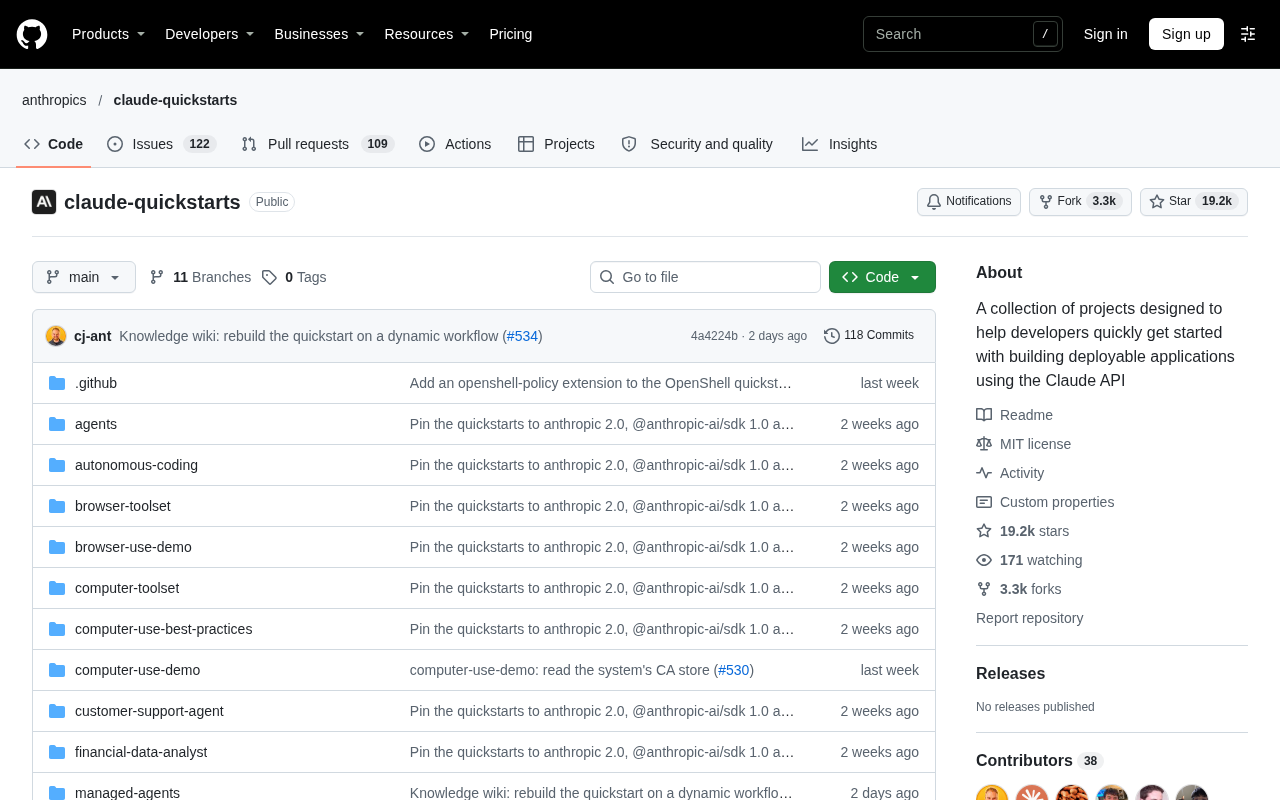
Claude API Quick Start: The Official Quickstarts Project Collection
Anthropic's official claude-quickstarts project collection helps developers quickly build deployable apps with the Claude API. Nearly 20k stars, Python-based, great for beginners and prototyping.
 Tech Frontiers
AI Agents Connecting Directly to APIs: Which Calls Can Be Safely Allowed?
AI agents can call any API, but the real challenge is deciding which calls can be safely allowed. This article analyzes allowance decisions from three dimensions—intent matching, least privilege, and controllable impact—and argues that the control layer should sit outside the agent, combined with audit traceability to build a trustworthy API call governance mechanism.