Claude Autonomously Designs Proteins with 35% Success Rate, Far Exceeding Human Expert Performance

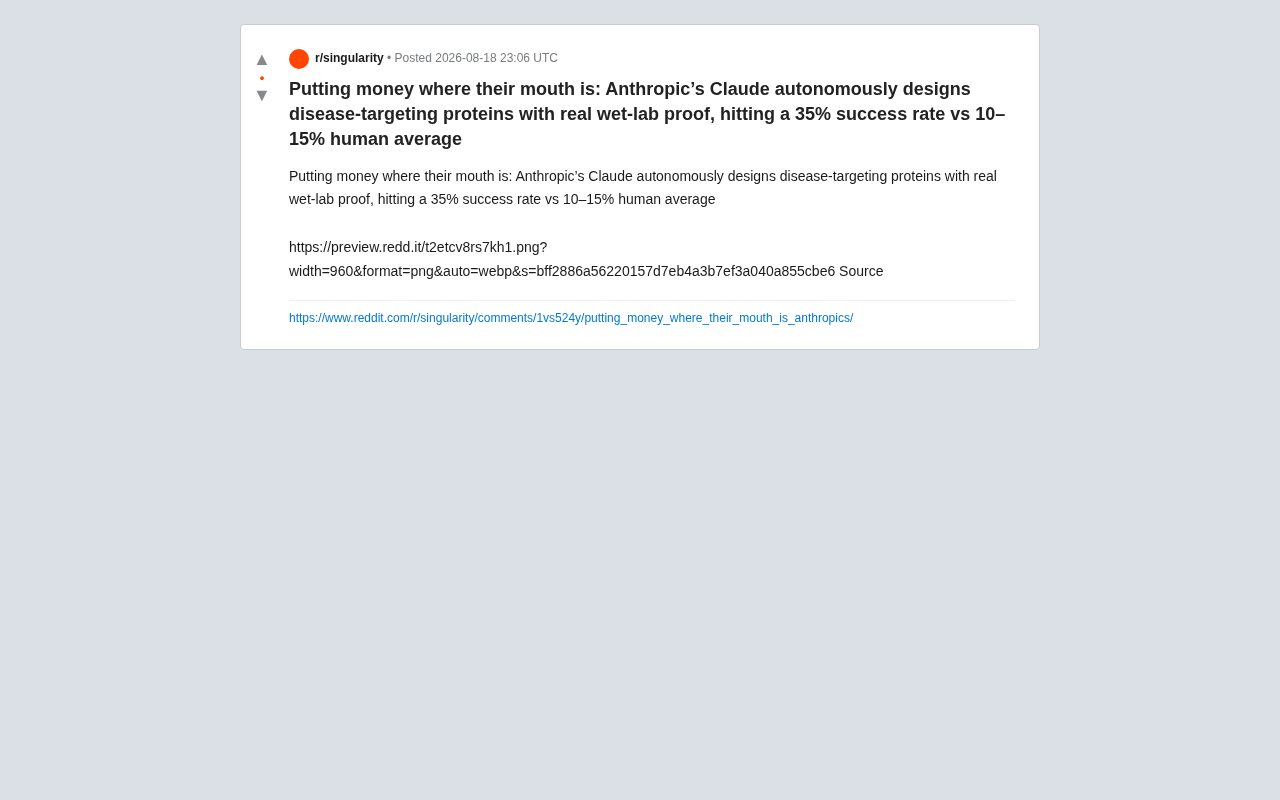
Claude autonomously designs disease-targeting proteins with 35% lab-verified success rate, over double human expert levels.
Anthropic's Claude model achieved a 35% experimental success rate in autonomously designing disease-targeting proteins, far exceeding the 10-15% average for human experts. Validated through real wet-lab experiments rather than simulations alone, this result signals AI's transition from theoretical assistance to practical scientific productivity, with potentially transformative implications for drug development timelines, rare disease treatments, and the evolving role of research scientists.
AI Moves from "Armchair Theorizing" to Wet-Lab Validation
For a long time, applications of large language models in biomedicine have largely remained at the "armchair theorizing" level—summarizing literature, generating hypotheses, and so on. The real test is: can solutions proposed by AI withstand verification in an actual laboratory (wet-lab)? In life science research, "wet experiments" refer to physical experiments conducted in real laboratories using actual biological materials (such as cells, proteins, nucleic acids, etc.), in contrast to "dry-lab" work that relies purely on computer simulations and mathematical modeling. Wet experiments are the "ultimate arbiter" for validating scientific hypotheses, because no matter how sophisticated computational simulations are, they cannot fully capture the complexity of real biological systems—the dynamic behavior of proteins in solution, interactions with cellular environments, the effects of post-translational modifications—all of which can only be truly confirmed through wet experiments.
Anthropic's recently published results provide a striking answer—its Claude model achieved a 35% experimental success rate in autonomously designing proteins that target diseases, far exceeding the 10%–15% average for human experts.
What makes this data particularly noteworthy is the qualifier "real wet-lab proof." Many of AI's achievements in biology have long faced the "simulation-reality gap" problem—molecular designs that perform excellently in computational environments often fall far short when they enter real laboratories. In this case, however, the protein sequences designed by AI didn't just remain in computer simulations; they were actually synthesized and functionally validated in the laboratory. This means we're no longer discussing theoretical possibilities, but reproducible, measurable experimental results.
35% vs 10%-15%: What the Gap in Protein Design Success Rate Means
In the field of protein engineering, "success rate" typically refers to the proportion of designed proteins that correctly fold and achieve their intended function (such as binding a specific target or catalyzing a specific reaction). To understand this, one must grasp the inherent difficulty of protein design tasks: a protein containing just 100 amino acid residues has 20^100 (approximately 10^130) possible sequence combinations—far exceeding the total number of atoms in the universe. Finding sequences that correctly fold and perform specific functions within such a vast search space is no small feat. Human experts, relying on years of accumulated experience, structural biology knowledge, and extensive trial and error, achieving 10%–15% is already impressive.
An Efficiency Revolution, Not Just a Simple Performance Improvement
Claude raising this rate to 35% means one in every three designed proteins is usable, whereas human experts often need to design seven to ten before hitting one success. In the pharmaceutical industry, where "failure" is the norm, a doubling or tripling of success rates directly corresponds to dramatically shortened R&D cycles and significantly reduced costs.
More importantly is the keyword "autonomously." This implies Claude isn't just assisting humans with a single step, but can independently complete the entire chain from understanding requirements, designing sequences, to outputting solutions. This end-to-end autonomous capability stands in stark contrast to traditional specialized structure prediction tools.
Take AlphaFold as an example: developed by DeepMind, it rose to fame at CASP14 (Critical Assessment of protein Structure Prediction) in 2020, essentially solving the single-chain protein structure prediction problem and being recognized by Nature as a major breakthrough of the year. AlphaFold3, released in 2023, further expanded to predicting complex structures of proteins with DNA, RNA, and small molecule ligands. However, AlphaFold essentially solves the "forward problem"—given an amino acid sequence, predict what three-dimensional structure it will fold into under natural conditions. Protein design is the diametrically opposite "inverse problem": given a desired function or structure, design from scratch an amino acid sequence that can achieve that function. The inverse problem is far more difficult than the forward problem.
The most cutting-edge specialized AI tools in protein design currently include RFdiffusion (diffusion model-based protein backbone generation), ProteinMPNN (sequence design), and Chroma (generative protein design), among others. These tools typically need to be chained together in pipelines and require domain experts for fine parameter tuning. The fact that Claude, as a general-purpose language model, can be competitive in this domain suggests that large-scale pretraining may have implicitly learned deep patterns in protein sequence-structure-function relationships—a phenomenon worthy of deeper investigation in itself.
A General-Purpose LLM Enters Specialized Scientific Domains
What's thought-provoking is that Claude is fundamentally a general-purpose large language model, not a domain-specific model trained specifically for protein design. If this result holds up, it will challenge a long-standing assumption: does scientific discovery necessarily require highly specialized narrow AI?
From Conversational Assistant to AI Research Partner
Anthropic has consistently emphasized its positioning in AI safety and "beneficial AI." Extending model capabilities to high-value scientific tasks like protein design is both a demonstration of technical prowess and a strategic move—evolving from a general conversational assistant toward a true "research partner."
However, rational scrutiny is warranted here. These results currently come primarily from the company's own disclosures and have yet to undergo broader peer review and independent replication. In scientific research, peer review refers to critical examination of research methods, data analysis, and conclusions by independent experts in the same field; independent replication requires that different laboratories using the same methods can achieve consistent results. These two processes are cornerstones for ensuring the reliability of research findings. In recent years, the AI field has seen multiple instances where stunning results self-published by companies were later found to involve overhyping—such as cherry-picking benchmarks, data leakage between test and training sets, and loose definitions of "success."
Several key details remain unclear: How large was the test sample? How complex were the designed proteins? On what difficulty level of tasks was the "35% success rate" achieved? In protein design, success metrics can be defined in multiple ways—correct folding, target binding, whether binding affinity reaches therapeutic levels, whether stability is maintained in vivo—different standards can lead to vastly different success rate numbers. Whether the human baseline comparison was for simple tasks or frontier challenges makes a significant difference in the weight of the conclusion.
Potential Impact on the Biopharmaceutical Industry and Drug Development
If AI's ability to autonomously design proteins is continuously validated and scaled, the implications will be profound.
The drug development "funnel" will be reshaped. Modern drug development is typically described as a funnel model: starting from thousands to tens of thousands of initial candidate molecules, passing through successive screening stages—target validation, lead compound optimization, preclinical studies, Phase I/II/III clinical trials—ultimately, only a tiny fraction of molecules make it to market approval. According to estimates from the Tufts Center for the Study of Drug Development, a new drug takes an average of 10-15 years from discovery to market, costs approximately $2.6 billion in R&D, and has an overall success rate of less than 10%. In the traditional process, lead compound screening is a lengthy and expensive phase. AI's high-success-rate protein design capability can dramatically improve the quality of candidate molecules at the very top of the funnel, reducing attrition rates at subsequent stages and producing significant cascading effects.
Rare diseases and personalized treatments gain new opportunities. Currently, there are over 7,000 known rare diseases worldwide, approximately 95% of which have no approved treatments. For rare diseases with small market sizes where R&D investment is difficult to recoup, the traditional commercial logic of drug development often doesn't hold. Protein-based drugs (biologics) are among the fastest-growing drug categories today, including monoclonal antibodies, fusion proteins, enzyme replacement therapies, etc., with the global biologics market exceeding $400 billion in 2023. Once AI reduces protein design costs, the commercial viability of these previously shelved disease areas will significantly improve.
The role of research talent will transform. Researchers may be liberated from laborious trial-and-error experiments, shifting toward higher-level hypothesis design, result interpretation, and experimental oversight. The core value of scientists will shift from "hands-on experiments" more toward "asking the right questions" and "designing proper validation strategies."
Conclusion: Cautious Optimism About AI Protein Design
Claude's performance in protein design is undoubtedly an important signal of AI moving toward real scientific productivity. It shifts the standard for evaluating AI capabilities from "text fluency" back to the hardcore dimension of "can experiments succeed."
But we should also remember that promotional data from a single source needs to withstand the test of time and peer scrutiny. What will truly determine this technology's fate is whether it can be reproduced in the hands of independent institutions, whether it can handle the complex scenarios of real drug development, and ultimately whether it can be translated into actual therapies that benefit patients. Regardless, the trend of AI moving from an assistive tool toward an autonomous scientific discoverer is becoming increasingly clear.
Related articles

Alphabet's $700 Billion Market Cap Wipeout: Is Massive AI Spending Strategic Vision or a Money Pit?
Alphabet's market cap dropped $700B as massive AI spending sparks fierce Wall Street debate. Deep analysis of Google's AI investment surge, divided market views, and the tech industry's AI reckoning.
Qwen3-VL Multimodal Fine-Tuning in Practice: Architecture Deep Dive and Complete LoRA Fine-Tuning Guide
Deep dive into Qwen3-VL vision-language model architecture, covering Vision Encoder alignment, LLM backbone principles, and complete LoRA fine-tuning workflow from setup to training and testing.

Harness Multi-Agent Framework: A Deep Dive into Planner→Builder→Evaluator Three-Agent Collaboration
Deep dive into the Harness multi-agent framework's three-agent paradigm (Planner, Builder, Evaluator), covering Agent Loop design, circular invocation prevention, Sandbox isolation, and A2A vs SubAgent selection strategies.