Claude Code Account Ban Prevention: IP, Payment, and Account Management Best Practices

A seasoned Claude Code user breaks down Anthropic's ban detection logic and five key dimensions of account protection.
A heavy Claude Code user who has experienced dozens of bans systematically analyzes Anthropic's multi-layer Agent cascade detection logic, offering detailed advice across five dimensions: IP cleanliness, browser fingerprinting, payment consistency, account seasoning, and behavioral rhythm. The core strategy is to make your account appear as a genuine local user across every detectable dimension — using static ISP or residential IPs, disabling WebRTC and IPv6, keeping billing addresses aligned with usage IPs, seasoning new accounts on lower-tier plans before upgrading, and never hitting usage limits while simulating the target timezone's work schedule. Google Play paired with a physical Visa/Mastercard is rated the top payment method, while virtual cards rank last due to frequent flagging. Two easily overlooked critical red lines: never reuse a previously banned device, and always keep your IP unchanged when opening any emails from the platform.
A Bilibili content creator who has been using Claude Code for two years and survived thirty to forty account bans shares their hard-won experience navigating Anthropic's ban waves. This article systematically organizes their core methods to help you understand Claude Code's ban logic and how to protect your account.
Disclaimer: This article is purely an informational summary and analysis of the original material. Operations that circumvent platform risk controls may violate Anthropic's Terms of Service. Readers should exercise their own judgment and proceed at their own risk.
Claude Code's Ban Logic: Multi-Layer Agent Detection
According to this creator's analysis, Anthropic's banning system is not a simple black-box randomizer — it's a multi-tier, multi-level detection Agent chain that makes progressive judgments. When the system determines that an account "doesn't look like it's being used by a real person," it escalates to the next Agent for re-examination, layer by layer. The vast majority of flagged accounts are banned before they ever reach human review.
This explains why so many users feel that bans seem "completely random" — in reality, each layer of Agents is collecting signals across different dimensions (IP, fingerprint, payment, behavioral patterns, etc.), and an anomaly in any single dimension can trigger escalation to the next level. Understanding this logic is the foundation for all subsequent protective measures.
This kind of multi-layer Agent detection system is also known in the industry as a "risk control decision tree" or "anti-fraud cascade model," and is commonly used in financial payments and large SaaS platforms. The core principle is to push costly human review to the very end, with multiple low-cost automated rule engines or lightweight AI models handling batch filtering upfront. Each Agent layer focuses on different signal dimensions — the first layer might only check IP blacklists, the second introduces device fingerprinting, the third incorporates payment characteristics, and the fourth analyzes behavioral timing sequences. The advantage of this cascading design is a low false-positive ban rate with manageable resource consumption. For users, this means a "single point breakthrough" strategy is almost useless — fix your IP problem but have anomalous payment information, and you'll still get caught at the next layer. Anthropic uses Claude models themselves as internal review tools, which gives their detection logic a degree of natural language understanding that makes it theoretically harder to bypass with a single trick compared to pure rule-based engines.
IP Cleanliness: The First Line of Defense
The creator rates IP quality as the highest priority (five stars). The core recommendation is to use a static ISP or long-term residential IP — both are considered equivalent in quality. Pseudo-static IPs are acceptable as long as they pass IP checks.
Several clear prohibitions:
- Do not use shared IPs with thousands of users, datacenter IPs, or blacklisted IPs
- Pseudo-residential IPs are marginally acceptable, but "don't use garbage ones"
- Do not frequently rotate IPs
They specifically warn that true residential IPs generally cannot be used directly as chain proxies — you must route them through a relay server for TV proxy (relay) purposes. The choice of detection tools also matters — some tools incorrectly classify "pseudo-static" IPs as "true static," so cross-validate using more comprehensive detection tools.
Browser Fingerprinting and Environment Leakage
One high-risk point many people overlook is WebRTC. Chrome-based browsers have WebRTC enabled by default, which leaks the user's real IP address — not the proxy IP — effectively handing your identity directly to the detection system. It must be disabled.
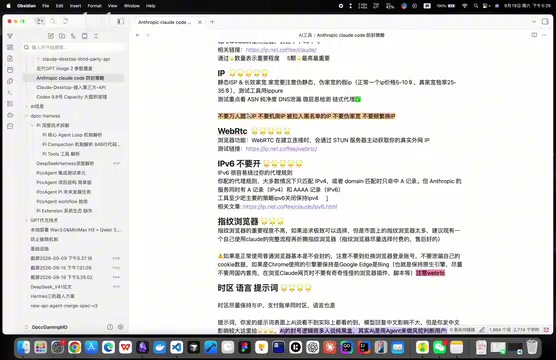
IPv6 must also be disabled (five stars). The creator notes that IPv6 records contain more detail, and while most matching runs on IPv4, even a small number of IPv6 records can be passed upstream and used as grounds for a ban. Stick to IPv4 for all AI-related activity.
Regarding fingerprint browsers (three stars, medium importance), they're not strictly necessary, but a paid solution is worth considering if you want maximum stability — free products are not recommended. Also emphasized: bind one fixed primary browser for long-term use, preferring Chrome, Edge, or Firefox, and avoid domestic Chinese re-skinned browsers. Don't let Cookie data leak.
WebRTC (Web Real-Time Communication) is a W3C-standardized browser API originally designed to enable peer-to-peer audio and video calls. When establishing a connection, it needs to collect the IP addresses of all available network interfaces on the local machine (including LAN and public IP addresses), negotiating the optimal path via the ICE (Interactive Connectivity Establishment) protocol. This process occurs at the JavaScript layer and completely bypasses the browser's proxy settings — even if a system proxy or VPN is active, WebRTC will still expose the host machine's real IP in STUN requests, readable by any script on the page. Browser fingerprinting refers to combining dozens of parameters — Canvas rendering output, WebGL information, font lists, screen resolution, timezone, AudioContext, and more — into a hash value that serves as a "soft identifier" for the device. Because these parameter combinations are highly unique, even after clearing cookies or switching accounts, cross-account associations can still be detected if the fingerprint remains unchanged.
Timezone, Language, and Payment Consistency
Tight alignment of timezone, language, and billing address is listed as critically important (four stars). If you're using a US IP, use US timezone and a US payment billing address.
There's a counterintuitive detail regarding language: the creator recommends not conversing with Claude in Chinese. The reasoning is that even if Anthropic claims not to collect user content, the model's Chinese-language responses may still be visible and could serve as anomaly signals — there's even concern about "trackers" being embedded (similar to tracking pixels in emails). Using Chinese as input has less impact, but the model's Chinese output reveals characteristics.
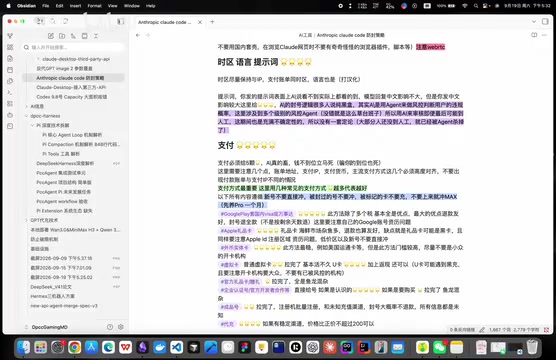
Payment (five stars) is the "one mistake and you're dead" critical point:
- Billing address, payment IP, and daily usage IP must be highly consistent
- Currency automatically follows the IP, no need to worry about it separately
- Use locally mainstream payment methods (US region: Visa, PayPal, Apple Pay)
- Don't use flagged cards or previously banned cards
- Don't immediately jump to Max — spend at least a month seasoning on Pro first
Payment Method Rankings: From Five Stars to "Forget It"
The creator rates various payment methods:
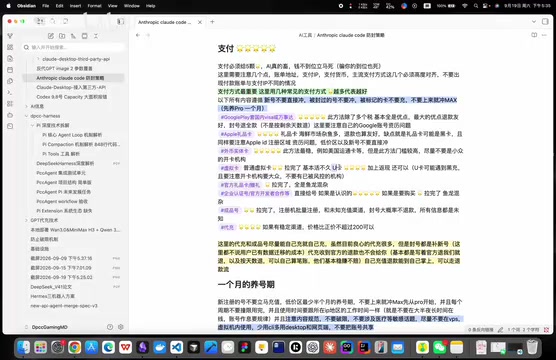
- Google Play + domestic Visa/Mastercard (five stars): Despite an extra $25 tax, upon getting banned you can receive a full refund on the first occurrence (not prorated by days used), making it excellent value. Note that Google account history, billing address, and residential address must be consistent.
- Apple gift cards (four stars): Previously five stars, but as they grew popular, the secondhand market (Xianyu) became flooded with bad actors, making it easy to accidentally buy cards tied to stolen payment methods.
- Foreign physical cards (five stars): Such as American Express cards — a high barrier to entry but "absolutely solid"; not easy for most people to obtain.
- Virtual cards (forget it / one star): Primarily used for free trial abuse; officially flagged extremely quickly and don't last long. Youka cards get four stars if they have a chargeback line; without one, not recommended.
- Official gift cards, Xianyu pre-made accounts, purchased accounts (one star): A mixed bag of unknown quality, credentials you don't control, and extremely high risk.
- Third-party top-up services (four stars, conditional): Acceptable if you have a stable channel and the premium is under 200 CNY above face value; otherwise not recommended. When banned via top-up, you often only get a replacement account, and the math rarely works out.
Account Seasoning and Behavioral Patterns
New accounts should absolutely not rush to the highest-tier subscription. The creator recommends seasoning new accounts in lower-price regions for two to four weeks, starting with Pro and not jumping straight to Max.
In terms of usage rhythm, act "like a real human":
- Don't burn through your entire usage quota each session — keep 20–30% remaining, never hit the hard limit
- Maintain regular usage patterns — if using a US IP, simulate US working hours
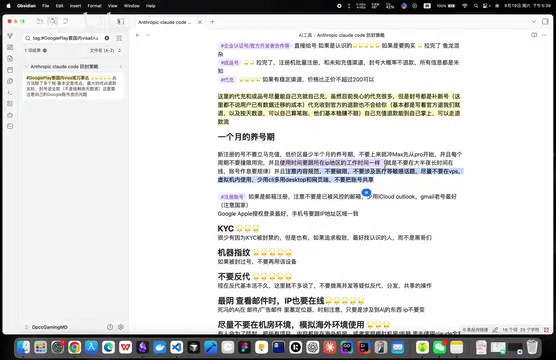
On content compliance, avoid jailbreaks and stay away from sensitive topics like medical advice (Claude is particularly sensitive to medical topics). For tool choice, the recommendation is to minimize CLI usage — CLI is easy to flag through reverse proxies and carries high-concurrency call risks. Prioritize the official Desktop client or web interface, since Desktop has a built-in virtual machine and running Claude Code inside it is safer than running it directly on your host machine.
Registration and Device Red Lines
For registration email, avoid high-risk email domains: iCloud and Outlook have been over-registered by bot farms. Old Gmail accounts are ideal, or use Sign in with Apple.
A few easily fatal red lines:
- Never reuse a previously banned device (five stars) — device MAC and device ID are already on record; reusing them almost guarantees a ban
- No reverse proxying, distribution, high-concurrency calls, or account sharing (five stars); your IP must remain consistent
- Your IP must be active and unchanged when reading emails (five stars, described as "the sneakiest one") — emails and advertisements may contain trackers, and switching IPs before opening them will get you flagged and banned immediately
- Overseas cloud PCs / datacenter environments (three stars) offer excellent isolation but detection systems can still read device fingerprint data for analysis, so risk remains
KYC verification (three stars) won't normally cause a ban — if you want to be meticulous you can ask someone you know, but for most people, finding someone through Xianyu won't get you banned because of it.
Email tracking pixels are 1×1 transparent images embedded in HTML emails. When the recipient opens the email, their email client sends an HTTP request to the image server, which can then record the request time, the user's IP address, and User-Agent. This technology is widely used for delivery rate statistics in marketing emails, but can also be used for security purposes — detecting the account holder's real geographic location. The "tracker" mentioned in this article works on exactly this principle: if a user registered with a US IP but opened the Anthropic verification email while on a domestic IP, the server records a sudden change in IP geolocation that contradicts the account's normal usage location, triggering a risk flag. Some advanced tracking implementations also embed unique tokens in the hyperlinks within email body text, transmitting IP information upon click as well. Therefore, when handling any email from the target platform — including marketing emails and billing notifications — always ensure your proxy environment matches your day-to-day usage environment.
Conclusion
The underlying logic of this entire approach is to perform as a "genuine local user" across five dimensions — IP, browser fingerprint, payment consistency, account seasoning, and behavioral rhythm — in response to Anthropic's multi-layer Agent detection system. It bears repeating: these operations fundamentally involve circumventing platform risk controls and may violate the Terms of Service. Readers should have a clear understanding of the compliance and account risks involved.
Related articles

Felix Rieseberg Personal Homepage
Felix Rieseberg's personal homepage sparks attention on Hacker News. This article covers the Slack engineer's technical background, the rise and fall of nativefier, and the value of a developer homepage as a tech calling card.

@ai-sdk/vue 3.0.306 Patch Release Syncs with [email protected] Update
@ai-sdk/vue 3.0.306 released, synced with [email protected]. A routine patch release for the Vercel AI SDK ecosystem with no public API changes; the Vue adapter layer stays version-aligned with the core package.

Gemini 4 Argon API Launches: The Era of Million-Token Output Begins
Google launches Gemini 4 Argon with sparse MoE architecture, up to 1M output tokens, and a 68.90% Vals Index score, available across API, AI Studio, and the Gemini app.