Claude Code Adds 'Wrap-Up Allowance': No More Abrupt Mid-Task Cutoffs When You Hit Your Limit

Claude Code's new Wrap-Up Allowance gives a brief buffer at the usage limit for a graceful task finish.
Claude Code has introduced a Wrap-Up Allowance feature: when users hit the plan's five-hour usage limit mid-task, the system no longer hard-stops immediately. Instead, it provides a small, capped buffer so the model can bring current work to a reasonable stopping point. The interface shows "Usage limit reached · wrapping up" when triggered. This is a soft-landing mechanism, not a quota expansion — it won't bypass the core limit or guarantee task completion, but it effectively prevents the half-finished states that plague multi-file refactors and long tool-call chains. Developers should still plan task pacing wisely and wait for the billing cycle to reset after the allowance runs out.
What Is the Wrap-Up Allowance?
Claude Code recently added a feature called the Wrap-Up Allowance to its official support documentation. It addresses a pain point that seasoned users know all too well: when Claude Code is working through a complex task and hits the plan's five-hour usage limit, the response gets cut off mid-stream — leaving behind a half-finished, inconsistent result.
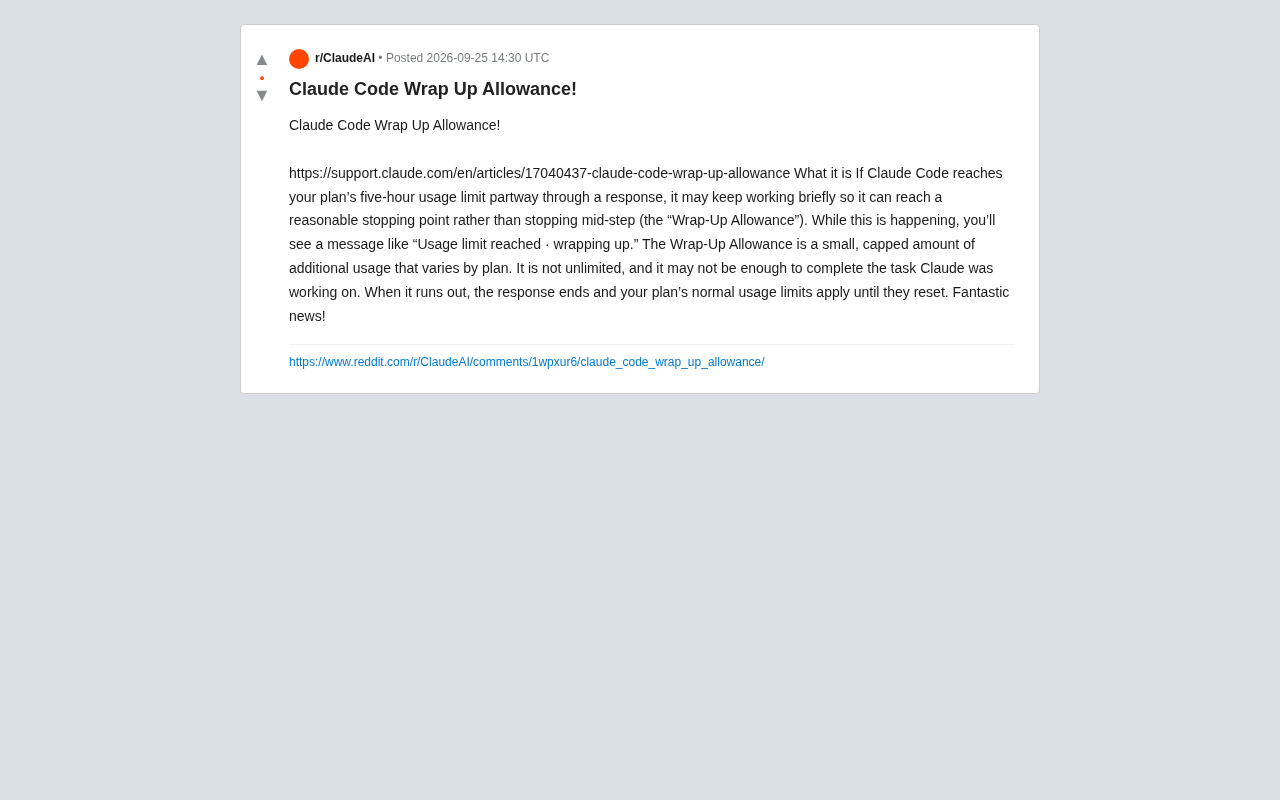
According to Anthropic's official support page, if Claude Code reaches the plan's five-hour usage limit while generating a response, the system will allow it to "work a little longer" to reach a reasonable stopping point, rather than halting abruptly in the middle of a step. This additional working time is what's referred to as the Wrap-Up Allowance.
Claude Code is Anthropic's AI coding assistant for developers, offered under a subscription model that includes a core constraint: the "five-hour usage limit." This "five hours" isn't simply wall-clock time — it represents the cumulative compute quota the model can use to generate responses within a billing cycle, expressed in time units. Since Claude Code is often used for multi-step, multi-file programming tasks — such as cross-module refactoring, automated test generation, or long chains of tool calls — these tasks consume far more quota per response than ordinary conversations. Developers working intensively can easily hit the limit mid-task, which is exactly what motivated a smoother way to handle the cutoff.
How It Works
When the Wrap-Up Allowance is triggered, a notice appears in the interface: "Usage limit reached · wrapping up." This signals that the system has detected you've exceeded your limit, but instead of cutting things off immediately, it gives the model a short buffer to bring the current work to a deliverable stopping point.
It's important to be clear: this allowance is small and capped, and the exact amount varies by plan. Anthropic explicitly notes two constraints: first, it is not unlimited; second, it may not be enough for Claude to complete the entire task it's currently handling. In other words, the Wrap-Up Allowance is designed for a graceful finish — not a backdoor extension.
Once this additional allowance is exhausted, the response ends and your plan returns to its normal usage-limit state until the next billing cycle resets.
Tool use is key context for understanding why this matters. Claude Code doesn't just generate text — it executes chains of tool calls to read files, run commands, write code, and more. A complex task might involve dozens of chained tool calls. If the system hard-stops in the middle of one of those calls, not only could output files end up in an inconsistent state, but Claude also loses track of the task context, making it very difficult to seamlessly resume from the breakpoint. The Wrap-Up Allowance is designed precisely for this "atomicity" need — letting an in-progress tool-call chain or code generation block reach a logical closure point, so the output has at least a minimum level of usability and continuity.
Why This Is a Welcome Change
For developers who rely heavily on Claude Code, having a task cut off mid-execution is a genuinely frustrating experience. Imagine the model is in the middle of a multi-file refactor, running through a long sequence of tool calls, or generating a complex block of logic — and it suddenly stops because it crossed a usage threshold. The result isn't just unusable; it may leave behind a half-finished state that requires manual cleanup, on top of the compute that was already spent.
The Wrap-Up Allowance turns a hard stop into a soft landing. Even if the task doesn't fully complete, the current step gets wrapped up into something readable and resumable, reducing the cost of rework. That's why some Reddit users responded to this update with nothing but "Fantastic news."
Boundaries to Keep in Mind
Good news as it is, don't set your expectations too high. The Wrap-Up Allowance is fundamentally a buffer mechanism, not a quota expansion. It won't help you circumvent the five-hour core limit, and it won't give you extra time just because your task is more complex.
A few practical tips worth keeping in mind:
- Plan your task pacing: If you know you're approaching your usage limit, avoid kicking off large, time-intensive tasks right at that point — you risk hitting the threshold at exactly the wrong moment.
- Understand the prompt: When you see "wrapping up," recognize that the current session is about to end. You can proactively guide the model to output the most critical parts first.
- Wait for the reset: Once the allowance is exhausted, there's no shortcut — you'll need to wait for your billing cycle to reset before normal limits are restored.
Summary
The Wrap-Up Allowance is a small change with a meaningful impact on user experience. It doesn't alter Claude Code's underlying usage rules, but it adds a layer of cushioning at the most frustrating moment — hitting the limit — so tasks can end gracefully rather than crash mid-execution. For developers who depend on Claude Code in their daily workflow, this kind of polish often does more for day-to-day smoothness than a major feature release ever could.
Related articles

Chain of Thought Isn't Just for AI: How Humans Can Use CoT to Improve Thinking Quality
Chain of Thought isn't just a prompt trick for large models. Starting from a Hacker News discussion, this article analyzes why CoT works for human thinking too, breaks down actionable ways to transfer it, and highlights the key differences between human CoT and machine CoT.
Cloudflare Teams Up with OpenAI: Closi…
Cloudflare Teams Up with OpenAI: Closing the Loop from Vulnerability Discovery to Defense with AI
Cloudflare uses OpenAI Daybreak to investigate security vulnerabilities and generate reviewable remediation plans, while developers use Codex to boost coding efficiency and quality.

Orca Multi-Agent Orchestration in Practice: A Guide to Parallel Collaboration with Claude and Codex
Orca is Stable AI's free open-source agent workbench supporting 34 agents like Claude Code and Codex in parallel. Learn its Git worktree isolation, multi-model orchestration, and mobile management.