Claude Code Agent Teams Explained: Core Differences Between Sub-agents and AI Team Collaboration
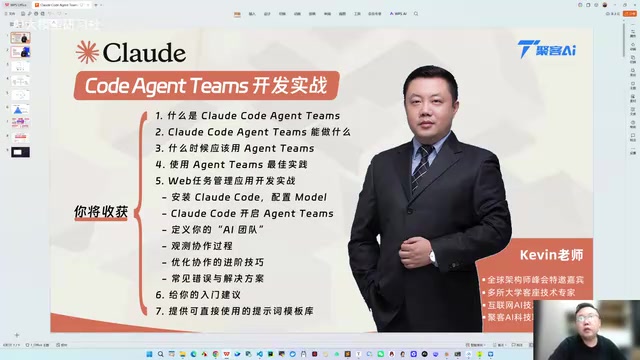
Understanding the core differences between Sub-agents and Agent Teams in Claude Code AI collaboration
Claude Code's Agent Teams feature marks a shift from tool-assisted to team-collaborative AI programming. Unlike independent Sub-agents suited for research tasks, Agent Teams enable real-time collaboration with shared task boards and cross-validation, ideal for development and refactoring scenarios requiring deep coordination.
From "Solo Work" to "Team Collaboration": A New Phase in AI Programming
As AI programming tools become increasingly prevalent, a technical consultant specializing in enterprise AI implementation shared his real-world experience completing enterprise projects with Claude Code during a live stream on Bilibili. Currently serving as an AI technology consultant for five companies while guiding two graduate research projects, his core message centered on a groundbreaking concept—Claude Code Agent Teams (AI agent teams).
He opened with a pointed question: Has your company truly adopted Claude Code or similar AI programming tools? Or are you still stuck in the "hand-coding with occasional AI assistance" phase? In his view, remaining in traditional development modes puts you in a "very dangerous" position.
Enterprise Hiring Trends Have Shifted: AI Programming Skills Now a Hard Requirement
The speaker described his enterprise research experiences this year: signing a deep strategic partnership with Alibaba at Hangzhou Cloud Valley in April, and conducting in-depth exchanges with technical managers and project leaders from Tencent, ByteDance, and other companies in Shenzhen in May. He observed a clear trend—major tech companies have widely adopted AI-assisted development pipelines, rarely relying on the traditional "throwing bodies at problems" approach.
You may not have noticed the shift in hiring direction. He pointed out that technical job postings nowadays rarely target specific languages (like Java, frontend, C++, etc.), but instead seek "AI-related" and "cross-language" composite talents—engineers who can proficiently use AI assistance for project development.
This shift has profound underlying logic: large language models naturally possess cross-programming-language capabilities, allowing an engineer skilled in AI-assisted development to rapidly switch technology stacks with AI help. GitHub Copilot research data shows that developers using AI-assisted programming complete tasks 55% faster on average. When AI can handle massive amounts of syntax-level coding work, engineers' core value shifts to system design, architectural decisions, and AI tool orchestration capabilities. This explains why companies no longer insist on hiring experts in specific languages, but rather value candidates' comprehensive ability to master AI toolchains.
This signal has real-world significance for every developer: the moat of single-language skills is being eroded, while the ability to master AI tools becomes the new competitive advantage.
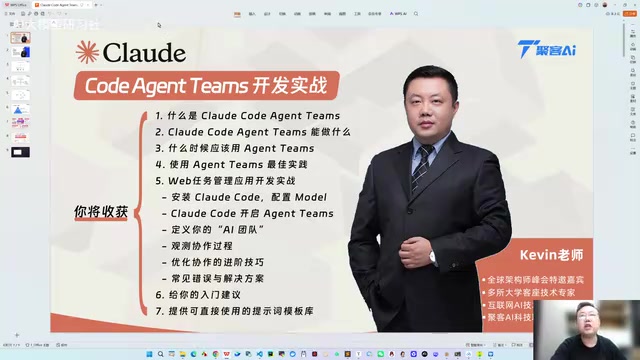
What Are Claude Code Agent Teams?
Agent Teams is a feature launched by Anthropic, initially as an experimental version and now officially released. The speaker believes this marks a completely new phase in AI programming: Claude Code is no longer just an AI tool, but an AI team capable of collaboration.
To understand the significance of this feature, you first need to understand Claude Code's positioning. Claude Code is Anthropic's command-line AI programming tool, allowing developers to interact directly with AI in the terminal, having AI read entire codebases, write code, execute commands, and run tests. The Agent Teams feature builds upon this foundational architecture, leveraging large language models' multi-instance parallelism and inter-process communication mechanisms, enabling multiple AI agents to work collaboratively in a shared project environment. Implementing this feature involves multiple key technologies including context window management, task state synchronization, and inter-agent messaging protocols.
In the speaker's words: "In a real programming task, you're no longer fighting alone—you have an AI team collaborating." This team can self-purify, assist each other, and even challenge one another—this is exactly the revolutionary experience it brings.
Simply put, Agent Teams allows you to launch multiple AI agents, having them work together like a real development team to complete complex tasks.
Essential Differences Between Sub-agents and Agent Teams
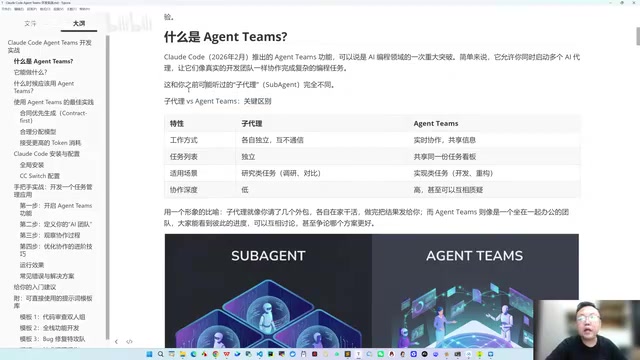
The speaker particularly emphasized that to truly master this capability, you must first clarify the core differences between Sub-agents and Agent Teams. He compared them across multiple dimensions:
Working Method Comparison
- Sub-agent: Independent and non-communicating. This is the classic model—a main agent orchestrates multiple sub-agents, each working in its own independent context, then returning results to the main agent for unified orchestration and management.
The sub-agent model originates from the classic Master-Slave architectural design pattern. In AI programming, this pattern is typically implemented by forking child processes: the main agent breaks down complex tasks into multiple independent subtasks, each assigned to an independent AI instance. Each sub-instance has its own independent context window—the total amount of information AI can "remember" and process in a single conversation. Independent contexts avoid information interference, but the tradeoff is that sub-agents cannot share discoveries and progress in real-time.
- Agent Teams: Real-time collaboration with shared information. Multiple agents communicate and collaborate in real-time, sharing the same information—this is the most crucial difference.
Task Management Mechanism
- Sub-agent: Each sub-agent's task is independent.
- Agent Teams: All agents share the same task board, like a Kanban board in team collaboration.
The Kanban mentioned here is a project management method originating from the Toyota Production System, later widely adopted by the agile development community. A typical Kanban board contains columns like "To Do," "In Progress," and "Done," with team members synchronizing progress by moving task cards. In Agent Teams, multiple AI agents share a Kanban-style task board where each agent can see which tasks have been claimed, which are in progress, and which are completed. This mechanism prevents duplicate work and allows agents to dynamically adjust their work priorities based on overall progress.
Scenario Selection
- Sub-agent is better suited for research tasks, such as market research or industry comparisons. Each sub-agent handles an independent domain, and isolation effectively prevents context data confusion.
The "context data confusion" mentioned here is technically called context pollution, a core challenge in large language model applications. When AI's context window is flooded with too much irrelevant information, the model's attention becomes scattered, leading to reduced output quality, hallucinations, or deviation from task goals. For example, in market research, if analysis data from healthcare and finance industries are mixed in the same context, AI might misattribute data between the two sectors. This is why research tasks are better suited for the sub-agent model with independent contexts.
- Agent Teams is better suited for development, refactoring, and other scenarios requiring information sharing, because these tasks inherently require frequent progress synchronization among members.
Collaboration Depth Differences
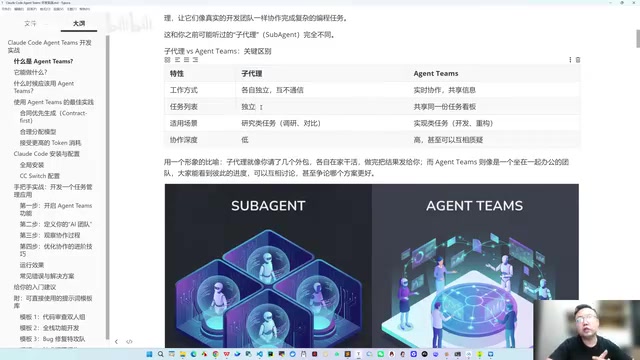
This is where the two differ most. Sub-agents have low collaboration depth because they simply don't communicate; Agent Teams have extremely high collaboration depth, with agents challenging each other and cross-validating. The speaker drew an analogy to a classic practice in software engineering—similar to "cross testing" in team development: I test your module, you test mine, thereby improving overall quality.
Cross testing is a long-validated quality assurance practice in software engineering, aligned with the philosophy of code review. Its core logic: code authors often have cognitive blind spots regarding their own code, and having another developer test or review it makes it easier to discover potential logic flaws and edge case oversights. Research shows code reviews can catch 60-90% of software defects. The mutual challenging and cross-validation among agents in Agent Teams essentially automates this human engineering practice, having AI team members play reviewer roles for each other, thereby improving code quality without human intervention.
A Vivid Analogy to Help You Understand Both Models
To help the audience understand more intuitively, the speaker provided a vivid analogy:
Sub-agent is like hiring several contractors who each work at home, then package and send you results, which you then consolidate.
Agent Teams is like a group of people working together in an office, able to see each other's progress, discuss with each other, and even jointly judge which technical direction is better—like a brainstorming session.
This analogy precisely captures the essence of both paradigms: the former is "distributed result aggregation," while the latter is "real-time collaborative team operations." From a software architecture perspective, Sub-agent is closer to the MapReduce model—distributing tasks (Map) then uniformly reducing (Reduce); while Agent Teams is closer to a shared-memory multithreading collaboration model, with all participants interacting in real-time in the same "workspace."
Practical Insights for Developers
Several directions worth considering can be distilled from the speaker's sharing:
First, AI programming is evolving from "tool assistance" to "team collaboration." The emergence of Agent Teams means a single developer can command an AI team to complete complex engineering tasks that previously required multiple people. This speaker himself is a practitioner who "single-handedly implemented and launched an enterprise project end-to-end through Claude Code." This "one-person army" working model is redefining the labor cost model of software development—a project that previously required a five-person team three months to complete might now be finished by an engineer skilled at orchestrating AI teams in a few weeks, which will have far-reaching impacts on the entire software outsourcing and services industry.
Second, understanding the applicable boundaries of different agent paradigms is crucial. Blindly using Agent Teams may not be efficient—research and investigation tasks using independent Sub-agents can actually avoid context pollution, while development and refactoring tasks are where Agent Teams shine. Choosing the right AI collaboration model is itself a kind of "AI engineering literacy" that needs cultivation. Just as experienced architects know when to use microservices and when monolithic architecture is more appropriate, future AI-native developers need the intuition and experience to judge when to use Sub-agents and when to use Agent Teams.
Finally, for teams and individuals still stuck in traditional development modes, mastering the complete AI programming pipeline capability is no longer a "bonus"—it's becoming a career competition "requirement." From GitHub Copilot to Cursor, and now Claude Code's Agent Teams, the evolution of AI programming tools is exceeding expectations. Each iteration widens the productivity gap between developers who "can use AI" and those who "cannot."
Note: This article is compiled from a single UP master's live stream sharing on Bilibili. The enterprise partnerships and research data mentioned come from the speaker's personal statements; readers should reference them rationally in combination with their own practice.
Related articles
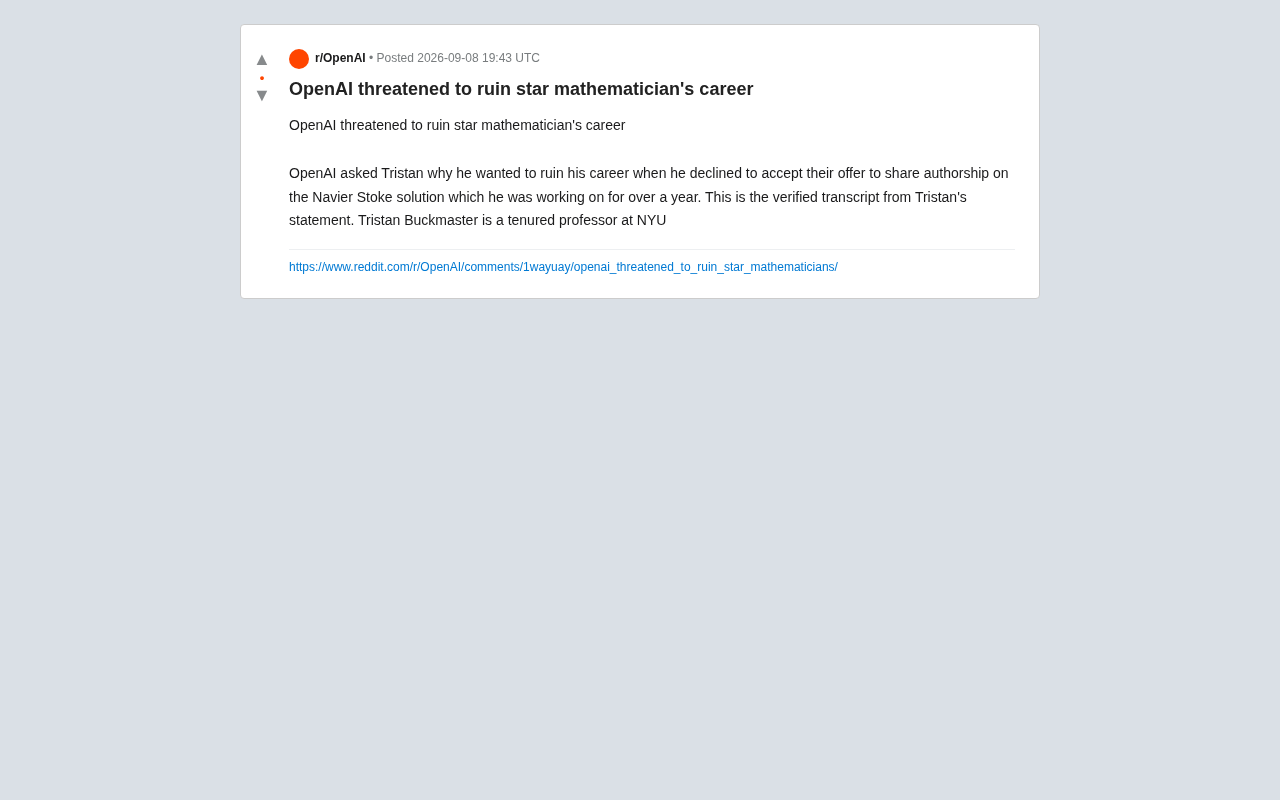
OpenAI Authorship Dispute: The Battle Over Academic Boundaries in the AI Era
OpenAI disputes authorship with mathematician Tristan Buckmaster over Navier-Stokes research, raising ethical questions about AI involvement in science.
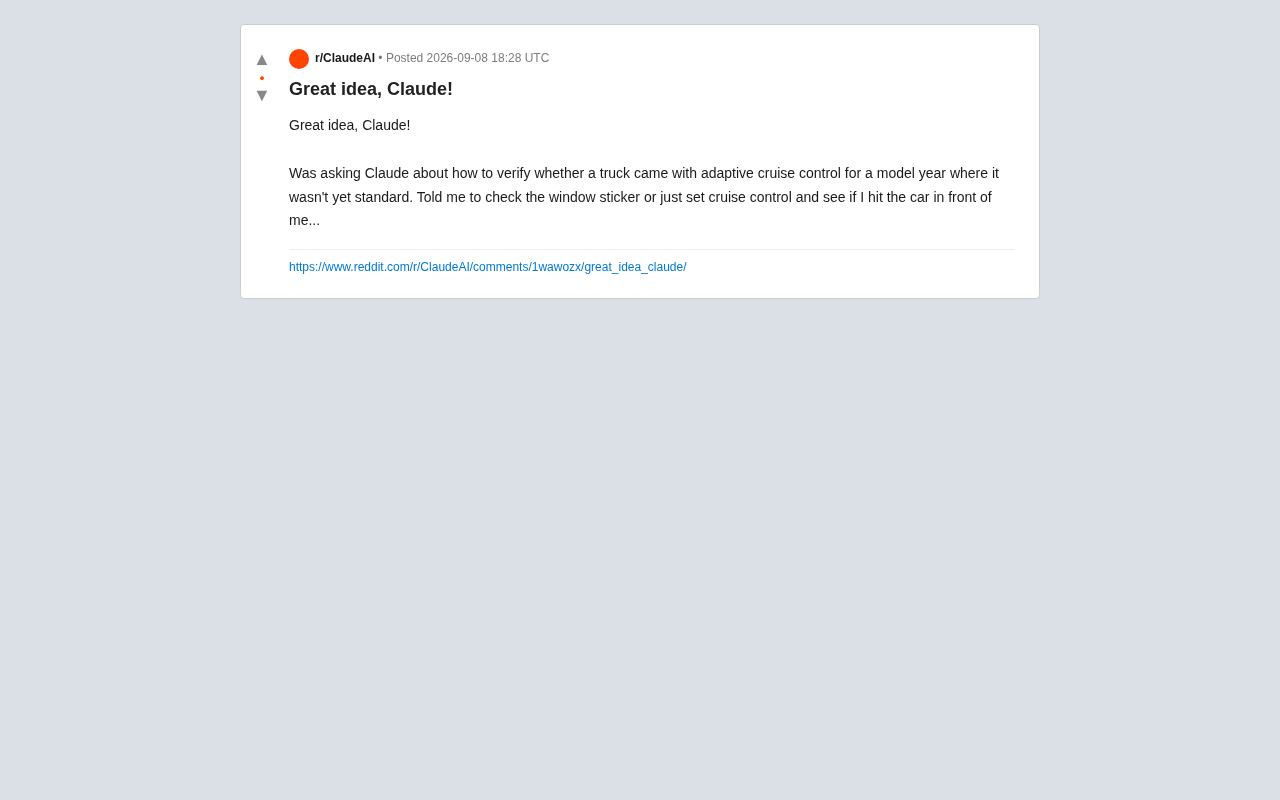
Claude Suggests User Test ACC by Crashing Into Car Ahead: Where Are AI Safety Boundaries?
Claude suggested a user test ACC by crashing into the car ahead—this absurd response sparked AI safety discussions. This article analyzes why LLMs generate implicitly dangerous advice and the blind spots in AI safety guardrails.
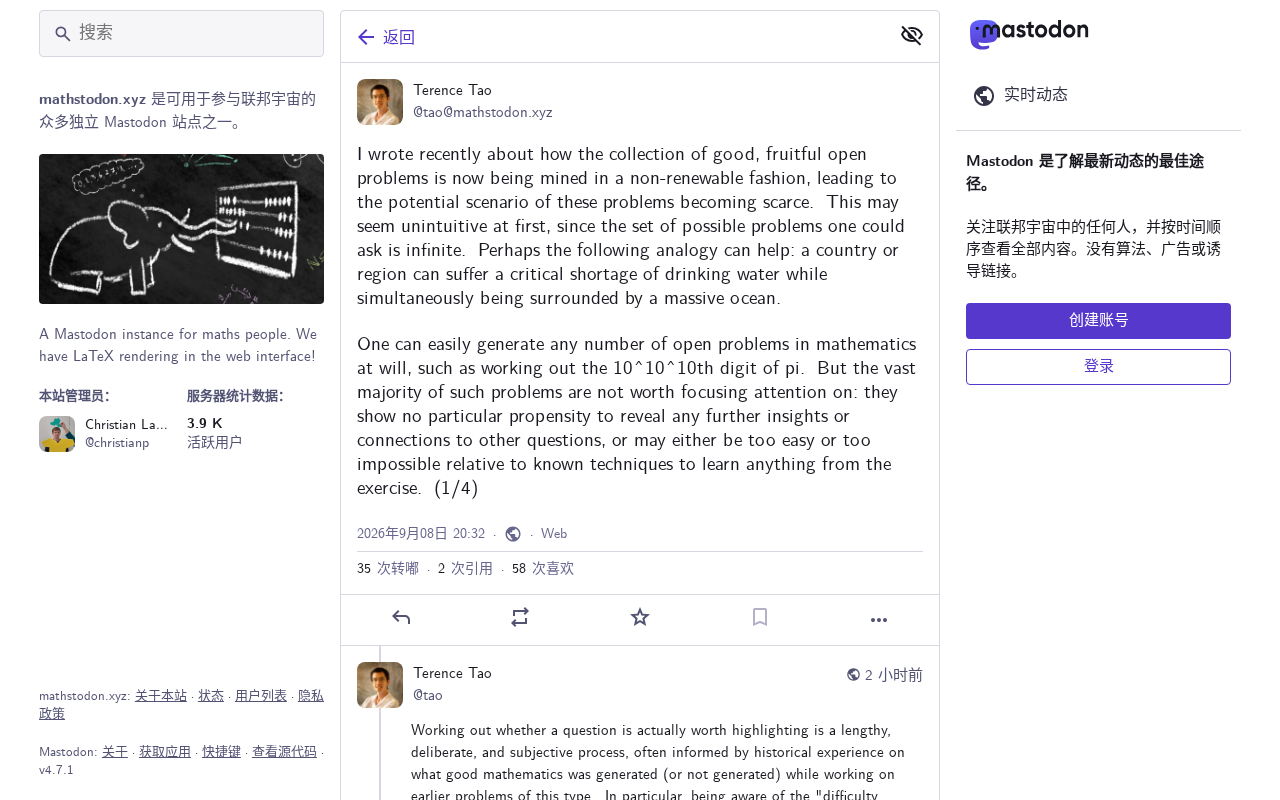
Terence Tao's Warning: AI Is Depleting the Non-Renewable Resource of Mathematical Problems
Fields Medalist Terence Tao warns that AI is mining mathematical problems in a non-renewable way. Exploring sustainability of math research in the AI era, the evolving role of human mathematicians, and balancing AI power with human creativity to maintain academic ecology.