Claude Code Agent Teams Hands-On: Is Multi-AI Collaborative Development Actually Worth It?

Architecture breakdown and practical evaluation of Claude Code's experimental Agent Teams feature
Claude Code's experimental Agent Teams feature allows multiple AI agents to communicate via mailboxes, share task lists, and coordinate work — breaking through the isolation of traditional sub-agents. In a hands-on demo building a SaaS idea generator, it completed the build with zero errors but only improved output quality by 10%-30%, while token consumption potentially tripled. Current limitations include no session recovery and task marking anomalies, making it recommended only for specific scenarios like large project architecture setup.
What Are Agent Teams? How Do They Differ from Sub-agents?
Claude Code recently introduced an experimental feature — Agent Teams. Unlike traditional sub-agents, Agent Teams allow multiple AI agents to communicate with each other, share task lists, and coordinate the entire development process.
Previously, Claude Code's sub-agent mode had a core limitation: agents couldn't communicate with each other. They operated independently, completely unaware of each other's progress. Agent Teams fundamentally changes this — through a team lead coordinating the effort, team members work independently within their own context windows while gaining real-time visibility into other agents' activities and adjusting their output accordingly.
Technical Background: The Revival of Multi-Agent Systems (MAS)
Multi-Agent Systems (MAS) is a classic research direction in artificial intelligence. Its core idea is to decompose complex tasks among multiple agents with different capabilities for collaborative completion. In the era of large language models, this concept has been revitalized — each agent is essentially an independent LLM instance with its own context window, tool-calling permissions, and execution state. The architectural design of Agent Teams draws from the "microservices" concept in software engineering: each service (agent) is independently deployed with its own responsibilities, communicating through a message bus (mailbox) for loose coupling. This design means that a local failure of a single agent won't immediately crash the entire system, but it also introduces coordination overhead and state synchronization complexity.
Put simply, sub-agents "work in isolation," while Agent Teams "work together and can consult each other."
Architectural Design and Role Division in Agent Teams
Team Hierarchy
Agent Teams adopts a hierarchical collaboration architecture where each role has its own responsibilities:
- Team Lead: Oversees the big picture, creates tasks and assigns them to team members
- Team Members: Such as researcher, UI designer, frontend engineer, backend engineer, etc.
- Task List: All pending tasks are listed and assigned one by one
- Mailbox: Enables information sharing between agents

The Hidden Cost of Context Windows and Agent Communication
The context window is a key concept for understanding Agent Teams' cost structure. Each agent instance maintains an independent context buffer. When agents need to share information, that information must be serialized and injected into the target agent's context. This process not only consumes additional tokens but grows at a near-exponential rate as team size and communication frequency increase. While the mailbox mechanism solves the "can they communicate" problem, "how expensive is communication" remains the core bottleneck of the current architecture — which directly explains the dramatic token consumption increase discussed later.
Which Scenarios Are Suitable for Agent Teams
Agent Teams isn't a silver bullet. It's best suited for the following types of scenarios:
- Parallel exploration: Researching and reviewing code from multiple angles simultaneously
- Large new project development: Parts that are independent but need coordination
- Comprehensive hypothesis testing: Multi-dimensional analysis and debugging of existing codebases
- Cross-layer coordination: Synchronized progress between frontend/backend, research and implementation
Practical Demo: Building a SaaS Idea Generator with Agent Teams
Project Background and Configuration
The demo project is a Next.js-based SaaS idea generator that scrapes Reddit data via BrightData, then hands it to three AI agent roles for processing:
- Researcher: Responsible for data collection and analysis
- Strategist: Distills actionable SaaS directions
- Devil's Advocate: Critically examines idea feasibility from the opposite perspective
About BrightData and Reddit Data Collection
BrightData (formerly Luminati Networks) is a leading global web data collection infrastructure provider, offering residential proxies, data center proxies, and dedicated scraping APIs. In AI application development scenarios, it's commonly used to bypass anti-scraping measures and obtain structured public web data. Reddit, as one of the world's largest anonymous discussion communities, provides "problems and complaints" posts that serve as a natural data source for uncovering real user pain points — this is precisely the technical implementation path for the product methodology of "finding SaaS opportunities from real user needs." The three-role agent design (researcher, strategist, devil's advocate) also reflects the application of the classic "Six Thinking Hats" critical thinking framework in AI collaboration.
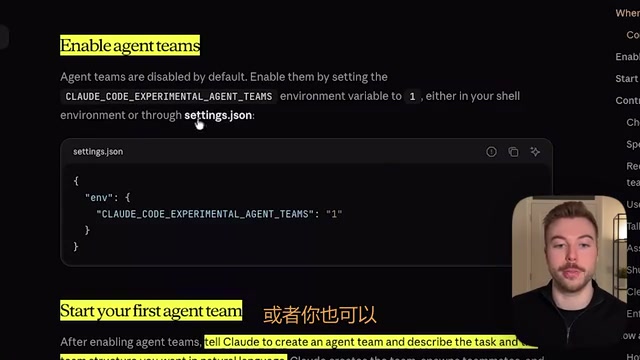
To launch Agent Teams, you need to add configuration in settings.json and enable experimental features. Once set up, you simply describe the team structure and specific tasks in natural language to get started.
Multi-Agent Parallel Execution Process
After launch, you can observe multiple agents working in parallel. Using Shift + Up/Down keys, you can check each agent's running status, or switch to split-screen display mode for a more intuitive view of each member's execution process.
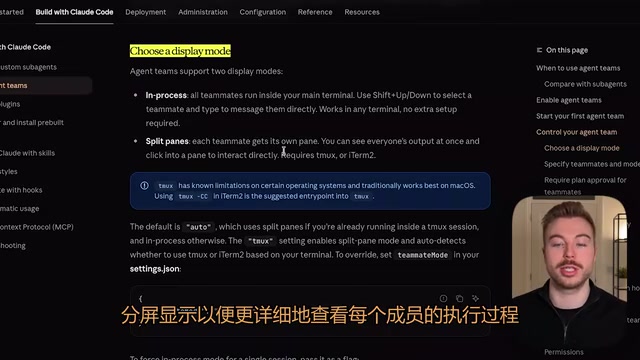
A noteworthy feature is the ability to interact with specific agents at any time. For example, if you're unhappy with the UI, you can send new design instructions directly to the frontend agent, which will proactively communicate with the backend agent to ensure coordination.
Final Output Results
The final application was built successfully with zero errors, capable of scraping Reddit data and generating SaaS idea suggestions. However, the quality of generated ideas was mixed — some scored only 3 points, with the best around 6 points — indicating that multi-agent collaboration output still requires human oversight and optimization.

Key Limitations and Pitfalls
Agent Teams is still in the experimental stage, and several obvious issues were encountered during actual use:
- No session recovery: Tasks cannot be resumed after interruption; team members disappear along with the session
- Task completion marking anomalies: Sometimes team members can't mark tasks as complete, potentially causing infinite loops
- Single team limitation: Each session can only have one team; nested teams are not supported
- Fixed leader role: Once the team lead is designated, they cannot be changed
- Dramatic token consumption increase: Heavy inter-agent communication significantly drives up costs
The Engineering Implications of "Experimental Feature"
The "Experimental Feature" label in software products typically carries three layers of meaning: APIs may undergo breaking changes, stability hasn't been thoroughly validated in production environments, and feature boundaries aren't fully defined. From an engineering perspective, the currently missing session recovery (Checkpoint/Resume mechanism) in Agent Teams is a critical threshold for multi-agent systems to become production-ready. When long-running complex tasks are interrupted due to network fluctuations or system errors, all intermediate states (each agent's execution progress, generated code, negotiation results) are completely lost, meaning enormous time and token cost waste. This problem has mature solutions in distributed computing (such as checkpointing mechanisms and event sourcing), but adapting them to the stateful execution model of LLM agents remains a current engineering challenge.
Particular attention should be paid to the fact that if you enable "dangerous mode to skip permissions," all sub-agents will receive the same elevated permissions, which poses security risks in an experimental feature.
Is It Worth Using? A Pragmatic Cost-Benefit Assessment
From hands-on experience, Agent Teams' output quality improves only about 10% to 30% compared to traditional approaches, while token consumption can triple or more. For most everyday development scenarios — fixing bugs, brainstorming new features, writing new components — this is complete overkill.
Recommended Use Cases
- Initial architecture setup for large projects
- Complex debugging requiring parallel multi-angle verification
- Parallel development of mutually independent modules
Not Recommended For
- Routine bug fixes
- Single feature development
- Cost-sensitive projects
More Pragmatic Alternatives
Rather than relying on Agent Teams, consider these alternatives: use well-structured MRD/PRD documents paired with regular sub-agents, or have a single agent complete tasks with detailed prompts.
Document-Driven Development: Shifting Coordination Costs from Runtime to Design Time
MRDs (Market Requirements Documents) and PRDs (Product Requirements Documents) serve as "system prompts" for AI programming. Their core value lies in making implicit collaboration knowledge explicit. Well-structured requirements documents can provide a single agent with sufficiently rich context to complete task boundaries that would otherwise require multi-agent negotiation to clarify — all within a single session.
Related articles
 Product Reviews
The Programmer's Desk Setup Guide: Building a Workspace That Feels Like Home
Discover how programmers build productive, comfortable workspaces. From multi-monitor setups to ergonomic design, explore the desk philosophy that drives focus and flow.
 Product Reviews
Qoder vs Cursor Real-World Comparison: Which $20/Month AI IDE Is Better?
Hands-on comparison of Qoder vs Cursor AI IDEs: Agent autonomy, human interaction count, and architecture decisions. Qoder needed only 2 interactions vs Cursor's 8.
 Product Reviews
Cursor Cloud Agent Demo: Eliminating Bottlenecks Across the Entire Software Development Lifecycle
Deep analysis of Cursor's Cloud Agent demo showing how cloud VMs, automated test artifacts, and a full-chain control plane systematically eliminate human bottlenecks across the software development lifecycle.