Claude Code Agent Teams in Practice: A Complete Guide to Multi-Agent Collaborative Development
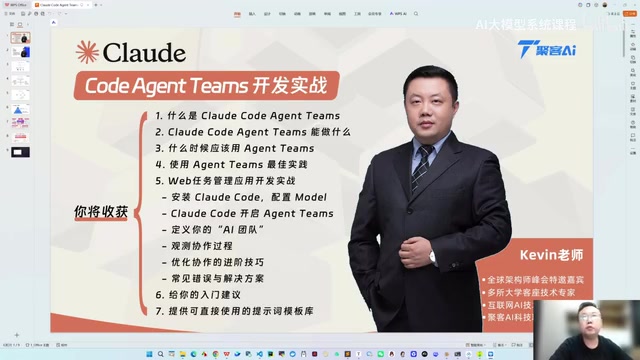
A practical guide to multi-agent collaborative development with Claude Code Agent Teams.
This guide explains Claude Code Agent Teams — Anthropic's multi-agent collaboration feature for AI programming. It covers the key differences between Subagents (isolated, independent) and Agent Teams (real-time, collaborative), showcases Anthropic's 16-agent compiler project, and outlines three best practices: Contract First design, strategic model tier allocation (Opus for architecture, Sonnet for implementation), and accepting higher token costs for parallel execution.
From Tool to Team: AI Programming Enters a New Phase
As more enterprises integrate AI programming tools into their production pipelines, the "one person paired with one AI" model is being fundamentally reshaped. According to a Chinese tech YouTuber deeply involved in AI technology consulting, he single-handedly delivered and launched a complete enterprise-grade project using Claude Code over the past month. The key behind this achievement is Claude Code Agent Teams, a feature Anthropic introduced and has since graduated from experimental to production status.
Claude Code is a command-line AI programming tool released by Anthropic in 2025 that allows developers to interact directly with Claude models in the terminal to write, debug, and refactor code. The Agent Teams feature was initially released as an experimental (beta) capability and, after months of iteration, has been officially promoted to one of Claude Code's core features. Under the hood, it relies on Anthropic's multi-agent orchestration protocol, enabling multiple Claude instances to be launched within a single project workspace and collaborate in real time through a shared file system and message bus.
This creator also serves as an AI technology consultant for five companies and supervises two graduate research projects. He's observed a clear industry signal: enterprise job postings rarely distinguish between "Java Engineer," "Frontend Engineer," or "C++ Engineer" anymore. Instead, they're being replaced by cross-language, AI-assisted development roles that demand composite skills. In other words, developers who still rely exclusively on writing code by hand are in an increasingly precarious position.
What Agent Teams represents is no longer a single AI tool, but rather a self-evolving, collaborating, and even mutually challenging AI team. When facing complex programming tasks, you're no longer fighting alone — you have an intelligent agent team that can coordinate in real time.
Subagent vs. Agent Teams: Key Differences Explained
Many people tend to conflate "Subagents" with "Agent Teams," but the two differ fundamentally in how they work.
Work Mode: Independent Aggregation vs. Real-Time Collaboration
Subagents operate in a model of independent execution with no inter-agent communication. A main agent dispatches multiple subagents, each completing its task within its own isolated context, then returning results to the main agent for unified management. The advantage of this design is that each subtask's context remains uncontaminated, preventing data interference.
Here, "context" is a core concept in how large language models process tasks — it refers to all the information the model can "see" and "remember" within a single conversation, typically measured in token count. Claude's context window can reach up to 200K tokens. When multiple unrelated tasks share the same context, information from different domains can interfere with each other, degrading output quality — a phenomenon known as "context contamination." The isolation design of Subagents is specifically meant to avoid this problem, ensuring each subtask executes in a clean information environment.
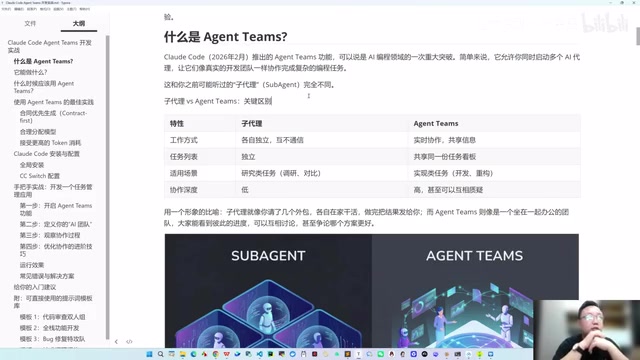
Agent Teams, on the other hand, operates through real-time collaboration with shared information. Multiple agents communicate in real time, share a single task board, can see each other's progress, and can even discuss and challenge each other's approaches — similar to "cross-testing" in enterprise software engineering: I test your module, you test mine.
An Intuitive Analogy
Here's a simple way to think about it: Subagents are like freelancers you've hired — each working from home independently, packaging up their results and sending them to you for integration. Agent Teams are like a co-located team working together in the same office, brainstorming and pushing forward together, discussing which direction is better at any moment.
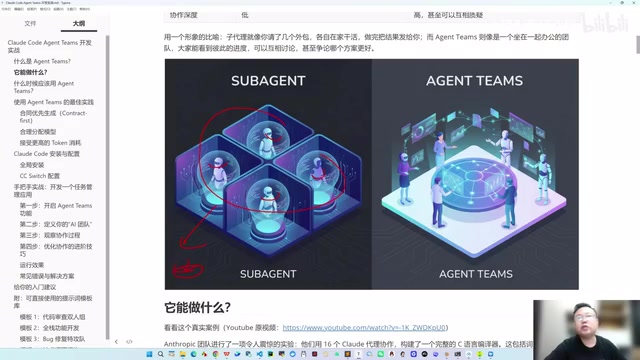
Subagent vs. Agent Teams: Use Case Comparison
| Dimension | Subagent | Agent Teams |
|---|---|---|
| Communication | No inter-communication | Real-time communication |
| Task Management | Independent tasks | Shared task board |
| Collaboration Depth | Low | High |
| Use Cases | Research, market comparisons, and other independent tasks | Full project development, code refactoring, and other scenarios requiring shared information |
In short, when conducting multiple vertical market research tasks, isolated Subagents help avoid context contamination. But when developing a full application involving frontend-backend coordination, the deep collaboration of Agent Teams is what you need.
Real-World Case Study: 16 Agents Collaborating to Build a Compiler
The upper bound of Agent Teams' capability is remarkable. According to an experiment disclosed by Anthropic, they used 16 Claude agents working simultaneously to build a complete compiler, with total API costs of only about $20,000.
A compiler is core software that translates high-level programming languages into machine-executable code, typically involving multiple stages: lexical analysis, syntax analysis, semantic analysis, intermediate code generation, code optimization, and target code generation. Traditionally, building a complete compiler is one of the most complex engineering challenges in computer science, usually requiring an experienced team working for months or even years. Anthropic's accomplishment of completing this task with 16 agents in a relatively short time not only demonstrates the upper bound of multi-agent collaboration engineering capability but also shows that Agent Teams has significant advantages when handling highly modular, interface-clear, yet implementation-complex system-level projects.
This case reveals Agent Teams' true value scenarios:
- Building complete applications: When multiple modules need coordinated development, development efficiency multiplies;
- No context loss: When multiple agents share information, critical details don't get lost in transit;
- Large codebases with complex dependencies: Ideal for feature development involving extensive inter-module dependencies.
The core idea is to map traditional software engineering team roles to agents: where a project team used to have UI designers, frontend engineers, backend engineers, and QA engineers, now each of these roles is defined as an individual Agent, forming a true "Agent Team." This is precisely the development paradigm Claude offers.
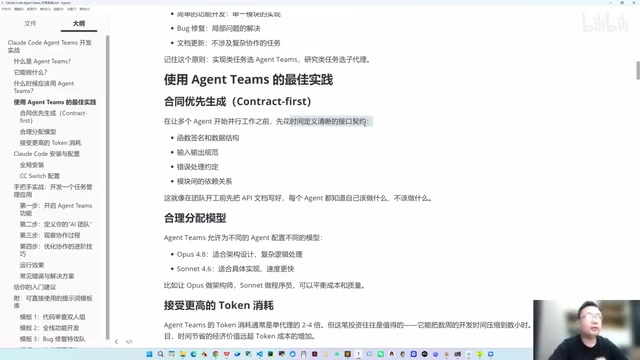
Agent Teams Best Practices: Three Core Principles
1. Contract First
This is the most important principle. Before letting multiple Agents work in parallel, you must first invest time in defining clear interface contracts (API/interface design). This is entirely consistent with traditional software engineering — frontend and backend teams always define their interfaces and APIs before actual coding begins. Only after the contracts are locked down can you delegate frontend Agents to implement according to the contract and backend Agents to develop accordingly, both working in parallel without conflicts.
The Contract First design philosophy originates from best practices in Service-Oriented Architecture (SOA) and microservices architecture. Its core idea is: before any concrete implementation begins, define the interaction protocols between services in a formalized way, including API endpoints, request/response data structures, error code conventions, etc. Common contract definition tools include OpenAPI/Swagger (for REST APIs), Protocol Buffers (for gRPC), GraphQL Schema, and others. In multi-agent collaboration scenarios, this principle becomes even more critical — because agents can't compensate for insufficient interface definitions through vague verbal communication the way human teams can. Clear contracts are the only guarantee that parallel development won't go wrong.
2. Allocate Models Wisely to Reduce Costs
This is the key to cost control. Take a three-agent project as an example:
- Architect Agent: Responsible for defining the overall architecture and interface contracts. Requires the highest capability — consider using Opus or a stronger model;
- Frontend/Backend Implementation Agents: Responsible for actual code implementation. More economical models like Sonnet work well here.
Anthropic's Claude model family is tiered by capability and cost: Opus is the flagship model with the strongest reasoning abilities and deepest context understanding, suited for complex architectural design and high-level decision tasks, but also the most expensive per million tokens. Sonnet is positioned as a mid-tier model that excels at code generation and everyday programming tasks with an outstanding cost-performance ratio. There's also the lighter Haiku model, suitable for simple text processing and classification tasks. Mixing different model tiers in Agent Teams essentially digitizes the management principle of "putting the right person in the right job" — using the most powerful model for critical decisions and economical models for batch execution, achieving optimal balance between quality and cost.
Letting Opus serve as the architect and Sonnet as the programmers ensures quality on critical decisions while keeping overall costs under control.
3. Accept Higher Token Consumption
This is an unavoidable trade-off of using Agent Teams. Since multiple agents work in parallel and need to communicate frequently and efficiently, the back-and-forth interactions inevitably lead to higher token consumption. Typically, a single run costing $2–4 is within the normal range.
Tokens are the basic billing unit for large language models, encompassing both user input (prompt tokens) and model output (completion tokens). In multi-agent collaboration scenarios, token consumption increases significantly due to several factors: first, each Agent needs to receive task context and shared information; second, inter-agent communication messages themselves consume tokens; third, when an Agent needs to review or challenge another Agent's output, additional reading and analysis overhead is generated. Based on Claude's current pricing, Opus model input costs approximately $15 per million tokens with output at approximately $75, while Sonnet costs approximately $3 for input and $15 for output. Therefore, a smart model allocation strategy can reduce overall costs by several times.
The creator shared his own real-world benchmarks: for a demo-level project using a three-agent configuration of "Opus as architect + Sonnet as frontend/backend programmers," running for about 15 minutes, the total cost was approximately $10. For enterprise-grade development, this cost is virtually negligible compared to traditional human resource investment.
Conclusion: The Development Paradigm Has Already Shifted
The emergence of Agent Teams marks AI programming's leap from "assistive tool" to "collaborative team." Its underlying logic isn't mysterious — it essentially migrates mature software engineering methodologies (interface contracts, role specialization, cross-validation) onto multi-agent collaboration.
For developers, the real dividing line is no longer "whether you can write code in a particular language," but rather whether you can efficiently organize and deliver a complete project using an AI team. As enterprise hiring trends increasingly lean toward AI-assisted development, mastering workflows like Agent Teams may well be the most worthwhile capability to invest in going forward.
Related articles

Chain of Thought Isn't Just for AI: How Humans Can Use CoT to Improve Thinking Quality
Chain of Thought isn't just a prompt trick for large models. Starting from a Hacker News discussion, this article analyzes why CoT works for human thinking too, breaks down actionable ways to transfer it, and highlights the key differences between human CoT and machine CoT.
Cloudflare Teams Up with OpenAI: Closi…
Cloudflare Teams Up with OpenAI: Closing the Loop from Vulnerability Discovery to Defense with AI
Cloudflare uses OpenAI Daybreak to investigate security vulnerabilities and generate reviewable remediation plans, while developers use Codex to boost coding efficiency and quality.

Orca Multi-Agent Orchestration in Practice: A Guide to Parallel Collaboration with Claude and Codex
Orca is Stable AI's free open-source agent workbench supporting 34 agents like Claude Code and Codex in parallel. Learn its Git worktree isolation, multi-model orchestration, and mobile management.