Claude Code Burns 15% of Its Tokens Every Turn Just to Display Three Words

Claude Code spends ~15–20% of its tokens on a three-word status line reinjected every turn.
Starting from a low-traffic Hacker News post, this article unpacks an easily overlooked cost sink: Claude Code spends roughly 15–20% of its tokens on a status line of just three words. The core explanation is that the status line isn't a pure UI element — it's injected into every request as part of the prompt and counts toward input tokens, a "small constant × high frequency" repeated overhead. This fixed injection both inflates token-billed costs and crowds the limited context window, lowering the density of useful information in long sessions. The article further notes that similar issues likely pervade persistent content such as system prompts and tool definitions, and recommends developers audit their context composition and factor token efficiency into tool selection.
How a Three-Word Status Line Eats Your Token Budget
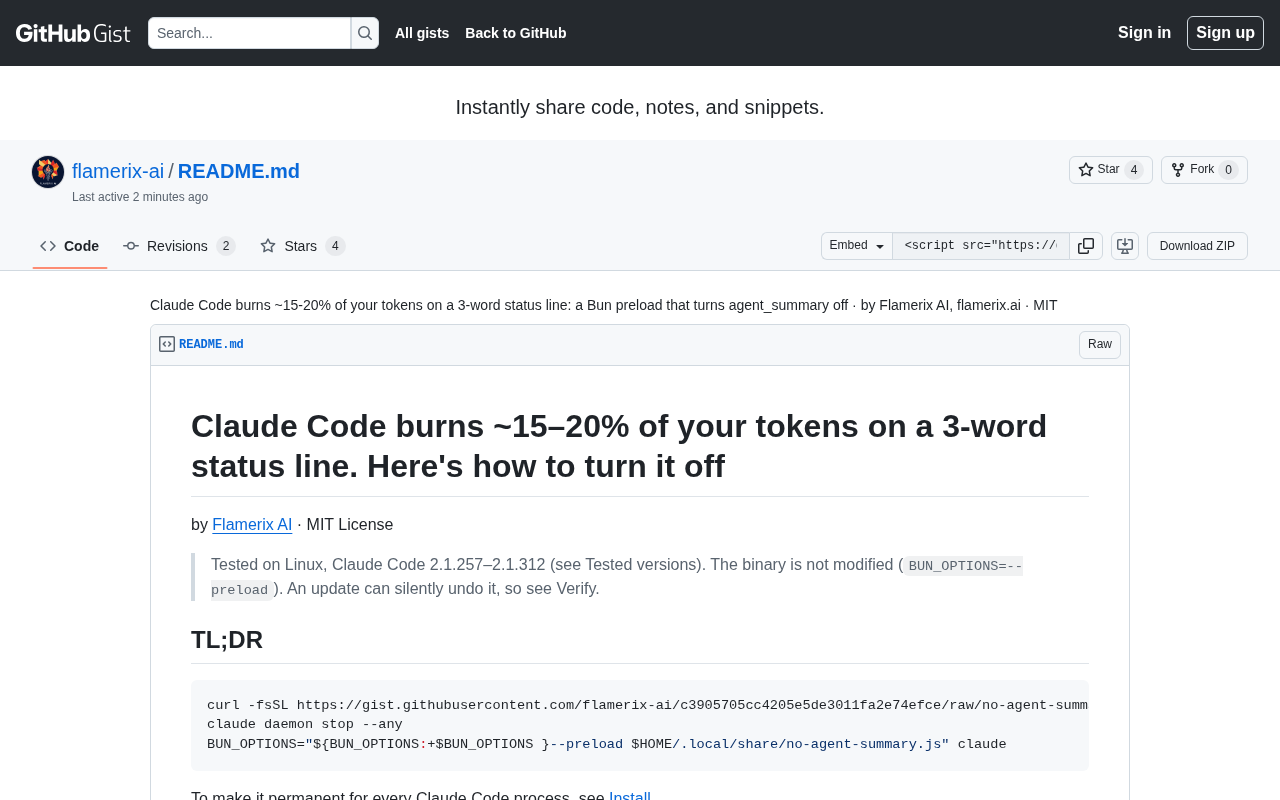
A post on Hacker News sparked discussion with a title that points directly at an easily overlooked cost sink: Claude Code spends roughly 15–20% of its token consumption on a status line of just three words. The post itself didn't rack up many points (34 points, zero comments), but the issue is specific enough to be worth unpacking.
For AI coding tools billed by token, this kind of "invisible overhead" translates directly into real money. Developers tend to focus only on the conversation content and overlook the context the tool carries by default on every turn.
A Status Line Isn't "Displayed" — It's "Injected"
Where the tokens go
Many people understand the status line as a decorative UI element, as if it just renders a few words. But in tools built on conversational context like Claude Code, status information is typically injected into every request as part of the prompt. In other words, it isn't a static UI control — it's a piece of text that repeatedly appears in the context.
Once it enters the context, it counts toward input tokens. As conversation turns accumulate, the cost of this fixed content gets paid over and over. The 15–20% figure from the original post describes exactly the share of this repeated overhead in overall token consumption.
The key to understanding this overhead lies in distinguishing the billing structure of large language model APIs. Mainstream APIs (such as Anthropic and OpenAI) price input tokens and output tokens separately, where input tokens include the system prompt, conversation history, and newly attached context for each turn. Because the models themselves are stateless, every request must resend the full context — meaning anything that persists throughout the session gets billed again turn after turn. Command-line agents like Claude Code also keep tool-call records and file-read results in context, further enlarging the base of persistent content and making the fixed injection's share vary dynamically with session length.
Why three words still cost something
A single status line isn't long in itself — the problem is that it counts "every single turn." In multi-turn coding tasks, the model needs to keep reading context to stay consistent, so the fixed injected content gets billed repeatedly. This differs from a "one-time system prompt," which typically appears only at the start of a session.
From an engineering perspective, this is a classic "small constant × high frequency" cost structure. Negligible on a single look, it becomes a sizable share once multiplied by the number of interactions.
The Real Impact on Developers
A double squeeze on cost and context
Token consumption isn't just about the bill. The context window is a limited resource, and whatever fixed content occupies can't be left for code, logs, and user instructions. In long sessions, this crowding lowers the density of useful information and makes the model hit the window limit sooner.
For developers relying on Claude Code for multi-turn refactoring and debugging, this means more frequent context cleanup and potentially worse task continuity.
The context window refers to the maximum number of tokens a model can process in a single request — a hard ceiling, not an elastically expandable resource. Once accumulated content in a session approaches that limit, tools usually trigger context compaction or truncation, summarizing or discarding earlier conversation. The persistent status line, system prompt, and tool definitions, though fixed in size, are counted against the window on every turn — effectively continuously eroding the remaining space available for code and logs. So the fixed overhead shows up both as repeated charges on the bill and as a net reduction in usable context capacity.
A tool design issue worth noting
The reason this post is worth discussing is that it points to a widespread phenomenon: when designing prompt structures, AI coding tools tend to prioritize feature completeness and treat token efficiency as secondary. The status line is just one visible cut into the problem; similar fixed injected content may also include environment information, tool descriptions, formatting constraints, and more.
According to the post on Hacker News, 15–20% is a definite percentage range, not a vague qualitative judgment. This suggests developers should make token auditing a daily habit rather than only paying attention to the length of individual conversations.
What You Can Do
Audit your context composition
Developers can proactively check which content in a session is fixed injection and which is genuinely necessary. For tools like Claude Code, watching the size of persistent content such as the status line, system prompt, and tool definitions is the first step to controlling costs.
Treat token efficiency as a selection criterion
When evaluating AI coding tools, token efficiency should be a consideration alongside code quality and response speed. A tool that's powerful in features but has excessive fixed overhead may cost significantly more over the long run than its sticker price suggests.
The value of this HN post isn't in offering a solution — it's in putting "invisible consumption" on the table. For developers who work with Claude Code every day, this 15–20% figure is worth keeping in mind.
Most AI coding tools today don't show the token composition of individual requests in their interface; developers can only observe it indirectly through the usage field returned by the API, proxy logs, or third-party metering tools. Common auditing methods include comparing the input-token difference between enabling and disabling a feature, measuring the fixed size of system prompts and tool definitions in a single request, and plotting token consumption curves against session length. When incorporating token efficiency into tool selection, "total token consumption to complete the same task" can serve as a benchmark for horizontal comparison, rather than only looking at single-response speed or feature lists.
Related articles

Last Week Tonight Exposé: The Dangerous Ties Between Politicians and White Supremacy
Last Week Tonight investigates Georgia Senate candidate Mike Collins and Florida candidate Marshall Rawson, exposing their multiple ties to white supremacists and the Republican Party's silent response.
AI Buzz Weekly: GPT-6.5 Leak, New Claude Model, and MiniMax's Cost-Effectiveness
This week's AI buzz roundup: suspected GPT-6.5 leak, Microsoft configs showing GPT-6.1 Tera, Anthropic's new model that can identify entire classes of bugs, disappointing early Gemini 4 Carbon results, and MiniMax M3.1 Flash beating Claude Opus 5 and GPT-5.6 Sol in benchmarks at extremely low cost.

AI Briefing: Gemini 4 Carbon Released, Ant Open-Sources Ling-3.1
AI Briefing: Google releases Gemini 4 Carbon qubit model, claiming to surpass Opus 5.5 with half-price tokens; Ant open-sources Ling-3.1-1019 for real-task Personal Agents; domestic AI drug discovery succeeds in 18 of 19 projects, hitting all 6 GPCR targets; zero-revenue company valued at $20B raises another $1B; Sichuan convenience store robot sales fail.