Claude Code & Codex Agent Skills in Practice: From Beginner to Enterprise-Level AI Development

Build reusable Agent Skills first, then generate code — turning AI coding into a scalable engineering practice.
This article introduces an advanced AI programming approach adopted at major tech companies: instead of asking AI to generate feature code directly, developers spend roughly 70–80% of their time building reusable "Skills" that then drive code generation. Skills codify engineering patterns like caching and microservices into templates, giving AI team-level guardrails that prevent codebases from degrading into unmaintainable messes. The article compares three Agent tools — Claude Code (professional, pairs well with GLM), Codex (beginner-friendly, best with GPT), and WorkBuddy (domestic-friendly, recommended with DeepSeek) — and walks through use cases from WeChat article generation to Redis cache retrofitting.
Agent Skills: The Advanced Approach to AI-Assisted Programming
Most developers using AI coding tools default to a simple pattern: tell the AI "build me this feature," then feed it one requirement after another. This approach feels efficient at first, but it carries a serious risk — as the project grows, the AI-generated code tends to accumulate into an unmaintainable mess of spaghetti code.
The approach actually used in major tech companies and mature engineering organizations is different: developers spend most of their time building Skills, and then let those Skills drive code generation. According to one Bilibili presenter who shared this workflow, "In big tech companies, programmers using AI coding tools spend maybe 70–80% of their time writing Skills — actually writing code takes up much less time." The core benefit is that code produced through Skills is more consistent, easier to maintain, and far better suited for team collaboration over the long haul.
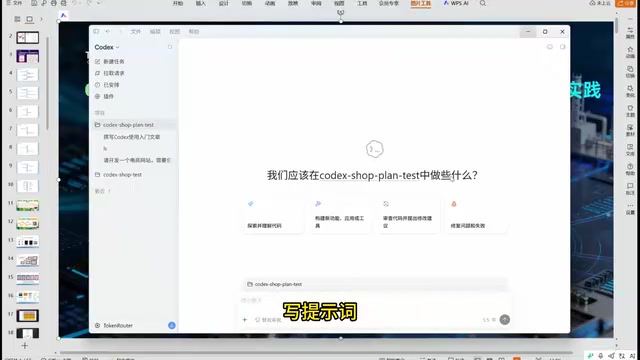
A Skill is essentially a reusable template. Simple Skills may contain nothing more than a few prompts; more complex ones can include code, scripts, and more. They capture recurring development patterns — things like caching architecture, distributed transactions, and microservice patterns — and codify them so your team doesn't have to reinvent the wheel every time.
The concept of Agent Skills originates from the "rules/conventions layer" design philosophy found in AI coding tools like Cursor and Claude Code. In these tools, a Skill is essentially a structured prompt template or executable script that tells the AI what conventions to follow in a given context — including code style, architectural choices, naming conventions, error handling patterns, and so on. This mirrors the concept of "design patterns" in software engineering: rather than describing requirements from scratch each time, you crystallize accumulated experience into reusable, repeatable patterns. From an engineering perspective, a Skill acts like a combination of a team's "coding standards document" and a "scaffolding generator" — except it can be directly understood and executed by an AI Agent, with no manual translation required.
How to Choose Between the Three Main Agent Tools
The presenter demonstrated three Agent tools, each with a distinct positioning:
Claude Code
Claude Code skews more professional and is better suited for experienced developers. It works best with Claude natively, but due to account ban risks and the need for a VPN, the presenter opted to connect GLM (Zhipu AI) as the backend model instead. For the demo, he installed the Claude Code plugin in VS Code and drove development through the IDE interface.
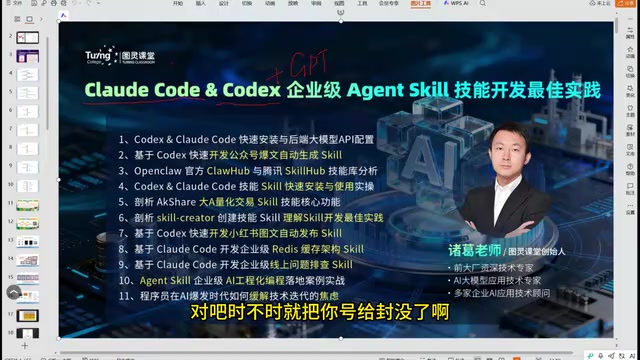
Claude Code is Anthropic's official CLI and IDE integration tool. Its core capability is allowing Claude to directly read and write local files, execute terminal commands, and understand the full context of a code repository — not just answer one-off questions. This "repository-level awareness" makes it significantly better than standard chat-based AI completion tools when handling complex tasks like cross-file refactoring and incremental development on existing codebases. Because Claude Code supports custom API endpoints, you can theoretically plug in any model that's compatible with the OpenAI API format (such as GLM or DeepSeekAd), though actual performance depends heavily on the model's ability to follow long-context instructions. It's worth noting that Anthropic enforces fairly strict checks on account usage regions and API call behavior — frequent access via proxy carries a real risk of account suspension, which is the main reason the presenter switched to a domestic Chinese model as the backend.
Codex
Codex integrates with GPT by default, which the presenter considers the best-matched pairing. It has stronger visualization capabilities, making it more accessible to beginners and a great fit for building relatively straightforward Skills. While you can swap out the backend model, the presenter recommends against it — the tool is simply "best matched with GPT."
WorkBuddy
For users who can't access overseas services or find VPN usage too cumbersome, WorkBuddyAd is the domestic Chinese alternative. It works similarly to the other two tools; the presenter paired it with DeepSeek, citing its excellent cost-performance ratio and solid overall capability.
The presenter's overall assessment: Claude Code and Codex are currently the two most capable AI coding tools in the world. Even when paired with strong domestic models (such as GLM, Qwen, Xiaomi MiMo, or DeepSeek), they still outperform combinations built entirely on domestic tooling.
Skill Development in Practice: From Simple to Complex
The presentation takes a progressive approach, covering dozens of Skill examples spanning content creation, quantitative analysis, automated publishing, and enterprise-level development.
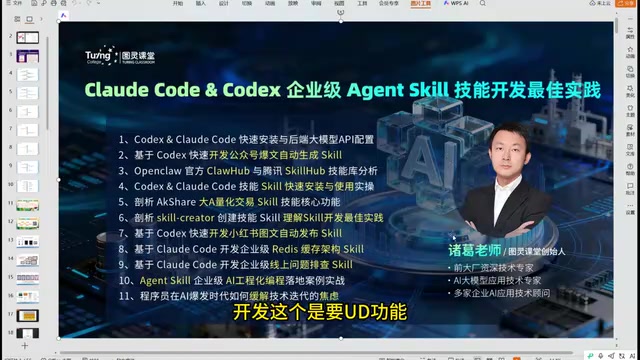
Beginner Level: WeChat Official Account Article Generation Skill
The most basic example is a Skill for automatically generating WeChat Official Account articles. The presenter demonstrates with both Codex and WorkBuddy simultaneously — first having each tool write an article titled "Getting Started with Codex," then walking through how to encapsulate this kind of task into a reusable Skill. Skills at this level have a low technical bar and can be implemented primarily with well-crafted prompts.
Intermediate Level: Quantitative Analysis and Automated Publishing
The next tier involves code-based scenarios, such as a Skill for quantitative analysis of A-share stocks. One of the most practically valuable demos is an automated Xiaohongshu (Little Red Book) image-and-text publishing Skill: users who manage Xiaohongshu accounts previously had to log in, upload, and publish content manually every day. After learning this Skill, they simply write (or have AI write) the content, then run a single command to publish everything automatically — a massive efficiency multiplier.
Enterprise Level: Architecture and Production Issue Diagnosis
For the more advanced developer-focused content, the presenter uses Claude Code to demonstrate enterprise-grade development scenarios, including Java architecture, Python architecture, Redis caching architecture, and production issue diagnostics. These scenarios often involve incremental development — not building from scratch, but layering new capabilities onto existing functionality.
The presenter walks through a typical example: adding Redis caching to a feature that previously had none. Writing a cache from scratch is straightforward enough, but retrofitting it into existing code is where engineering quality really gets tested — and that's exactly where Skills shine.
Why Skills Improve Code Quality
The core insight from this presentation is worth sitting with: having AI directly generate feature code is a fundamentally different engineering paradigm than having AI build a Skill first, and then letting that Skill generate the code.
The former tends to spiral out of control as projects grow, producing output that's hard to maintain. The latter embeds engineering standards, architectural conventions, and best practices directly into the Skill — effectively giving the AI a set of "team-level ground rules." The resulting code is more consistent, more predictable, and far better suited for multi-person collaboration and long-term evolution.
For organizations, this means AI-assisted coding graduates from being a "personal productivity tool" into a "systematic, engineering-grade development capability." By automating repetitive work through Skills, teams free up bandwidth for higher-value work.
From a software engineering perspective, "legacy spaghetti code" (the Big Ball of Mud anti-pattern) rarely forms because any single piece of code was written poorly. It forms because of a lack of consistent architectural constraints — each requirement gets implemented as fast as possible, and over time, coupling between modules accumulates until touching one thing breaks everything. When AI generates feature code directly, the model tends to produce the shortest path to "it runs" — with no awareness of the project's existing architectural style or conventions. This actively accelerates the Big Ball of Mud problem. Skills solve this by explicitly encoding architectural conventions, effectively running an "architecture review" before each piece of code is generated. The result naturally conforms to team standards — the same way CI/CD gates enforce coding standards in DevOps, except the constraint is applied at the generation stage rather than the review stage.
Conclusion
Whether you're a backend developer working in Java or Python, or a content creator running a Xiaohongshu or WeChat Official Account, Agent Skills offer a clear path to automating repetitive work. On the tooling side, Claude Code and Codex lean professional and represent the most capable options globally, while WorkBuddy is a domestic-friendly alternative. On the model side, GPT, GLM, and DeepSeek each have their optimal pairing scenarios. The key isn't which tool you use — it's whether you've adopted the "write Skills first" mindset to move AI-assisted development from ad hoc, prompt-by-prompt coding into a genuinely engineered, systematic workflow.
Related articles

How Big Can Stars Really Get? The Physical Limits of the Largest Stars
Red supergiants are the largest stars by volume, with radii up to 2,000 times the Sun, engulfing the inner solar system. But there is no precise upper limit on stellar size—models predict up to 15,000 solar radii. The most massive blue stars are far smaller than red supergiants—biggest and heaviest are two different things.

Apple HomeView Smart Display Full Feature Breakdown: Wall-Mount or Desktop, $299
Apple launches HomeView, a $299 smart display with wall-mount and desktop options, 12MP camera for facial recognition, smart home control, music playback, and recipe step-by-step cooking. Full breakdown of watch faces, apps, privacy, and cooking integration.

Where Did the Promised New Studio Go? Craft Computing Answers After Five Years
Craft Computing's host responds to viewer questions: the new studio promised five years ago was shelved as construction costs soared from $30,000 to $75,000, and was replaced by a 168-square-foot garage conversion.