Claude Code Evolves: From Coding Assistant to AI Project Manager

Claude Code now acts as an AI project manager — auto-decomposing goals, running parallel cloud threads, and sharing project memory.
Anthropic's new Projects feature for Claude Code marks a major leap from code-completion assistant to autonomous development management system. Users simply provide a high-level goal, and Claude Code breaks it into subtasks distributed across parallel AI threads — all running in the cloud with shared project Memory to maintain context across sessions. This shift is redefining the developer's role from writing code to setting goals and leading an AI team.
Claude Code Is No Longer Just About Writing Code
Anthropic's Claude Code is undergoing a fundamental shift in identity. It used to be a programming assistant that helped you complete functions and fix bugs. Now, it's stepping into the role of a "project manager" — instead of multiple people writing code together, Claude Code spins up multiple AI threads in the cloud and coordinates them to build the same project in parallel.
The logic behind this shift is straightforward: you no longer need to hand-hold it through every step. Just give it a goal. As demonstrated by creators on Bilibili, for example, you say "optimize the checkout speed for this project," and Claude Code takes it from there — breaking down the task on its own.

Automatic Task Decomposition and Parallel Multi-Thread Development
The most critical capability in the new Projects feature is its ability to break a vague goal into concrete subtasks and distribute them across different AI threads for parallel execution.
Take "optimize checkout speed" as an example. Here's roughly how it works: one thread investigates API performance bottlenecks, another handles the code changes, and a third runs tests to validate the results. Multiple Claude instances work simultaneously, and a "higher-level" Claude reviews the output from each thread, collects the results, and delivers a unified outcome.
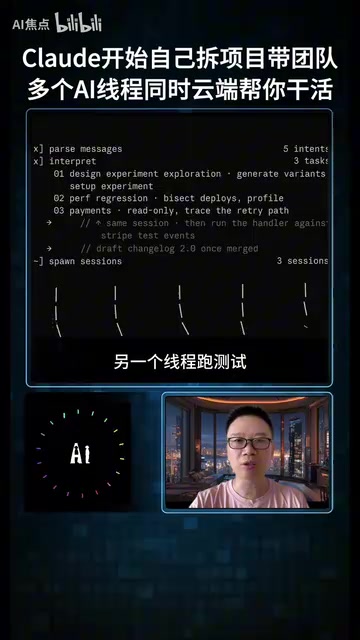
The significance of this mechanism is that it hands off the entire project management pipeline — task decomposition, parallel execution, and result aggregation — to AI automation. Developers are shifted from being executors to being goal-setters and reviewers.
This architecture is known in the AI field as a Multi-Agent System or Orchestration Pattern. The higher-level Claude acts as the Orchestrator, while the instances handling specific subtasks are called Sub-agents or Workers. This design isn't unique to Claude — OpenAI's Swarm framework, Microsoft's AutoGen, and other projects are all exploring similar multi-agent collaboration mechanisms. The core challenge lies in the quality of task decomposition at the orchestration layer: if the initial breakdown introduces ambiguity, parallel threads may diverge into inconsistent implementations, ultimately causing merge conflicts or logical contradictions. This makes the orchestrator Claude's ability to review code and resolve conflicts during the aggregation phase the critical bottleneck for the entire system's reliability.
Runs Entirely in the Cloud — No Interruptions When You Shut Down
Another noteworthy aspect: all AI threads run in the cloud, not on your local machine.
This creates a tangible difference in experience: close your laptop, head home for the day, and the threads keep working in the cloud. Come back the next morning, and they may have already completed most of the work. This "asynchronous, continuously running" model means AI-driven development is no longer constrained by your local device's uptime.

For time-intensive tasks like refactoring, testing, or large-scale changes, this cloud-based continuous execution is especially practical — it transforms the development process from "synchronously waiting" to "submitting a goal and asynchronously collecting results."
Shared Memory to Avoid Repeating Context
Multi-thread collaboration runs into a classic problem: how do different threads stay contextually aligned? Anthropic's answer is shared project Memory.
All threads share the same project Memory file, along with a record of every decision made previously. This means when you return the next day to continue working, you don't need to re-explain the project background, tech stack choices, or past trade-offs to the AI. This continuously accumulating "project memory" allows the AI team to maintain coherence across long-running tasks, rather than starting from scratch with every new conversation.
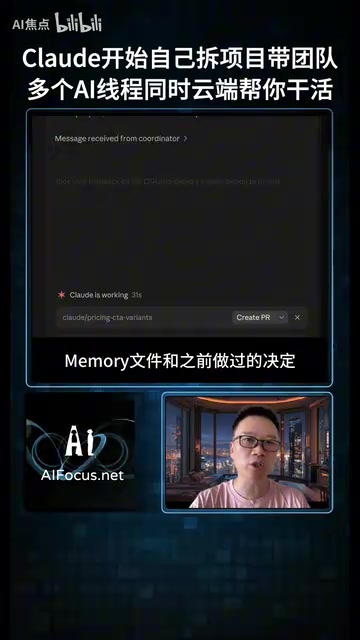
Shared Memory is essentially a persistent context management mechanism. Large language models are inherently "stateless" — once a conversation window closes, context is lost. To address this, there are generally two engineering approaches: expanding the context window to pack all historical information into the prompt, or introducing external storage to persist critical decisions, architectural choices, and coding conventions in files that can be read on demand. Claude Code's Projects Memory takes the latter approach — storing project context as structured text in shared files that all threads can read at startup. The advantage is cost efficiency and editability; the limitation is that the quality of what gets written into Memory depends heavily on the AI's ability to automatically summarize information. Omissions or inaccuracies in the records could in turn mislead future decisions.
The Developer's Role Is Being Redefined
Put all these capabilities together, and Claude Code increasingly resembles a project manager running a team of AI developers.
In the past, you fed AI one Prompt at a time, precisely describing each step. Now, you might only need to provide a goal — the decomposition, scheduling, and review are handled by the AI itself. This reflects a deeper shift in the human-AI collaboration paradigm: the real test for developers may no longer be how much code you can write, but whether you know how to "lead an AI team."
Of course, these capabilities are still largely in the demo and early-adoption phase. Reliability in real-world projects, the quality of complex task decomposition, and conflict resolution across multiple threads still need to be validated in actual development environments. But the direction is clear: AI programming tools are evolving from "helping you write code" to "autonomously managing the development process."
Related articles

Felix Rieseberg Personal Homepage
Felix Rieseberg's personal homepage sparks attention on Hacker News. This article covers the Slack engineer's technical background, the rise and fall of nativefier, and the value of a developer homepage as a tech calling card.

@ai-sdk/vue 3.0.306 Patch Release Syncs with [email protected] Update
@ai-sdk/vue 3.0.306 released, synced with [email protected]. A routine patch release for the Vercel AI SDK ecosystem with no public API changes; the Vue adapter layer stays version-aligned with the core package.

Gemini 4 Argon API Launches: The Era of Million-Token Output Begins
Google launches Gemini 4 Argon with sparse MoE architecture, up to 1M output tokens, and a 68.90% Vals Index score, available across API, AI Studio, and the Gemini app.