Claude Code Finally Supports AGENTS.md: AI Coding Configuration Moves Toward Standardization

Claude Code now supports AGENTS.md, pushing AI coding tool project configuration toward a unified standard.
Anthropic has added AGENTS.md support to its AI coding tool, Claude Code. AGENTS.md is a community-formed universal configuration convention that acts as a "project briefing" for AI agents, describing build processes, testing workflows, code style, and more. Previously, each tool used its own proprietary format, leaving projects cluttered with redundant, out-of-sync config files. Claude Code's adoption gives the convention another heavyweight backer, bringing it closer to a de facto standard — and signaling a maturing, more interoperable AI coding ecosystem.
Claude Code Joins the AGENTS.md Camp
Anthropic has added support for AGENTS.md files in its AI coding tool, Claude Code. The news, which surfaced on Hacker News with modest discussion, is nonetheless a meaningful signal for developers who regularly use multiple AI coding assistants — project configuration for AI coding tools is converging toward a common standard.
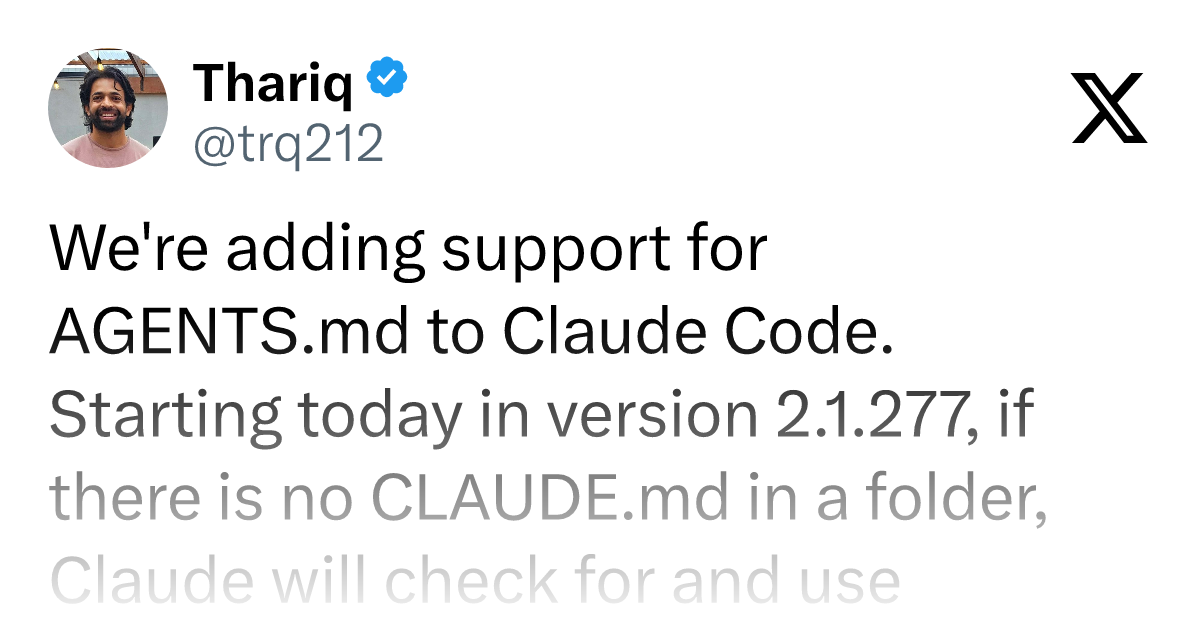
AGENTS.md is a configuration file format that has gradually taken shape as an informal convention in the developer community. It functions like a "project briefing" for AI coding agents — telling the AI how to build the repository, how tests are run, what code style conventions apply, which directories to leave alone, and so on. Previously, Claude Code used its own CLAUDE.md format, while other tools each had their own naming conventions, resulting in projects littered with redundant configuration files targeting different tools.
Claude Code is Anthropic's AI coding assistant built primarily around a command-line interface. It can directly read and write local files, execute terminal commands, run tests, and invoke external tools — positioning it as an "agent that autonomously completes coding tasks" rather than just a completion tool offering code suggestions. Unlike editor-embedded assistants such as GitHub Copilot, Claude Code emphasizes understanding the entire codebase and autonomously executing multi-step tasks. For exactly this reason, it needs a mechanism to understand a project's specific constraints — and AGENTS.md is the configuration file that fills that role.
Why Standardized Configuration Matters
For teams using multiple AI coding tools, configuration fragmentation is a real pain point. A project simultaneously housing CLAUDE.md, .cursorrules, and various proprietary format files not only carries high maintenance overhead, but the content across them easily falls out of sync. When team members use different tools, the project context each AI receives can be completely inconsistent.
The idea behind AGENTS.md is to provide a tool-agnostic, universal instruction file. Developers only need to maintain one file, and in theory any AI agent supporting the specification can read and follow it. Claude Code adding support means this convention now has another heavyweight backer, pushing it one step closer to becoming a de facto standard.
The AI coding space currently has multiple parallel project configuration specs: Cursor uses .cursorrules (newer versions have switched to a .cursor/rules directory), GitHub Copilot relies on .github/copilot-instructions.md, Anthropic's own Claude Code previously used CLAUDE.md, and OpenAI's Codex-family tools have their own conventions. AGENTS.md was originally introduced and popularized by OpenAI in its Codex CLI, then gradually picked up by other tools. Its name intentionally downplays vendor association, emphasizing an "agent-universal" positioning. Claude Code's support now extends coverage to the Anthropic ecosystem, further boosting the format's chances of becoming an industry-wide de facto standard.
The Community Sentiment Behind "Finally"
The word "finally" in the original headline is telling. It suggests that developers had long been hoping Claude Code would support this format — and that other tools may have already adopted it first. Anthropic's move is, in some sense, a response to community consensus rather than a leadership play.
In the competitive landscape of AI coding tools, this kind of interoperability improvement often reduces user switching and collaboration costs more effectively than raw model capability improvements. When configurations can be reused, the friction of switching between different tools decreases, and the market becomes more likely to compete on actual coding experience rather than lock-in effects.
Practical Impact for Developers
If you're already maintaining a CLAUDE.md in your project, consider gradually migrating to or supplementing it with an AGENTS.md, so team members using other agent tools can benefit as well. For new projects, adopting the universal format from the start can help avoid duplicated effort down the road.
It's worth noting that the available information on this announcement is limited. Specific compatibility details, the priority relationship between CLAUDE.md and AGENTS.md, and whether the old format is fully replaced — all of these questions should be verified against Anthropic's official documentation. Overall, this is a positive signal that the AI coding ecosystem is maturing toward greater collaboration and interoperability.
Related articles

DeepCell: One-Click AI Generation of Documents, Spreadsheets, and Slides
DeepCell tops Product Hunt with one-click generation of documents, spreadsheets, and slides, using the .deepcell format for linked updates, designed for System 2 tasks like modeling and sales reviews.

Doneas: 15-Minute Daily Accountability Calls That Keep Indie Developers From Procrastinating
Doneas is a daily accountability tool for indie developers: plan tasks on Monday, join a 15-minute call with five builders each day, and log deliveries on a public progress page. This article analyzes its core mechanics, effectiveness, and potential issues around retention and matching.

Fastlane 2.0: Fully Automated AI Ad Campaigns, From Creative to Optimization
Fastlane 2.0 is an AI ad automation tool: enter your website and it learns your brand, generates video and image ads, and runs and optimizes them on Meta, TikTok, Instagram, and YouTube.