Claude Code Game Studios: The Truth Behind 49 Agents

A 49-agent template counterintuitively shows the heaviest configuration ranks last; combination and rigor matter more than quantity.
The article focuses on Claude Code Game Studios, a project packing 49 agents and 74 skills into one template, emphasizing not the quantity itself but the cost structure of multi-agent systems. The README self-discloses that "the heaviest build ranks last," contrary to the intuition that bigger is stronger, but lacking reproducible evaluation methodology, this conclusion can only serve as a directional signal. The article thus offers two practical suggestions: first, actively set the modes.rigor configuration, running the lightest combination first before gradually raising the level to establish your own baseline; second, clarify what to skip, prioritizing trimming agents unrelated to the goal and skills that repeatedly cover the same stage. The final conclusion is to treat the template as a decomposable library of optional components and a configuration manual, not a performance guarantee.
When 49 Agents Squeeze Into a Single Template
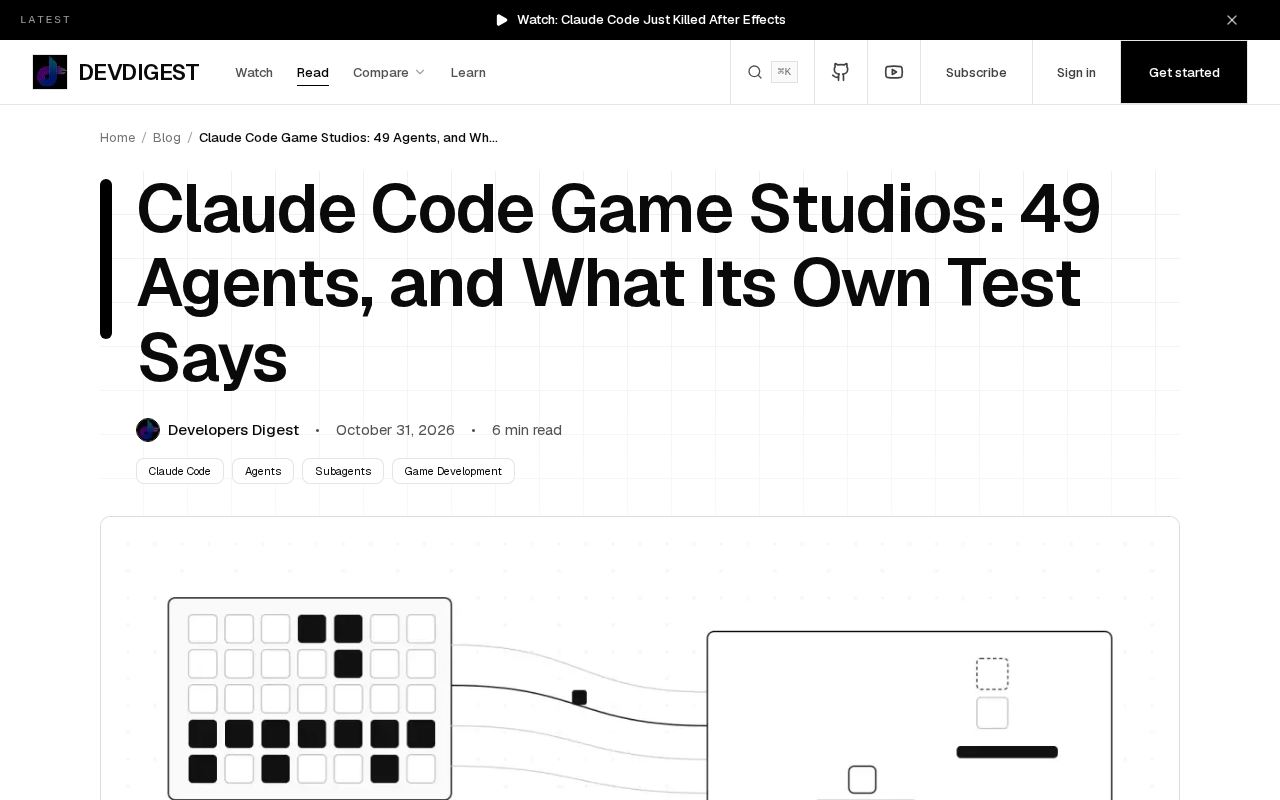
Claude Code Game Studios is a project that packs 49 agents and 74 skills into a single template. Many people's first reaction to "multi-agent collaboration" is that more is stronger, but this template's README offers a counterintuitive conclusion: the heaviest build ranks last. This sentence deserves to be unpacked on its own, because it points to a commonly overlooked cost-structure problem in multi-agent systems.
The README's Self-Disclosed "Last Place" Result
According to the original information, the README explicitly records this ranking result, but does not provide a complete evaluation methodology. This is both what makes it valuable and what warrants caution: valuable because the author did not hide data unfavorable to themselves; caution because, lacking reproducible evaluation details, we can only treat it as a directional signal rather than a precise benchmark conclusion.
Judging from engineering intuition, an increase in the number of agents and skills brings a simultaneous rise in context usage, scheduling overhead, and the difficulty of converging results. The phenomenon that "the heaviest build ranks last" is exactly the opposite of the naive expectation of "scale buys quality," suggesting that in this system, the choice of configuration strategy may be more critical than stacking up numbers.
In the context of this kind of multi-agent template, "the heaviest build" usually refers to the configuration combination that enables the most agents simultaneously, has the longest chain of dependent skills, and incurs the greatest context and scheduling overhead. Ranking it on the same dimension as the other configurations is essentially comparing the end-to-end performance of different combinations, rather than the capability ceiling of any single agent. This kind of ranking is highly sensitive to evaluation methodology: task types, success criteria, and whether token cost and latency are counted will all change the standings. Therefore, the README's conclusion is better read as "the heavy configuration showed no advantage under the author's evaluation conditions" rather than "the heavy configuration is necessarily worse." Only by understanding this can you correctly use the subsequent suggestions about rigor levels and trimming strategies.
modes.rigor: Tune This Knob First
The original information mentions that modes.rigor is a configuration item that needs to be set when using this template. Although the material does not elaborate on its specific values and semantics, from the naming we can judge that it relates to "rigor"—this kind of configuration usually determines how much validation, review, and self-checking the agent invests in the process.
A practical suggestion: don't turn everything on all at once. First run the complete process with the lightest combination, then gradually raise the rigor level and observe the curve of output quality and time consumption. The benefit of doing this is that you can establish your own baseline rather than directly inheriting someone else's defaults.
In multi-agent orchestration, a parameter like rigor is usually not a single switch but a multiplier affecting multiple stages: it may determine whether an agent performs additional self-review, whether cross-validation is triggered, whether an extra round of negotiation is added when results are inconsistent, and whether a more complete evidence chain is required. As the level increases, the number of round trips per task and context usage rise simultaneously, while the benefit depends on whether the task itself tolerates errors—for exploratory, open-ended game design tasks, overly high validation intensity may suppress divergence; for stages requiring strict consistency or verifiable output, high rigor yields obvious returns. Therefore, a reasonable approach is to set rigor separately for each process stage rather than maxing it out globally.
What to Skip
The original information also points out that "what to skip" is a question that needs answering, but does not list a specific inventory. Based on the common structure of template-type projects, we can offer judgment principles rather than a specific list: agents not directly related to the current task goal, and skills that repeatedly cover the same stage in the process, are the top candidates for trimming.
If you are unsure whether something should be skipped, a simple approach is to first run the process without it and compare the output differences. If the difference is negligible, it is redundant configuration.
The Trade-off Logic of Multi-Agent Templates
The value of Claude Code Game Studios lies not in the number "49" itself, but in the fact that it turns multi-agent orchestration into a decomposable template. The 74 skills and 49 agents provide a library of optional components, not a finished product that must be fully installed. What really determines the effect is how you combine them, and how parameters like rigor match task difficulty.
Treating it as a "configuration manual" rather than a "performance guarantee" is the most reasonable way to open this kind of template.
Related articles

DeepSeek Harness in Detail: DIY Your Own Software Like Building with LEGO
What is DeepSeek Harness? Using the metaphor of a car assembly platform, this article explains this equipment system of freely combinable functional modules, analyzes its spatiotemporal composability technical foundation, and shows how ordinary users can DIY exclusive software that does not exist on the market at extremely low cost.

DeepSeek Harness Step-by-Step Tutorial: Master DSH and Its Plugin Ecosystem in 50 Minutes
DeepSeek Harness step-by-step install tutorial: from Node.js environment setup to client installation, covering three plugin install methods — chat, marketplace, and command line — plus practical uses of local file access and plugin extensions.

DeepSeek Open-Sources Super-agent Architecture: A Turning Point for Proactive AI
DeepSeek's open-source Super-agent architecture proposes a new proactive AI paradigm: a central Agent dispatches tasks, sub-Agents execute autonomously, and humans only decide and accept. This article analyzes the watershed between passive and proactive AI, and the implementation logic of proactive Agents in scenarios like short-video lead generation.