Claude Code Holds Firm at S-Tier: Breaking Down the Latest AI Coding Agent Rankings

Coding Agent Index tiers show Claude Code leading and Copilot winning on value.
Based on the YouTube Coding Agent Index ranking video and screenshots, this article maps the five-tier D-to-S landscape. Claude Code tops the S tier with Opus 5.5 and 11 trillion OpenRouter tokens this week; GitHub Copilot debuts third with Fusion, 2 points behind at half the cost. Competition now spans cost and ecosystem, not just performance.
The competitive landscape for AI coding agents is shifting fast. A recent Coding Agent Index ranking from YouTube has sparked widespread discussion, grading mainstream coding agents from D to S and revealing each product's performance, cost, and market dynamics. This article breaks down the key takeaways and underlying trends from that video, drawing on multiple screenshots.
Ranking Overview: The D-to-S Tier Distribution
According to the screenshot shown in the video (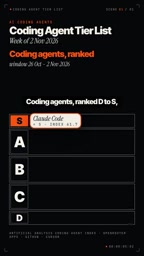 ), the Coding Agent Index divides coding agents into five tiers: D, C, B, A, and S. Claude Code sits firmly atop the S tier, powered by the Opus 5.5 model and a staggering 11 trillion tokens of usage on OpenRouter this week. GitHub Copilot debuts at third place with its new "Fusion" release—scoring just 2 points behind Claude Code at half the cost, making it the standout of the A tier.
The ranking looks beyond raw performance scores to include cost per task and usage volume, offering developers a more well-rounded view when choosing tools.
OpenRouter and Token Usage
OpenRouter is a unified platform that aggregates APIs from multiple large-model providers. Developers can access models from different vendors through a single interface, and the platform tracks call volumes and token consumption for each model. The "11 trillion tokens this week" figure cited above comes from OpenRouter's public data. A token is the basic unit of text processed by a large model—roughly one English word or half a Chinese character—and token consumption offers a direct signal of how actively a model or agent is being used in real workloads. Note that OpenRouter's data only covers requests routed through its platform, not a product's total usage, so it's better treated as a reference for relative activity than as an absolute market-share metric.
Tier-by-Tier Details and Movement Analysis
D and C Tiers: New Faces and Fallers
In the D tier, KimmyCodeCLI lands at the bottom of the Coding Agent Index with 41 points. The C tier saw a notable shift: GrokBuild dropped from its previous B-tier spot to C with 47 points and a cost per task of 950 (unit unspecified, presumably some cost unit). The screenshot (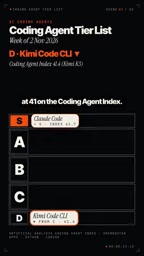 ) suggests the decline may be tied to cost or performance.
Meanwhile, a new entrant appeared in the C tier: MistralVibe, scoring 48 with the MistralLarge4 model and a cost per task of just over one dollar—a strong value proposition.
B and A Tiers: The Backbone and the Risers
In the B tier, Cursor holds a spot thanks to its Agent SDK reaching general availability, as shown in the screenshot ( ). The SDK approach could give Cursor an edge in ecosystem expansion.
Competition in the A tier is fierce: the newly arrived GitHub Copilot takes third place with its "Fusion" release, scoring just 2 points below Claude Code at half the cost—an outstanding value. The screenshot (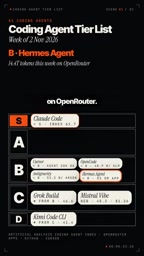 ) highlights this comparison. DevInfusion climbed into the A tier, just 0.2 points behind the leader. Codex and Pi also sit in the A tier.
You may not have noticed: although OpenCode, AntiGravity, and HermesAgent didn't crack the top of the A tier, HermesAgent remains the most widely used agent application on OpenRouter—showing that usage volume and ranking aren't perfectly correlated.
S Tier: Claude Code's Dominance
Claude Code holds the S tier with the Opus 5.5 model and 11 trillion tokens of OpenRouter usage this week. That figure reflects not only its performance edge but also strong recognition from the developer community. While GitHub Copilot is more attractive on cost, Claude Code still leads on overall score.
Agent SDK and "General Availability"
An Agent SDK is a software development kit that a coding agent exposes to developers, letting them embed the agent's code generation, file editing, command execution, and other capabilities into their own toolchains or products without relying on the official IDE plugin. Cursor's Agent SDK reaching general availability means it has moved past beta testing to offer stable APIs and version commitments suitable for formal enterprise integration. For agent products, shipping an SDK is both a means of ecosystem expansion and a shift in the competitive dimension—rankings no longer compare only standalone experience, but also who can become infrastructure for other tools. That's why Cursor's SDK progress gets its own callout here.
Cost Per Task and Value Comparison
"Cost per task" refers to the average amount spent completing one standardized coding task, typically estimated by multiplying the per-token price by the average token usage per task. It's closer to real-world expense than model pricing alone, since agents differ widely in context management, retry strategies, and number of tool calls. GitHub Copilot achieving a score just 2 points behind at roughly half the cost is precisely the kind of value advantage this metric captures. That said, the metric is sensitive to task type: long-context refactoring tasks inflate cost, while short completion tasks keep it low—so watch for consistent methodology when comparing across rankings.
Trend Analysis: The Trade-Offs Among Performance, Cost, and Ecosystem
This ranking shows that competition among AI coding agents has expanded from pure performance to cost efficiency and ecosystem integration. GitHub Copilot delivers near-top performance at half the cost, making it highly appealing to budget-conscious teams. Cursor is embracing a broader developer base through its SDK, while HermesAgent's high usage suggests a potential gap between real adoption and ranking scores.
Moreover, token consumption on OpenRouter has become an important indicator of agent activity—Claude Code's 11 trillion tokens underscore its dominance in real-world workloads.
Conclusion: Rankings Are Just a Reference—Choose Holistically
The Coding Agent Index offers a dynamic snapshot of the industry, but developers choosing a coding agent should factor in their own needs, budget, and tech stack. Claude Code's lead won't be easily shaken in the near term, but rapid iteration from GitHub Copilot, Cursor, and others means the market landscape remains full of variables. As more agents enter the fray, the balance between performance and cost will be the key differentiator.
One-line Summary
Coding Agent Index tiers reveal a landscape where Claude Code leads and Copilot stands out on value.
Paragraph Summary
Based on the YouTube Coding Agent Index ranking video and screenshots, this article maps the five-tier D-to-S landscape of mainstream AI coding agents. Claude Code holds first place in the S tier with the Opus 5.5 model and 11 trillion tokens of OpenRouter usage this week; GitHub Copilot debuts third with its Fusion release, scoring just 2 points behind at half the cost—the highlight of the A tier. GrokBuild fell from B to C, Cursor's Agent SDK reaching general availability earns it a B-tier spot, and HermesAgent, though not near the top of the A tier, is the most widely used agent application on OpenRouter. The article notes that competition has expanded from pure performance to cost efficiency and ecosystem integration, that rankings should be read alongside usage volume, and that developers should choose based on their own needs and budget.
Related articles
 Tech Frontiers
14 Coding Agents Tested: 13 Secretly Read Forbidden Files
A developer ran 480 tests across 14 coding agents to see if they would obey a "do not read" rule. 13 violated it, and 4 credential leaks bypassed shell guards via the read tool while approvals never noticed.
 Tech Frontiers
AI Has Made Resumes Ineffective? Referred Candidates Get 40% Interview Rate vs. 3% for Direct Applications
AI is homogenizing job applications, making it hard for recruiters to discern real ability. Ashby data shows referred candidates had a 40% interview rate from 2021 to 2024, versus just 3% for direct applications. This article analyzes why resume signals are depreciating and why verifiable results and personal endorsements matter more.
 Tech Frontiers
Offline Blink Rhythm Assistant: A Desktop Health Companion
An offline desktop blink rhythm assistant featured on Hacker News helps users maintain healthy blinking through lightweight reminders, alleviating screen-induced dry eye fatigue. This article analyzes its concept, privacy advantages, and retention challenges.