Claude Code in Practice: Harness Engineering for the Full AI Development Workflow

Use the Harness engineering framework to constrain Claude Code and move AI coding from toy to productivity.
Based on Bilibili creator Zhuge Laoshi's public lesson, this article explores the implementation path of AI engineering-based programming. The author points out that the main reason AI coding fails is not insufficient model capability, but a lack of engineering constraints—casual prompts, chaotic context, and missing verification. The core of the Harness framework is to bring AI coding into a controllable process: clarifying requirement boundaries, designing context injection, and establishing verification and rollback mechanisms. Using an enterprise e-commerce project as an example, the course demonstrates the full workflow from requirement breakdown to code implementation with Claude Code and domestic GLM large models, avoiding the risk of bypassing internet restrictions. The article also emphasizes that tool thinking and AI efficiency-improvement ability are becoming résumé highlights and interview bonuses.
Many developers' attitudes toward AI coding are diverging: some have given up entirely and gone back to writing code by hand, while others use AI agents to automate tedious work and free up time to polish projects worth putting on a résumé. In a public lesson, Bilibili creator Zhuge Laoshi (Teacher Zhuge) used Claude Code + Harness engineering-based programming as the main thread to demonstrate the full process from requirements to implementation. This article is based on that course content, combined with information from multiple sources, and outlines the key ideas of AI engineering-based programming.
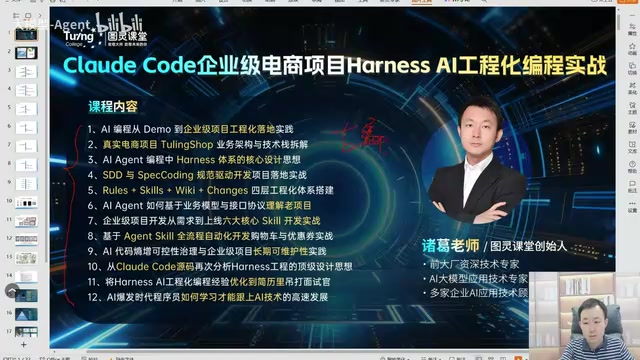
Why can't AI coding "be put to use"?
Zhuge Laoshi mentioned that many students are still doing "ancient-style programming" at their companies—pure handwriting. But at some large foreign companies, such as Anthropic and OpenAI, a great deal of code—even more than 90%—has already been handed over to large AI models. The problem is not model capability, but how it is used. Many developers try AI coding, encounter various obstacles, and eventually give up.
According to the consensus of Bilibili creator Zhuge Laoshi and some technical analysts on YouTube channels, failures in implementing AI coding often stem from a lack of engineering constraints: casual prompts, chaotic context management, and no verification step. If AI is simply treated as a code completion tool, the quality of output is naturally unstable.
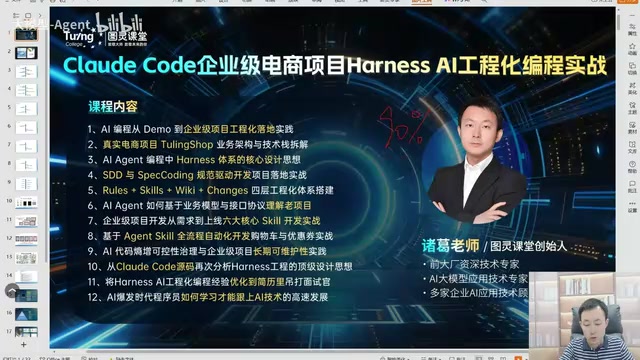
Harness engineering: making AI coding practical
Zhuge Laoshi emphasized that even if AI can complete most of the code, people still have many things to do. The core of Harness (an engineering-based programming framework) is to bring AI coding into a controllable process: clarifying requirement boundaries, designing how context is injected, and establishing verification and rollback mechanisms.
The course demonstrated using Claude Code with the VS Code development environment, with domestic large models (such as Zhipu's GLM series) selected for the backend to avoid the risk of needing to bypass internet restrictions. Zhuge Laoshi pointed out that using Claude Code with GLM can already produce good results; if a company uses Claude large models, following this Harness process for projects will only produce better results.
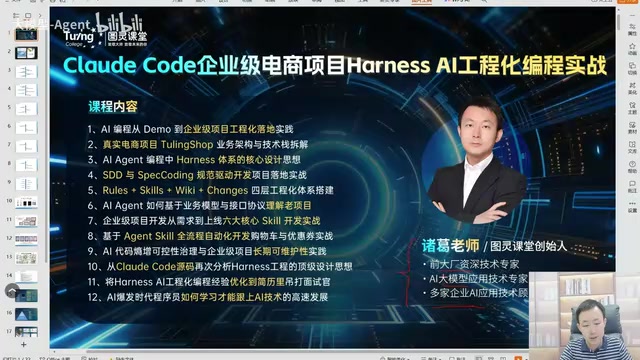
What is Claude Code: Claude Code is a command-line AI coding agent launched by Anthropic, not a simple code completion plugin. It runs in the terminal and can autonomously read project files, execute shell commands, run tests, modify code across multiple files, and iteratively adjust based on execution results. Compared with Copilot-style tools inside IDEs, Claude Code places more emphasis on "task-level" delegation: developers describe goals in natural language, and the agent plans the steps and implements them on its own. Precisely because it has permission to write files and run commands, engineering frameworks like Harness are even more necessary to constrain boundaries, control context, and verify output; otherwise, it is easy to produce changes that are hard to review.
Context injection and the context window: A large model can only "see" a limited length of text in each inference, and this upper limit is the context window. The quality of AI coding depends greatly on whether the context fed to the model is precise: indiscriminately stuffing the entire repository in both wastes the window and introduces noise; providing only fragments may miss key dependency information. So-called context injection means selectively organizing requirement descriptions, relevant files, interface contracts, coding standards, and so on into structured input. "Preparing concise context for each task" in the Harness process is essentially about maximizing signal density within the window budget, and this is also a key part of moving AI coding from casual prompting toward engineering.
Key points from the enterprise e-commerce project practice
The course used an enterprise e-commerce project as a case study to show how Harness is used in real business. The core process includes: breaking requirements down into AI-executable tasks, preparing concise context for each task, automatically running tests and static checks after code generation, and triggering rollback and retry on failure.
Zhuge Laoshi has an architect background at internet giants such as JD.com and Vipshop, and currently runs both an online education company and a large-model project company. The course content comes from his enterprise implementation practice. According to his introduction, the accompanying learning materials include a 50-plus-page Harness AI engineering-based programming document and corresponding code.
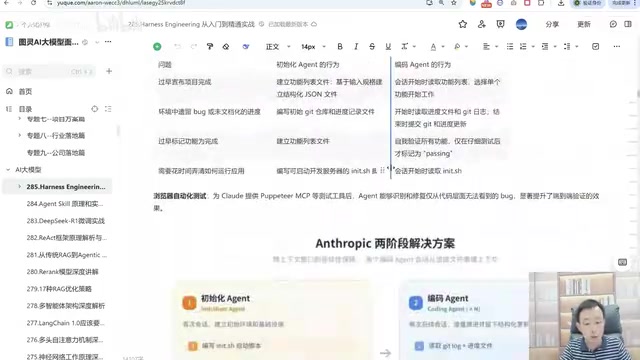
Rollback and retry mechanisms: When AI-generated code fails tests or static checks, the system needs to be able to safely undo the change and try again—this is rollback and retry. In engineering practice, this is usually implemented with Git branches or commit snapshots: record a baseline before each AI change, restore to the baseline if verification fails, and then re-prompt the model with the failure information. Static checks include type checking, linting, dependency auditing, and other steps that can find problems without running the code. Making "generate—verify—rollback" an automated closed loop can significantly reduce the risk of AI producing unmaintainable code, and it is also the core added value of Harness compared with using models bare.
Tool thinking sets candidates apart
Zhuge Laoshi mentioned that what interviewers really want to see is the ability to solve problems and improve efficiency in implementation. For the same requirement, while others slog through it with clumsy methods, you can use AI agents to implement it quickly and simplify the process—this difference is a résumé highlight and an interview bonus. Only by learning to use AI to automate tedious work will you have time to polish projects worth putting on a résumé.
This view is consistent with discussions in multiple technical communities: the competitiveness of AI coding lies not in knowing how to write prompts, but in whether AI can be embedded in engineering processes to stably produce maintainable code.
Conclusion
The engineering-based approach of Claude Code + Harness provides a reproducible path for AI coding to move from "toy" to "productivity." The key lies in process constraints rather than the model itself. Domestic large models can already support this practice, and it is worth developers trying and verifying.
Related articles

GPT-Image 2.6 Dual Release: A Double Upgrade in Speed and Precision
OpenAI releases GPT-Image 2.6 with Flare for faster generation and Sunburst for complex prompts and dense infographics. API adds markup editing, SVG, and GIF support.

Robert Caro: How to Get Insiders to Talk and Uncover the Hidden Logic of Johnson's Money Politics
Pulitzer winner Robert Caro shares how he interviewed John Connally, revealing how pressing on Johnson's funding annotations got insiders to explain political money logic.

Showing This Video to Someone in 2014: The Stunning Evolution of AI Video
From the viral Reddit post "Show this AI video to someone from 2014," we look back at a decade of AI video generation's leap from academic research to indistinguishable reality, analyzing the cognitive impact and trust challenges amid the flood of synthetic content.