Claude Code in Practice: How an IT Veteran Uses AI Programming to 10x Development Efficiency

IT veteran transforms from AI skeptic to believer, achieving 10x efficiency with Claude Code.
An overseas blogger with an IT background transformed from a deep AI skeptic into a true believer. Using AI programming tools like Claude Code and Base44, he compressed development projects that previously took weeks or even years into minutes or hours—including an S&P 500 investment analysis tool and a Bitcoin strategy backtesting platform. He argues that AI code quality issues are solvable, and the key is providing AI with detailed requirements and QA processes just as you would manage human programmers.
From Skeptic to AI Believer
Just a few months ago, this overseas blogger with an IT background was deeply skeptical about AI. His logic was simple: massive data centers are being built, billions in investment are pouring in, but all we have is a ChatGPT that fabricates data and frequently makes reasoning errors. When AI can only write poems and generate images but can't create real hard value, what's the point of all this investment?
However, two months ago, after seriously trying Claude Code, his perspective did a complete 180.
This blogger is no technical novice—he first studied business and finance, then transitioned into programming, working at a major insurance company in Hong Kong where he led a team handling backend integration development. After launching his YouTube channel five years ago, he outsourced website development to a former colleague on an hourly rate due to limited bandwidth. Now, Claude Code has completely changed that equation.
How Claude Code Works: As Simple as Talking to a Programmer
Claude Code is an AI coding agent released by Anthropic. Unlike basic code completion tools (like GitHub Copilot), a Coding Agent represents a more advanced form of AI-assisted programming—it can not only generate code snippets but also understand entire project contexts, autonomously plan task steps, invoke terminal commands, read and write to the file system, and continuously iterate across multiple interaction rounds. These tools typically rely on the large language model's "Tool Use" capability at their core, allowing the model to actively trigger external operations during reasoning rather than passively responding to single queries.
The blogger explains that you hand it your project, give it access permissions, and can even let it deploy websites directly. You talk to it like chatting with ChatGPT, but Claude Code can actually execute code modifications.
"You tell it: help me create this website with these features. Claude Code will finish it in minutes. Projects that used to take me weeks now get done in minutes."
Even more impressive, he connected Claude Code directly to his phone. When an idea strikes during daily life, he sends it directly to Claude Code via the command-line interface for execution. Want to make a change to the website? Just ask it—done in minutes. All this for just $100 per month in subscription fees.
Is AI Code Quality Really That Bad? Addressing Common Criticisms from the Programming Community
The programming world is currently split into two camps: the younger generation fully embracing AI agents, and the older generation insisting on manual coding while pointing out problems with AI output—lack of scalability, "spaghetti code," and changes in one place breaking things elsewhere.
"Spaghetti code" is a classic software engineering term describing code with chaotic structure, extremely high coupling between modules, and convoluted logic jumps—like a tangled plate of spaghetti that's difficult to read, maintain, and extend. This problem commonly exists in rapidly iterated projects that lack standards and is not unique to AI programming. Modern software engineering systematically controls code quality through unit tests, integration tests, code reviews, and CI/CD pipelines—mechanisms that apply equally to AI-generated code.
The blogger considers these criticisms a "straw man argument." Manual coding has the exact same problems, and we have countermeasures: QA teams, integration tests, unit tests. The issue is that most people treat AI projects like small hobby projects—they don't ask AI to write tests, don't have AI render in a browser to check mobile responsiveness, and don't perform any of the QA steps they would in a manual workflow.
Key Insight: If we provide AI with the same granularity of requirements we give human programmers—including acceptance criteria, user stories, and detailed ticket structures—AI performs much better. The more specific the prompt, the higher quality the output. This is no different from managing human programmers.
Case Study 1: Building an S&P 500 Investment Analysis Tool with AI
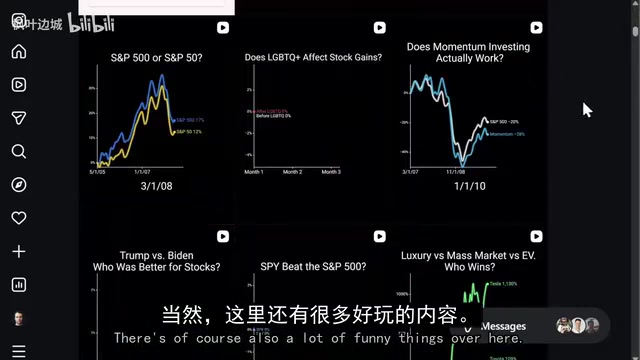
Inspired by an Instagram investing account, the blogger wanted to test a hypothesis: does buying only the top 1, 5, or 10 stocks by market cap in the S&P 500 outperform buying all 500?
This project would take at least several days of manual programming, but using Base44 (an AI programming platform requiring no installation) took only an hour or two.
Base44 represents the rise of a new generation of "AI-native" no-code development platforms. Unlike traditional no-code tools (such as Bubble or Webflow) that rely on visual drag-and-drop, these platforms use natural language conversation as their core interaction method, with AI automatically generating, deploying, and maintaining complete applications in the background. Users don't need to configure development environments, manage servers, or understand code structure. This space has seen numerous competitors emerge between 2024-2025, including Bolt.new, Lovable, v0, and others, collectively forming an emerging ecosystem of "natural language as development interface" that is lowering the barrier to software creation from "knowing how to code" to "knowing how to describe requirements."

The final product includes:
- Logarithmic/linear scale charts
- Comparison of S&P 1 through S&P 25 subsets against the full S&P 500
- Excess returns, Sharpe ratio, and volatility analysis
- Historical constituent tracking (e.g., from General Electric and ExxonMobil to today's NVIDIA, Apple, and Google)
The Sharpe Ratio, proposed by Nobel laureate William Sharpe, is a core metric for measuring risk-adjusted returns of an investment portfolio. The formula is "(Portfolio Return - Risk-Free Rate) / Portfolio Standard Deviation." A higher ratio indicates greater excess return per unit of risk taken. In quantitative investment analysis, it forms a standard evaluation framework alongside volatility and maximum drawdown (Max Drawdown), serving as an essential tool for professional investors and quantitative researchers.
His first prompt was only five or six lines: "I want an app that compares the performance of the S&P 500 against its subsets (top 1, top 5, top 10, etc.)." He then iteratively refined from there.
Case Study 2: Bitcoin Strategy Backtesting Platform via Vibe Coding
"Vibe Coding" is a concept coined by OpenAI co-founder Andrej Karpathy in early 2025, describing a development approach that is highly AI-dependent, driven by natural language, and de-emphasizes traditional programming conventions—developers rely more on intuition and immediate feedback to push projects forward rather than strictly following software engineering methodologies. The concept quickly sparked widespread discussion in the tech community, with supporters arguing it dramatically lowers creative barriers and critics raising concerns about reliability and maintainability in production environments.
This was a project the blogger "always wanted to build but never had the energy for"—a complete trading strategy backtesting platform. He previously used Excel to backtest moving average strategies, but when needing to cover multiple assets, multiple parameters, financing costs, bid-ask spreads, and slippage, Excel fell short.
After Vibe Coding with Claude Code, he built an incredibly complex application featuring:
- Moving average backtesting with parameter optimization
- Fast/slow moving average combination strategies
- Multiple technical indicator support
- Asset ratio analysis (BTC/ETH, individual stocks/indices)
- Leverage optimization and liquidation point calculation
- Seasonality analysis
- Regression analysis
The blogger admits: "If I had developed this manually, it might have taken years to reach this level; if I had hired someone, the cost could have been hundreds of thousands of dollars."
Related articles
 Product Reviews
The Programmer's Desk Setup Guide: Building a Workspace That Feels Like Home
Discover how programmers build productive, comfortable workspaces. From multi-monitor setups to ergonomic design, explore the desk philosophy that drives focus and flow.
 Product Reviews
Qoder vs Cursor Real-World Comparison: Which $20/Month AI IDE Is Better?
Hands-on comparison of Qoder vs Cursor AI IDEs: Agent autonomy, human interaction count, and architecture decisions. Qoder needed only 2 interactions vs Cursor's 8.
 Product Reviews
Cursor Cloud Agent Demo: Eliminating Bottlenecks Across the Entire Software Development Lifecycle
Deep analysis of Cursor's Cloud Agent demo showing how cloud VMs, automated test artifacts, and a full-chain control plane systematically eliminate human bottlenecks across the software development lifecycle.