Claude Code in Practice: Turning AI into an Autonomous Engineer That Runs While You're AFK

Transform Claude Code into an AFK-capable autonomous engineer by applying real software engineering fundamentals.
This article explores how developers can leverage Claude Code not just as a coding assistant but as a truly autonomous AI agent capable of working independently for hours. The key insight is that engineering fundamentals—requirements gathering, architecture design, feedback loops, and quality assurance—matter more than prompt tricks. By structuring your codebase for AI readability and building proper automated validation, you enable a paradigm shift from AI code completion to AI autonomous task execution.
AI programming tools are evolving at an astonishing pace, but many developers remain stuck in a frustrating loop: sitting in front of their screens watching AI write code line by line, feeling like it's actually less efficient. The core issue often isn't the AI itself, but whether we possess the real engineering skills to harness it effectively. Based on the core philosophy of a Claude Code practical course, this article explores how to upgrade AI from an "assistive tool" to a "trusted autonomous engineer."
This Isn't Just a Claude Code Course — It's an AI Programming Engineering Course
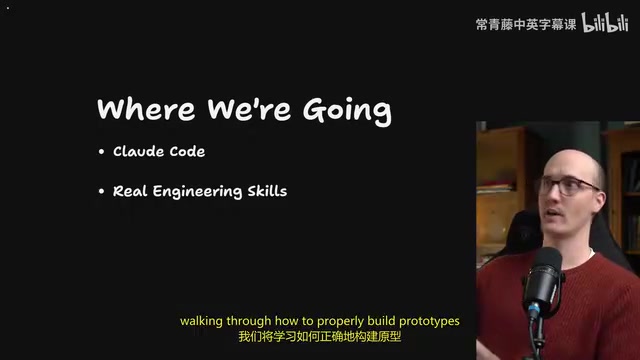
The course author opens with a counterintuitive premise: although it's called a "Claude Code course," it's fundamentally an AI programming engineering course. Mastering Claude Code's features is merely the most superficial, obvious takeaway. The real value lies in developing real engineering skills that transfer to any tool and any language.
"Engineering skills" here doesn't refer to proficiency in a particular programming language, but rather the systematic methodologies accumulated over decades in software engineering — including requirements analysis, architecture design, quality assurance, continuous integration, and more. These methodologies began taking shape during the software crisis of the 1960s, evolving through waterfall models, agile development, DevOps, and other paradigms. The emergence of AI tools hasn't rendered these principles obsolete; rather, it has made their importance more pronounced: when code generation speed is no longer the bottleneck, the ability to correctly define problems, design sound architectures, and establish effective validation mechanisms becomes the decisive factor.
The author argues that while tools have changed in the AI era, the fundamental engineering methodology hasn't. For developers who already have solid engineering foundations, this course functions more as a "conversion course" — helping you adapt existing engineering skills to new tools. For those who haven't yet built that engineering foundation, it's also an excellent opportunity to systematically learn the full engineering lifecycle.
Covering the Complete Software Engineering Loop
The course content isn't limited to "how to give AI instructions" — it covers the entire software engineering chain:
- Planning: Clarifying project direction and milestone objectives
- Requirements Gathering: Transforming vague ideas into executable specifications
- Prototyping: Rapidly validating feasibility
- Codebase Structure Design: Maximizing the effectiveness of feedback loops
Feedback loops are a core concept in control theory and systems engineering. In software development, they manifest as the iterative process of: write code → test/validate → discover issues → fix → re-validate. Common feedback mechanisms include unit tests, integration tests, type checking, linting rules, CI/CD pipelines, and more. The tighter the feedback loop (i.e., the shorter the time from writing code to receiving feedback), the higher the development efficiency. For autonomous AI programming, these automated feedback mechanisms are essentially giving AI "eyes" — it can instantly know whether the code it wrote is correct, enabling self-correction without requiring human line-by-line review.
All these elements ultimately bind deeply with AI capabilities, forming a systematic AI collaboration methodology.
The Ultimate Goal: An AI Agent That Runs While You're AFK
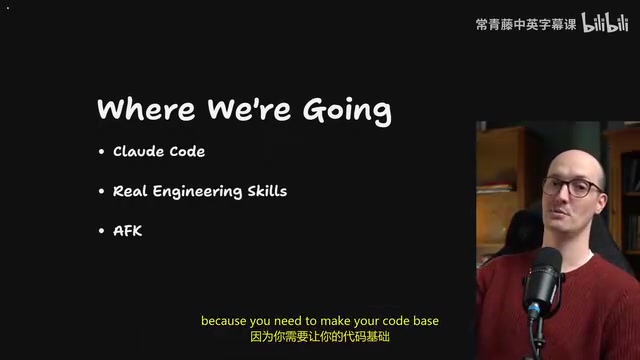
The course's ultimate vision is building an AI Agent that can "run AFK." AFK means "Away From Keyboard" — when you step away to do other things, the AI continues working autonomously and continuously for hours.
This concept aligns closely with current AI Agent architecture trends: evolving from simple single-turn conversational code completion (like GitHub Copilot's early form) to autonomous agents that can understand context, formulate plans, execute multi-step operations, and self-verify. Achieving this goal requires solving several key challenges: accuracy of task decomposition, effective utilization of long context windows, error recovery mechanisms, and preventing AI "drift" (deviation from the original objective) in the absence of constraints.
The author pinpoints the pain point most people experience: many feel they "have to watch AI the entire time" when using it for programming, creating an illusion of low efficiency. The root problem isn't that AI is insufficiently capable — it's that you haven't configured your codebase and runtime environment to be suitable for AI autonomous operation.
Quality Assurance Is the Biggest Challenge for AFK Operation
The truly difficult part is: how do you guarantee the quality of output at the end of each AFK session? This is precisely where "real engineering skills" come into play. The author emphasizes a key insight:
You need to make your codebase an environment that AI "likes" working in and can produce high-quality code within. And this is more about the code itself than about the AI.
Research shows that the quality of AI-generated code is highly correlated with the quality of input context. A codebase with chaotic structure, inconsistent naming, and lacking type annotations will lead AI to generate equally low-quality code — because large language models fundamentally learn from and continue existing patterns. Conversely, a codebase with clear module separation, consistent coding style, a comprehensive type system, and high test coverage provides AI with a powerful "demonstration effect." Additionally, documentation practices like README files, Architecture Decision Records (ADRs), and inline comments significantly help AI understand project intent, producing code that better matches expectations.
In other words, whether AI can work autonomously at high quality largely depends on the codebase's readability, structural clarity, test coverage, and the completeness of feedback mechanisms. This also explains why simply stacking prompt engineering tricks can't produce transformative results — engineering fundamentals are the foundation.
Mastering AI Programming Methodology Through Playground Practice
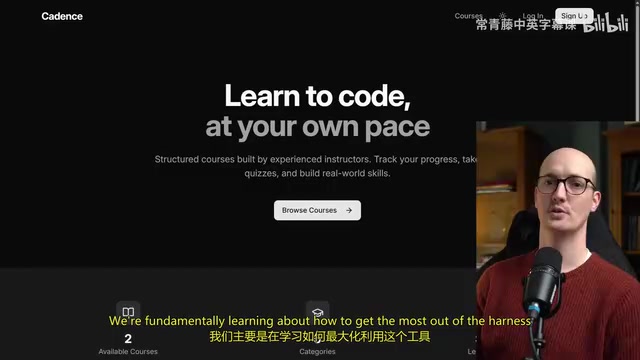
The course uses an approximately 20,000-line application built with TypeScript, React, and Node as a "Playground." Students can complete exercises in this environment or apply the same methods to their own codebases.
A notable detail: the author specifically states that you don't need to be proficient in TypeScript, Node, or React. The core of the course is learning how to maximize the use of the "harness" (the runtime framework/vehicle for AI programming), and these learnings apply to any language and any project. After all, in this workflow, the vast majority of code is written by AI.
The concept of "harness" deserves elaboration. In software testing, a test harness refers to a framework that provides the runtime environment and infrastructure for automated testing. By analogy in AI programming, harness refers to the entire infrastructure that enables AI to run effectively — including the project's build system, testing framework, type checker, code formatting tools, Git workflow, and more. A well-configured harness allows AI to receive immediate feedback after each code modification (whether compilation passes, whether tests pass, whether types are correct), enabling autonomous iterative improvement.
The Human Engineer's Role: From Writing Code to Knowing When to Intervene
This course conveys a thought-provoking repositioning: in the era of autonomous AI programming, the human engineer's value is no longer "typing code" but knowing when to intervene.
The author mentions that after completing the course, you'll be able to:
- "Parallelize" yourself, collaborating with Claude to dramatically increase speed
- Know precisely when human intervention is needed — such as during prototyping and research phases
- Build Plans, PRDs (Product Requirements Documents), and multi-stage Kanban boards that allow AI to work independently for hours
PRDs have traditionally been communication vehicles between product managers and development teams, while Kanban is a management tool from lean manufacturing used to visualize workflow. In the AI collaboration context, these tools gain new significance: PRDs are no longer just documents for humans to read — they become "context anchors" for AI to understand the full scope of a task; each Kanban card becomes an atomized task unit that AI can independently pick up and execute. Decomposing large goals into multiple clear, independent, and verifiable small tasks is the key prerequisite for enabling AI to "work unsupervised for hours" — each task has clear completion criteria, and AI can independently judge whether it has met them.
The Paradigm Shift from AI Code Completion to AI Autonomous Task Completion
This philosophy reflects the paradigm shift currently underway in AI programming: from "AI completing code" to "AI completing tasks autonomously." The former only requires good prompts; the latter requires comprehensive engineering support — clear requirements documentation, verifiable milestone objectives, sound code structure, and automated feedback mechanisms.
This paradigm shift can be compared to the leap from a "calculator" to "autonomous driving." Code completion mode (like Tab completion, inline suggestions) is similar to a calculator — humans handle thinking and decisions, while the tool merely accelerates execution. Autonomous task completion mode is analogous to L4 autonomous driving — AI handles path planning, operation execution, and exception handling, while humans only supervise at critical checkpoints. This transformation fundamentally restructures the skill requirements for developers: typing speed for writing code becomes irrelevant, replaced by system design ability, requirements definition ability, quality standard-setting ability, and the ability to audit and judge AI output.
For developers who want to genuinely improve their AI programming productivity, this perspective offers a clear path: rather than chasing flashier prompting tricks, return to engineering fundamentals and build your codebase into an autonomous workspace that AI can rely on — and one you can trust.
Key Takeaways
Related articles

Chain of Thought Isn't Just for AI: How Humans Can Use CoT to Improve Thinking Quality
Chain of Thought isn't just a prompt trick for large models. Starting from a Hacker News discussion, this article analyzes why CoT works for human thinking too, breaks down actionable ways to transfer it, and highlights the key differences between human CoT and machine CoT.
Cloudflare Teams Up with OpenAI: Closi…
Cloudflare Teams Up with OpenAI: Closing the Loop from Vulnerability Discovery to Defense with AI
Cloudflare uses OpenAI Daybreak to investigate security vulnerabilities and generate reviewable remediation plans, while developers use Codex to boost coding efficiency and quality.

Orca Multi-Agent Orchestration in Practice: A Guide to Parallel Collaboration with Claude and Codex
Orca is Stable AI's free open-source agent workbench supporting 34 agents like Claude Code and Codex in parallel. Learn its Git worktree isolation, multi-model orchestration, and mobile management.