Claude Code Is Making App Development Accessible to Everyone: A New Bar for Personal Software

A coding amateur built a personal Whisper app with Claude Code, revealing how AI has crossed a new threshold for non-developers.
A Reddit user with only basic coding knowledge shared how they used Claude Code to build a personal Whisper transcription app. What impressed them most wasn't code generation, but Claude Code's ability to run tests autonomously, analyze results, self-correct, and sandbox changes before deployment. The article identifies three broader signals: the revival of personal software, understanding code mattering more than writing it, and professional developers' value shifting toward architecture and complex judgment. While the experience is subjective and the task relatively simple, it marks a perceptible threshold in AI coding tools empowering non-professionals to solve real problems.
When a Coding Amateur Meets Claude Code
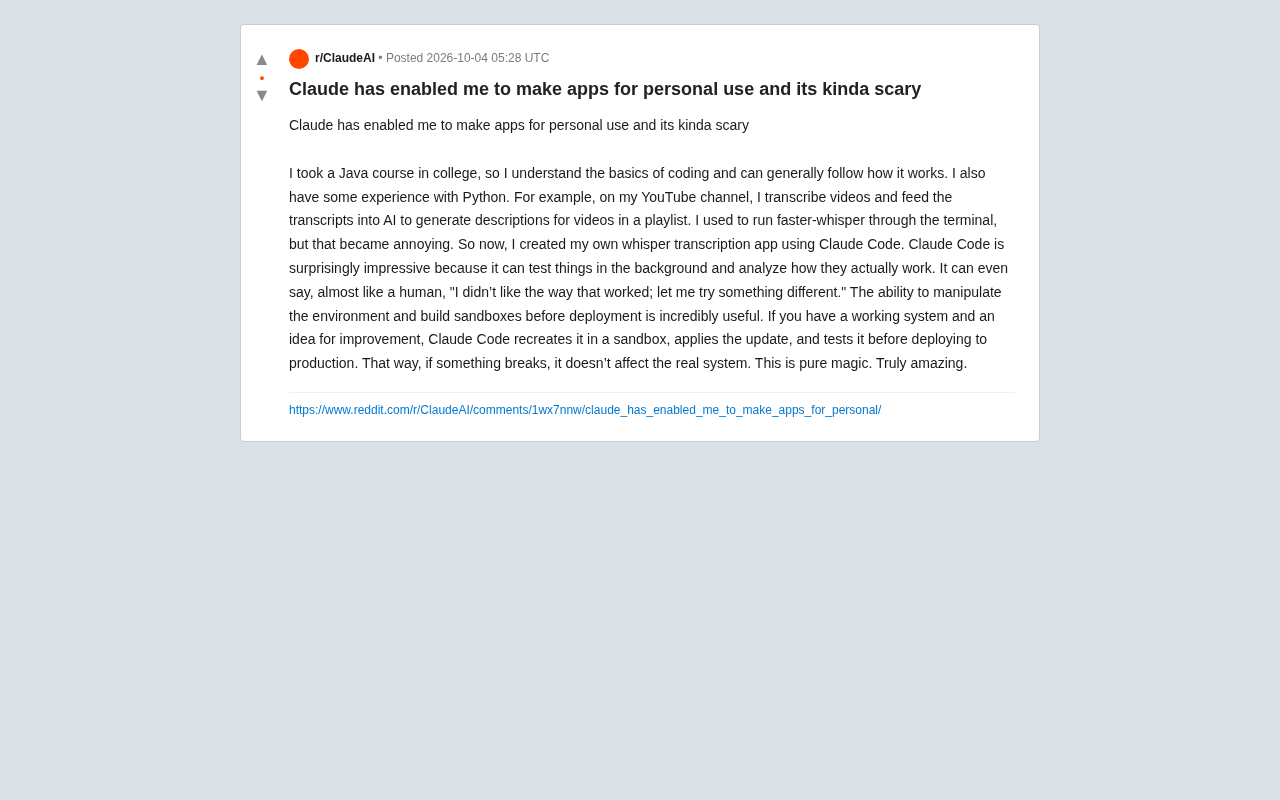
A Reddit user recently shared their firsthand experience with Claude Code under a dramatically titled post: "Claude lets me make apps for myself and it's a little scary." This isn't a professional engineer showing off — it's an account from an ordinary person who took one Java course in college and knows some basic Python. Their description is candid and relatable: AI coding tools are pushing the barrier to software development lower than ever before.
This user runs a YouTube channel and regularly needs to transcribe videos into text, then feed those transcripts to an AI to generate playlist descriptions. Previously, they ran faster-whisper through the terminal — a clunky workflow. Now, they simply used Claude Code to build their own Whisper transcription app, solving the problem entirely.
faster-whisper is a high-performance inference implementation of OpenAI's Whisper speech recognition model, optimized with the CTranslate2 engine to run over 4x faster than the original with lower memory usage. Whisper itself is a multilingual speech-to-text model that OpenAI open-sourced in 2022, supporting nearly 100 languages with industry-leading accuracy. However, using it natively requires command-line interaction — model downloads, environment setup, parameter configuration — making it a steep climb for non-technical users. That's precisely why wrapping it in a graphical interface or simplified workflow becomes a genuinely valuable personal tool.
What's Actually Surprising About Claude Code
In this user's account, what impressed them most wasn't simply "it can write code" — that's been a baseline capability of large language models for a while. What actually felt "a little scary" was Claude Code's engineering behavior: it tests code in the background, analyzes the results, and even says things like "I don't like how that turned out, let me try a different approach."
This leap from "generating code" to "verifying code" is the fundamental difference between an Agent-based tool and a traditional code completion assistant. It doesn't just output plausible-looking text — it runs the result in a real environment and self-corrects based on feedback. For ordinary users who lack deep debugging skills, this step is critical, because they often can't tell whether the AI's code is actually correct.
Sandbox Mechanism: Making Experimentation Risk-Free
One capability the user specifically praised was how Claude Code handles sandboxing and deployment. As they described it, when you already have a working system and want to make improvements, Claude Code will:
- Recreate the existing system in a sandbox
- Apply the new updates
- Complete testing before deploying to production
This means even if a change breaks something, it won't affect the system you're actually using. They called this workflow "pure magic." From a software engineering perspective, what's happening is that professional practices like isolated environments, testing, and staged deployment are being automatically packaged into a conversational tool. Infrastructure that developers used to build by hand has become the AI's default behavior.
Claude Code is Anthropic's command-line AI coding assistant for developers, officially released in 2025. Unlike tools such as GitHub Copilot that center on code completion, Claude Code operates in an agentic mode: it can proactively read and write files, execute terminal commands, call external tools, and adjust its next actions based on execution results — forming a closed loop of "plan → execute → observe → correct." This design makes it closer to a collaborator capable of independently completing subtasks, rather than a pure text prediction tool. It's precisely this ability to directly operate in real environments that allows it to handle engineering steps like testing and debugging that traditionally required manual developer intervention.
In software engineering, a sandbox refers to a controlled execution environment isolated from the production system — its core value being that "changes don't affect real users." Professional development teams typically maintain four separate environments: development, testing, staging, and production, with any code change needing to pass through each stage before going live. Canary deployment is an even more granular strategy, pushing a new version to a small subset of users first and only doing a full rollout after confirming stability. These practices traditionally require significant effort to build and maintain. Claude Code presents this workflow in a conversation-driven way, giving users with no operations experience a natural "test before deploy" safety boundary by default — and that's the engineering reality behind what the user called "magic."
The Real Signal Behind "A Little Scary"
The word "scary" in the title is worth sitting with. It's both an exclamation and a subtle unease. When someone with only basic coding knowledge can build a working tool that meets their own needs in a short time, it sends a few signals:
Personal software is making a comeback. In the past, building an app to solve a small, personal pain point — one that only you would ever use — cost more than it was worth. Now the marginal cost has been pushed to near zero, and "building tools for yourself" has become a viable option. Software that isn't meant to be commercialized and only serves one person's workflow may be the first scenario where AI-assisted coding achieves mass adoption.
Understanding code matters more than writing it. This user emphasized that they can "roughly understand how the code works." That's precisely the key — the AI handles generation and testing, while the human handles direction, requirement description, and catching obvious errors. Being able to read code without having to write it is becoming a new kind of capability profile.
The moat for professional developers is being redrawn. When engineering practices like sandbox testing and self-correction are handled automatically by tools, developer value increasingly shifts toward architecture design, complex system trade-offs, and the judgment calls AI still struggles to make.
A Measured Take: This Is One Person's Story
It's worth noting that this is a single user's subjective experience in their own context — not a systematic evaluation. The transcription app they built is a relatively standard, well-scoped task, so strong AI performance here isn't surprising. Once you introduce large codebases, complex dependencies, ambiguous requirements, or high reliability demands, the situation becomes far more complicated, and self-correction can easily go off the rails.
But even with that caveat, the value of this story holds up: it demonstrates that AI coding tools have crossed a perceptible threshold in their ability to empower non-professionals to solve real problems. The "scary" feeling isn't about technological threat — it's an instinctive reaction to realizing that the boundaries of capability have been redrawn. For a growing number of ordinary users, "I could just build an app for that" is shifting from a joke into a genuine option.
Related articles

Chain of Thought Isn't Just for AI: How Humans Can Use CoT to Improve Thinking Quality
Chain of Thought isn't just a prompt trick for large models. Starting from a Hacker News discussion, this article analyzes why CoT works for human thinking too, breaks down actionable ways to transfer it, and highlights the key differences between human CoT and machine CoT.
Cloudflare Teams Up with OpenAI: Closi…
Cloudflare Teams Up with OpenAI: Closing the Loop from Vulnerability Discovery to Defense with AI
Cloudflare uses OpenAI Daybreak to investigate security vulnerabilities and generate reviewable remediation plans, while developers use Codex to boost coding efficiency and quality.

Orca Multi-Agent Orchestration in Practice: A Guide to Parallel Collaboration with Claude and Codex
Orca is Stable AI's free open-source agent workbench supporting 34 agents like Claude Code and Codex in parallel. Learn its Git worktree isolation, multi-model orchestration, and mobile management.