Claude Code Misclassification Appeals Guide: Three Feedback Channels for Optimizing AI Classifiers

A practical guide to appealing Claude Code misclassifications via three built-in feedback channels.
When Claude Code incorrectly blocks a legitimate request, users can appeal through three feedback channels: the /feedback CLI command, web interface thumbs up/down buttons, and Cowork collaboration feedback. This article explains the technical causes of false positives in AI safety classifiers and how human feedback drives closed-loop model optimization over time.
When AI Misclassifies Your Legitimate Request
Have you ever encountered this situation while using an AI coding assistant: a completely legitimate code request gets rejected by the system as a policy violation? This kind of "collateral damage" has a technical name in the industry — False Positive (FP) — and it's a limitation that content safety classifiers can never fully eliminate.
False positives are a foundational concept in statistics and machine learning, referring to cases where a model incorrectly predicts a negative-class sample (normal content) as positive (violating content). To understand this concept, you need to be familiar with the complete classifier evaluation framework: in a binary classification problem, all model predictions fall into four quadrants — True Positive (TP) refers to correctly identified harmful content, True Negative (TN) refers to normal content correctly allowed through, False Positive (FP) refers to normal content incorrectly blocked, and False Negative (FN) is harmful content that slips through undetected. The False Positive Rate (FPR = FP / (FP + TN)) is one of the core metrics for evaluating classifier quality. It's paired with False Negatives — i.e., failing to catch genuinely harmful content. These two exist in inherent tension: reducing false positives tends to increase false negatives, and vice versa.
This trade-off is formally described in Signal Detection Theory (SDT) through the ROC curve (Receiver Operating Characteristic curve). SDT originally emerged from studies of radar operators during World War II — researchers found that operators' accuracy in detecting enemy signals amid noise was systematically influenced by psychological expectations and alertness levels, not just raw perceptual ability. After being mathematized in the 1950s and 60s by Peterson, Birdsall, and others, it was widely adopted in medical diagnostics (such as sensitivity and specificity analysis in cancer screening), psychology, and machine learning. The ROC curve plots the relationship between the True Positive Rate (TPR) and False Positive Rate (FPR) across different decision thresholds, providing an intuitive view of overall classifier performance — the closer the Area Under the Curve (AUC-ROC) is to 1, the better the classifier. It's worth noting that when AI safety teams select operating points, they must also factor in a business cost matrix — the user trust lost from blocking one legitimate code request is not equivalent to the potential risk of letting one genuinely harmful piece of content through. This makes operating point selection fundamentally a business decision, not a purely technical one.
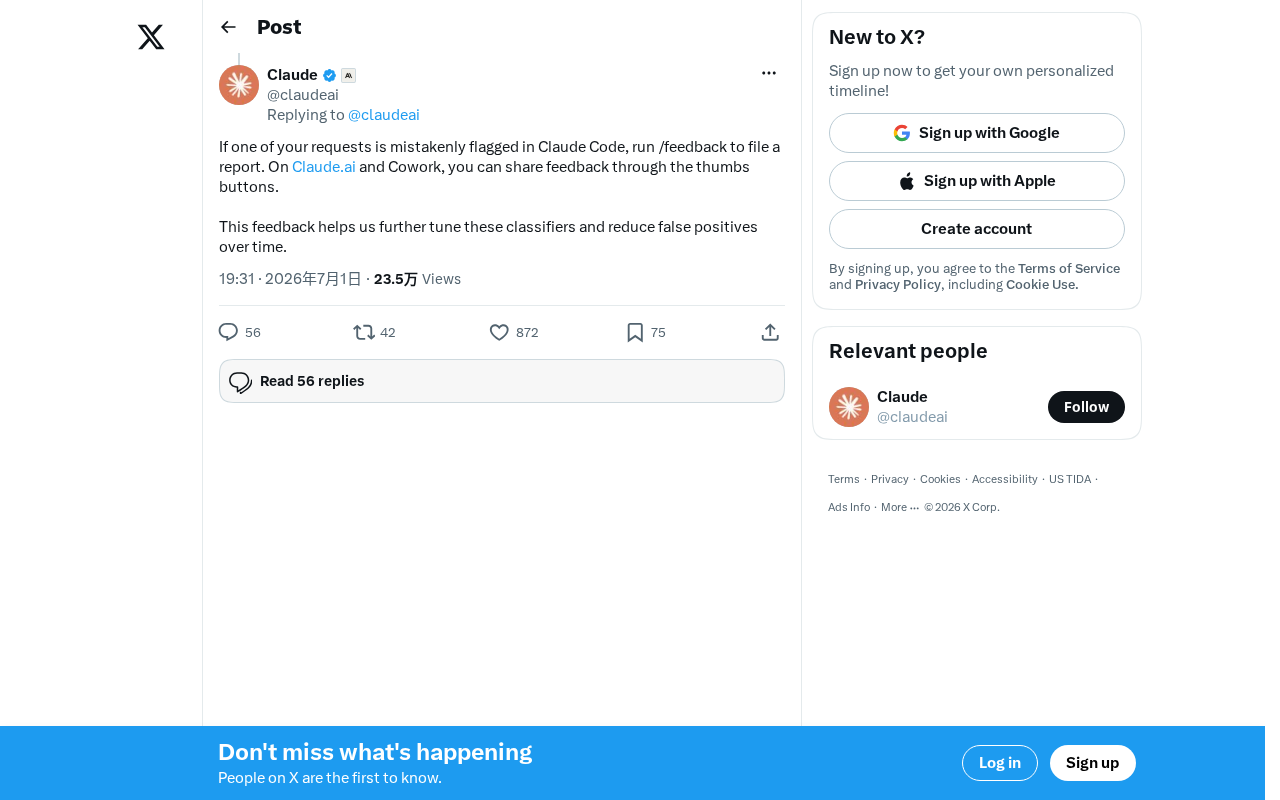
Anthropic has recently provided a clear resolution path for misclassification issues in Claude Code: when a request is incorrectly flagged, users can submit appeal reports through built-in feedback mechanisms, helping the team continuously calibrate the underlying safety classifiers.
Three Feedback Channels Explained
According to Anthropic's official documentation, users can submit misclassification feedback through the following methods:
The /feedback Command: The Most Direct Appeal Channel for Developers
In the Claude Code command-line environment, when a request is incorrectly flagged, simply run the /feedback command to submit a problem report. The key advantage of this design: the feedback process is seamlessly embedded in the development environment, with no need to switch to a browser or fill out tedious forms, dramatically lowering the barrier to submission.
From a product design perspective, embedding the feedback entry point within the command-line workflow (rather than redirecting to an external link) reflects the "minimum friction principle" — a principle rooted in behavioral economics and product design, systematically articulated by Nobel laureate Richard Thaler and Cass Sunstein in their 2008 book Nudge. The core insight of nudge theory is that human decision-making is profoundly shaped by "choice architecture" — by changing how options are presented rather than through coercion, you can significantly change people's behavior. In the context of digital products, this means reducing the operational cost of the "default path" is more effective than any incentive. Research shows that every additional step required to complete an action reduces conversion rates by roughly 20% on average. Product research at Google, Meta, and other tech companies confirms that the visibility and accessibility of feedback mechanisms are better predictors of actual feedback submission rates than users' subjective intentions. This is precisely why Claude Code chose to integrate the /feedback command directly into the CLI toolchain rather than relying on a separate issue reporting system — reducing the cognitive and operational cost of submitting feedback is a critical engineering decision for improving both the quality and quantity of feedback data.
Web Interface Thumbs Up/Down: Lightweight Signal Collection
Users on the Claude web interface can express their satisfaction through intuitive thumbs buttons — a thumbs up (👍) indicates a response met expectations, while a thumbs down (👎) flags a problematic response. This lightweight interaction design enables the continuous collection of large volumes of genuine user signals without interrupting the usage flow.
Feedback Support in Cowork Collaborative Scenarios
In Cowork multi-user collaboration scenarios, thumbs up/down feedback is also supported. Misclassifications in team collaboration environments tend to have broader impact, and this channel allows collective usage experiences to feed back into model optimization.
The Technical Logic Behind Feedback
Why Do Classifiers Produce False Positives?
When an AI system processes user input, it runs multiple safety classifiers in parallel to identify potentially harmful content, malicious code, or policy-violating requests. Modern safety classifiers typically employ a multi-level cascade architecture, drawing on the Defense in Depth philosophy from cybersecurity:
- Layer 1 consists of rule-based rapid filtering (e.g., keyword matching, regular expressions), with latency typically in the millisecond range — low false positive rate but limited recall;
- Layer 2 consists of lightweight machine learning models (e.g., distilled models like BERT-tiny, DistilBERT), capable of semantic preliminary judgment within tens of milliseconds;
- Layer 3 involves deep semantic understanding based on large language models — the highest precision but also the greatest inference cost, typically activated only for high-risk borderline cases.
This layered design balances response speed with judgment accuracy, and also explains why requests of different complexity may trigger different levels of review, causing varying response latency. It's worth noting that Knowledge Distillation technology plays a key role here: by compressing the "soft label" knowledge of large teacher models into small student models, developers can deploy lightweight classifiers at Layer 2 that balance both speed and semantic understanding — a technique formally proposed by Hinton et al. in 2015 that has since become a standard approach for industrial-scale AI deployment.
In coding assistant scenarios, classifiers must also handle the dual semantics of code — the same network scanning code can be a legitimate tool in a security research context, or a malicious payload in an attack context, making intent recognition particularly challenging. These classifiers are fundamentally probabilistic models that must find a balance between "over-blocking" and "miss risk."
When classifier thresholds are set too strictly, false positives emerge — legitimate programming requests (such as security testing code, system calls, network request operations) get misclassified as dangerous behavior. Conversely, thresholds set too loosely may let genuinely harmful content through. This is a classic trade-off challenge in the AI content moderation field, and the industry refers to overly conservative safety policies as a "Safety Tax" — sacrificing productivity for a safety margin.
Closed-Loop Optimization Driven by Human Feedback
Anthropic has explicitly stated that user-submitted feedback will "help further tune classifiers to reduce false positives over time." Behind this is a typical Human Feedback Loop mechanism:
- Users discover misclassifications in real-world scenarios
- Feedback signals are submitted through standardized channels
- The team aggregates real-world scenario data
- Classifiers are retrained and recalibrated
- System judgment accuracy continuously improves
This approach shares the same lineage as RLHF (Reinforcement Learning from Human Feedback), widely used in training large language models. RLHF was systematically described by OpenAI in the 2022 InstructGPT paper, with its complete workflow divided into three phases: first, Supervised Fine-Tuning (SFT), where the model learns from human demonstration samples; second, training a Reward Model (RM) that learns human preferences through pairwise comparison data — which is precisely the form of data collected by thumbs up/down buttons, where each user vote essentially tells the reward model "this type of response better matches human expectations than that one"; and finally, using the Proximal Policy Optimization (PPO) algorithm, iteratively optimizing the language model policy using the reward model's scores as a signal — PPO is a type of policy gradient method, and its "proximal" constraint ensures that each model update doesn't deviate too far, maintaining training stability. It's worth mentioning that Anthropic has further developed the Constitutional AI (CAI) framework on top of RLHF, introducing an AI self-critique mechanism: after generating a response, the model evaluates and revises its own output according to a set of preset "constitutional principles," reducing dependence on large-scale human annotation while making safety alignment goals more transparent and interpretable. Every thumbs up or thumbs down a user submits is essentially injecting real-world preference signals into this training pipeline.
Compared to laboratory annotation data, feedback generated by real users in actual working scenarios has higher distributional diversity, covering edge cases that annotators would struggle to anticipate — data from real usage scenarios is often the most irreplaceable resource for optimizing AI systems.
What This Means for Developers
For engineers who rely on Claude Code for daily development, this feedback mechanism conveys three key signals:
Misclassifications can be corrected. When encountering an unreasonable block, there's no need to silently accept it or abandon the tool — actively submitting feedback both addresses the immediate problem and drives product iteration.
Every piece of feedback has real value. The official commitment to use data for classifier tuning means that every thumbs down or /feedback appeal could influence the judgment logic of future versions. The "minimum necessary intervention principle" proposed in academia holds that AI safety measures should only intervene when necessary — and user feedback is the key signal that helps systems find this boundary.
Opening feedback channels is a hallmark of responsible AI deployment. Maintaining safety without compromising the experience of legitimate users is the core challenge facing all AI products today. Building a transparent feedback loop is a pragmatic choice for balancing safety with usability.
Summary
As AI coding assistants become deeply integrated into developer workflows, the accuracy of safety classifiers will continue to be a focal concern. Overly aggressive blocking directly undermines productivity, while overly permissive thresholds introduce potential risks. The user feedback loop that Anthropic has built through the /feedback command and thumbs up/down mechanism provides a practical path to resolving this dilemma.
For developers, making good use of these appeal tools is more than just improving your personal experience — it's a substantive contribution to shaping smarter, more reliable AI systems. Every edge case feedback helps classifiers find a more ideal operating point on the ROC curve, and pushes the entire AI safety field forward in its transition from "rule-driven" to "data-driven" precision calibration.
Related articles

Alibaba Launches Happy Shrimp: AI-Powered One-Click Complete Song Generation
Alibaba launches Happy Shrimp, an AI music generation tool that creates complete songs with lyrics, melody, arrangement, and vocals from natural language descriptions. In-depth analysis of its core features, differentiation from competitors like Suno, and industry impact.
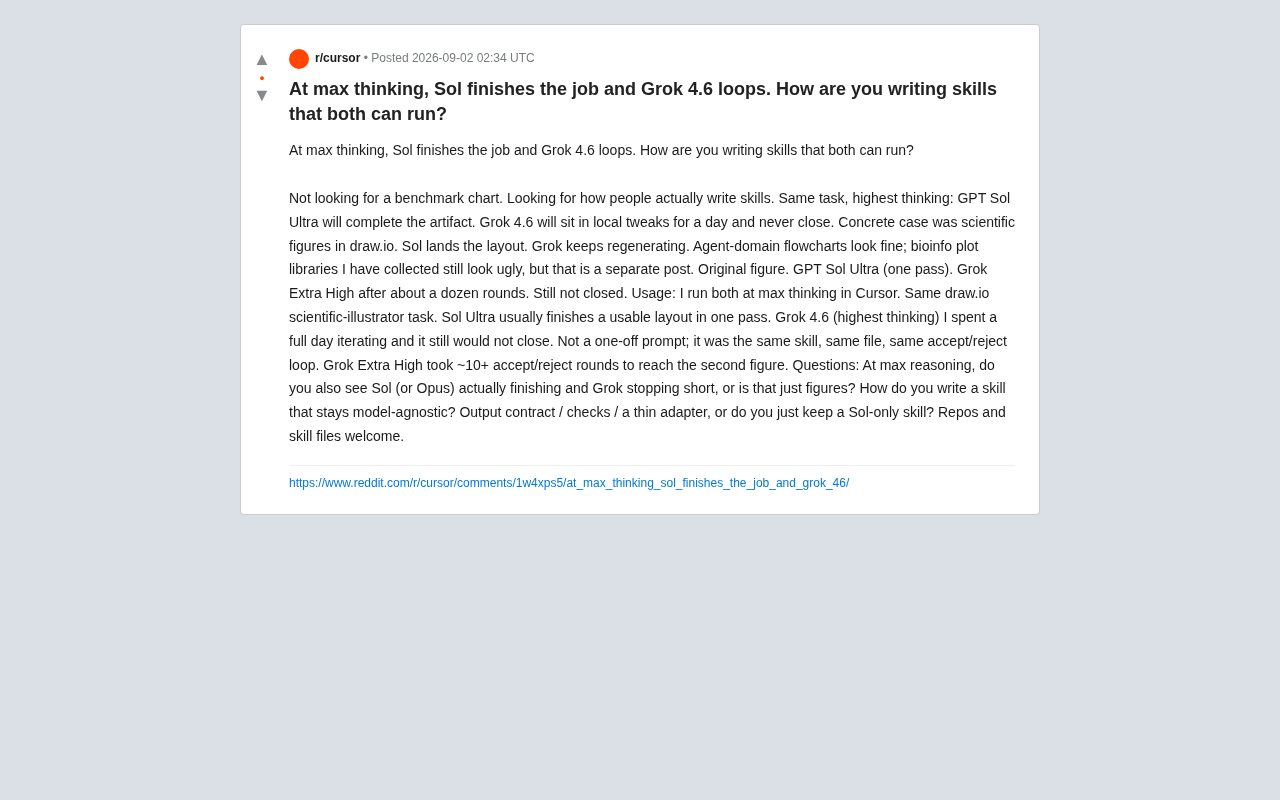
GPT Sol Ultra vs Grok 4.6: Real-World Task Completion Benchmark in Reasoning Mode
Developer benchmark reveals GPT Sol Ultra completes draw.io scientific diagrams in one iteration while Grok 4.6 fails to converge despite maximum reasoning mode, exposing that reasoning depth ≠ task delivery capability.
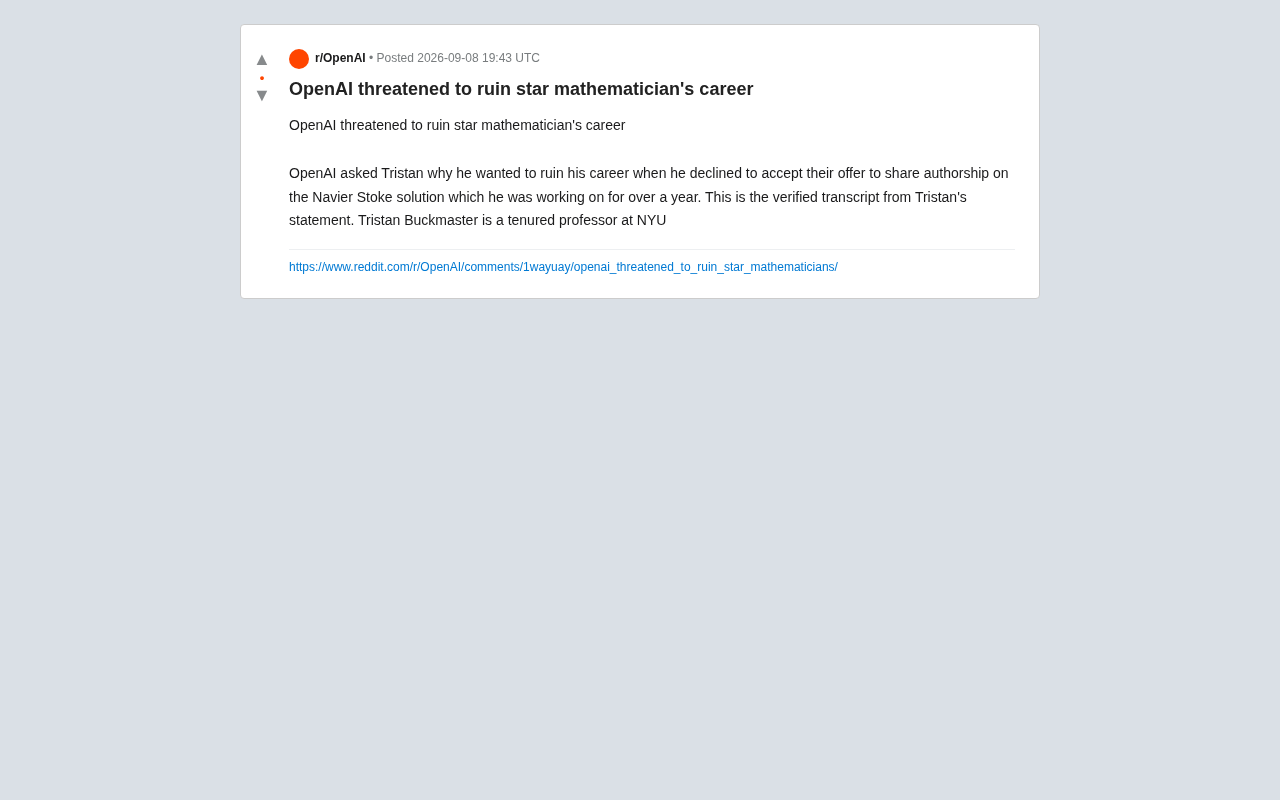
OpenAI Authorship Dispute: The Battle Over Academic Boundaries in the AI Era
OpenAI disputes authorship with mathematician Tristan Buckmaster over Navier-Stokes research, raising ethical questions about AI involvement in science.