Claude Code Now Supports AGENTS.md: Coding Agents Move Toward a Unified Standard
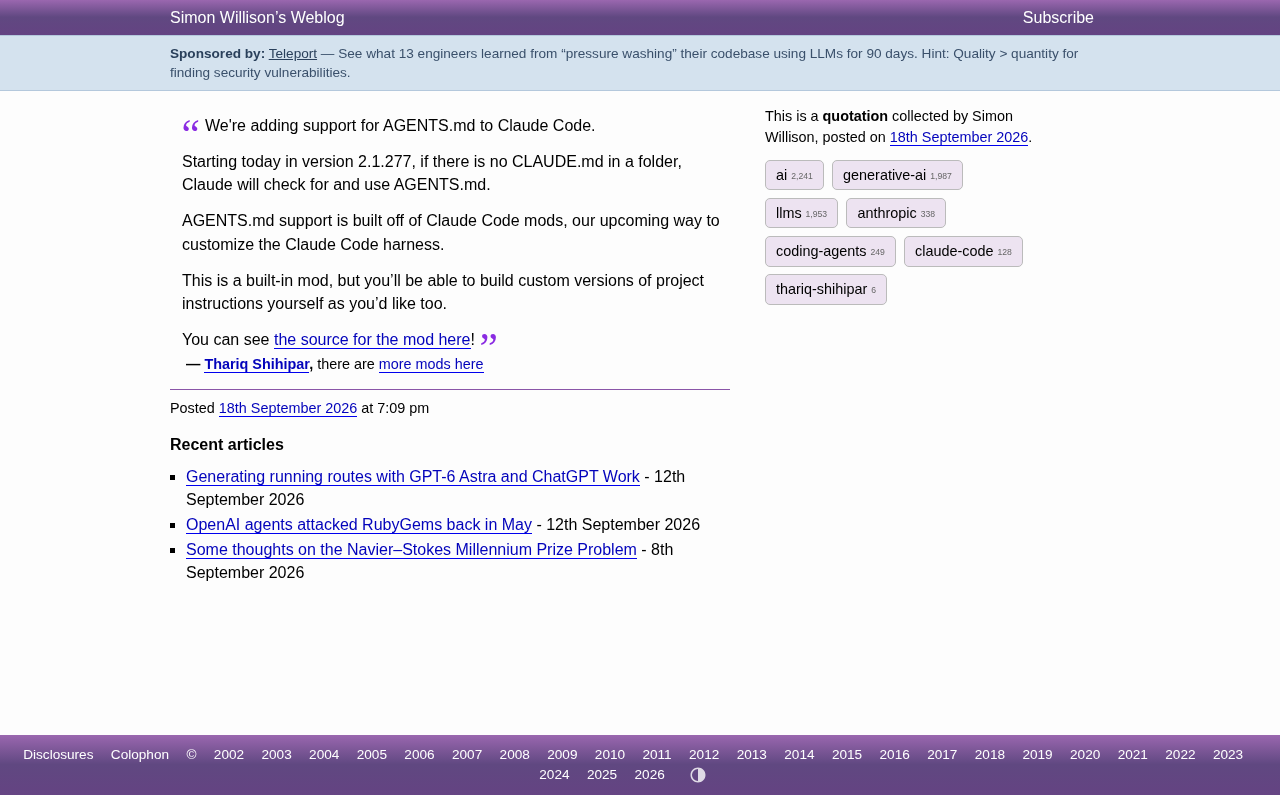
Claude Code 2.1.277+ supports AGENTS.md and introduces a modular mods extension system.
Anthropic has announced that Claude Code officially supports `AGENTS.md` starting from version 2.1.277 — a universal context file format being gradually adopted by multiple AI coding tools. When a project lacks a `CLAUDE.md`, Claude automatically falls back to `AGENTS.md` for backward compatibility. More notably, this feature is built on the upcoming **mods** customization mechanism rather than being hardcoded, making `AGENTS.md` support the first publicly open-sourced built-in mod and a live showcase of Claude Code's extensible platform ambitions.
Claude Code Embraces the AGENTS.md Universal Standard
Anthropic team member Thariq Shihipar has announced that Claude Code officially supports the AGENTS.md file starting from version 2.1.277. This means that when a CLAUDE.md file is not present in a folder, Claude will automatically look for and use AGENTS.md as the source of project instructions.
For developers who regularly switch between multiple coding agents, this is a noteworthy signal. AGENTS.md is not an Anthropic-exclusive format — it's an open convention being gradually adopted by multiple tools, using a unified Markdown file to communicate project context, coding standards, build instructions, and other contextual information to AI coding assistants. By proactively supporting this format, Claude Code is effectively reducing the migration costs caused by ecosystem fragmentation.
Why "Project Instruction Files" Are Becoming Increasingly Important
Today's coding agents are growing more capable, but their performance is highly dependent on understanding project context. A codebase with no documentation often leads agents to make changes that don't align with team conventions, while a clear project instruction file can significantly improve the usability of generated output.
Previously, Claude Code used its own proprietary CLAUDE.md, while other tools each had their own file naming conventions. Developers using multiple AI coding tools were forced to maintain several near-identical instruction documents. AGENTS.md was created precisely to solve this "one project, multiple instruction files" problem.
Claude Code's compatibility strategy is also pragmatic: it reads CLAUDE.md first, falling back to AGENTS.md when the former is absent. This backward-compatible design protects existing users' configurations while opening the door to a universal standard.
The Technical Foundation: Claude Code Mods
This AGENTS.md support wasn't simply hardcoded into the main program — it's built on top of mods, a customization mechanism coming soon to Claude Code. According to Thariq Shihipar, AGENTS.md is a "built-in mod" whose source code is publicly available on GitHub.
Mods are described as "a way to customize the Claude Code harness." In other words, Anthropic is modularizing Claude Code's behavioral logic so that features exist in a pluggable form. The team has also stated that developers will be able to build their own custom versions of project instruction handling in the future, rather than being limited to built-in behavior.
This is significant. It means Claude Code is gradually evolving from a closed command-line tool into a platform with genuine extensibility. Shipping AGENTS.md support as one of the first publicly available mods is both a functional delivery and a real-world demonstration of the mods mechanism itself.
The mods architecture is essentially a plugin system that abstracts behaviors previously hardcoded in the main program into independent, replaceable functional units. In software engineering, this design pattern is often called a "hook" or "middleware" pattern — the core runtime handles orchestration while specific behaviors are determined by external modules. For Claude Code, mods means that file reading strategies, context parsing logic, and even workflow trigger rules can iterate independently without waiting for a main program version update. Implementing AGENTS.md support as an open-source built-in mod — rather than embedding it in core code — also means the community can fork the implementation, modify parsing rules, or build entirely new context-handling logic based on its structure, all without waiting for an official release.
What This Means for Developers and the Ecosystem
From an ecosystem perspective, mainstream coding agents converging on AGENTS.md is a win for developers. A unified context file format dramatically improves project portability across different AI tools — the same instruction file can be read by Claude Code and potentially reused directly by other compatible tools.
For individual developers, the near-term action is simple: upgrade to version 2.1.277 or higher to enjoy this compatibility. If your project already has an AGENTS.md, Claude will recognize it with no additional configuration; if you also maintain a CLAUDE.md, it will still take priority.
The longer-term trend is even more valuable to consider. Once the mods mechanism is fully open, a community of third-party customizations may emerge around Claude Code — from instruction parsing to workflow integration, the extension possibilities are considerable. The combination of open-source code and built-in examples also lowers the barrier to community participation.
Summary
What looks like an unremarkable version update reveals two clear directions: first, coding agents are moving toward a unified context standard, with AGENTS.md poised to become a cross-tool universal convention; second, Claude Code is transitioning toward an extensible platform through the mods mechanism. For teams that rely on AI-assisted programming, adopting these universal standards early will bring real, tangible benefits when switching tools and collaborating.
Background
The AGENTS.md convention was originally popularized by the OpenAI Codex/ChatGPT ecosystem and has since been adopted by coding tools like Cursor and Windsurf. Its core idea is similar to .editorconfig (unified editor format configuration) or .github/CODEOWNERS (code ownership declarations): a plain-text file placed in the repository root that communicates conventions to all tools and contributors involved in the project, without requiring separate configuration for each tool. Typical AGENTS.md content includes: a project architecture overview, a list of core files that should not be modified, test run commands, code style conventions, and the approval process agents must follow before making changes. Keeping this information in version control ensures consistency during team collaboration and allows newly integrated AI tools to quickly "understand" a project without needing a manual introduction.
Related articles

GPT-6 Controls Blender to Generate Grey-Box Previz: A New Approach to Controllable AI Video
How a Bilibili creator used GPT-6 via Codex to control Blender for grey-box previz, then rendered final video with Seedance 2.5 — achieving highly controllable AI video shots.
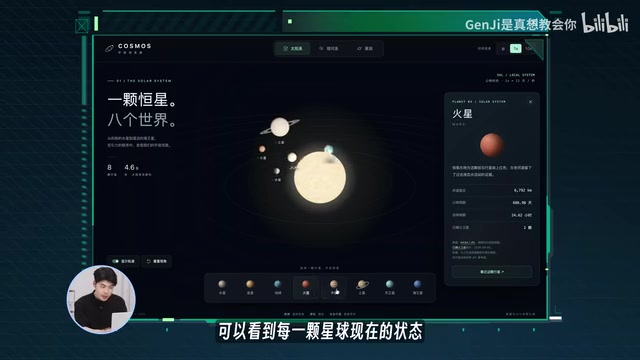
GPT-6 Astra Tested: 5 Real-World Cases That Put the 'AGI' Claim to the Test
GPT-6 Astra vs Kimi K3 vs GLM 5.3: a hands-on benchmark across 5 cases — universe browser, Apple-style product page, Plants vs. Zombies, Blender 3D modeling, and Xiamen city flythrough.

Masayoshi Son's All-In Bet on OpenAI: The Unicorn Hunter from Yahoo to GPT-6
SoftBank surged $70B in 4 days after GPT-6 Astra launched. Behind it: Masayoshi Son's decades-long bet from Yahoo and Alibaba to ARM and OpenAI.