Claude Code Now Supports AGENTS.md Universal Config, Plus New AI Open-Source Tool Releases

AI agents shift from prototypes to standardized, production-ready engineering as RSI and regulation debates intensify.
Claude Code 2.1.277 introduces `AGENTS.md` support alongside `CLAUDE.md`, advancing cross-tool agent rule standardization and reducing redundant config maintenance. Meanwhile, Garga's AgentKit framework shifts focus from prototyping to production stability, reflecting the industry's move from experimentation to dependency. AI's growing role in its own R&D — with Claude reportedly driving ~26% of Anthropic's research — is reigniting RSI debates, while a transatlantic divide grows over whether slowing AI development is about safety or protecting incumbents.
Claude Code Introduces AGENTS.md Support, Pushing Agent Rules Toward Standardization
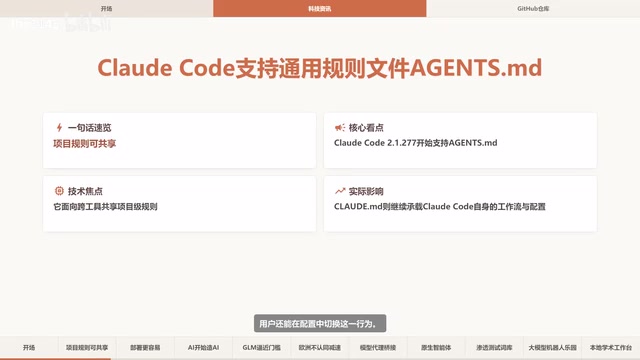
Claude Code version 2.1.277 has added support for AGENTS.md. While the change may seem minor, it points to an important standardization trend in the agent ecosystem: when a project folder doesn't contain a CLAUDE.md, the tool will automatically detect and use AGENTS.md instead.
The responsibilities of the two files are now more clearly delineated — AGENTS.md is designed for sharing universal rules across tools, essentially serving as a "universal instruction manual" that any AI coding assistant can read; CLAUDE.md retains Claude Code-specific configurations. Users can also toggle this behavior freely in settings.
For developers, this means they can describe project conventions in a single file and have agent tools from different vendors follow the same rules, eliminating the repetitive work of maintaining separate config files for each tool. It's also a signal that AI coding tools are moving from operating in silos toward protocol-level interoperability.
The concept of
AGENTS.mdwas originally popularized by the OpenAI Codex ecosystem, designed to provide code repositories with a machine-readable "project brief" that informs AI coding assistants about a project's tech stack, coding style, testing standards, prohibited operations, and other conventions. As tools like Cursor, Windsurf, GitHub Copilot, and Claude Code are increasingly used within the same codebase, developers face fragmentation — maintaining separate config files for each tool.AGENTS.mdaims to become the "greatest common denominator" in this space, similar to how.editorconfigunifies editor indentation rules, but at a higher level to standardize AI assistant behavior. This standard is still in the de facto standard stage with no formal cross-vendor agreement, and different tools parse its fields differently — but Claude Code's adoption signals that leading tools are beginning to converge in this direction.
From Prototype to Production: Agent Engineering Becomes the New Focus
AgentKit (1000Kit), an agent framework from Garga, shifts the focus from "building a working prototype" to "reliably getting agents into production." This hits directly at the core pain point of current agent deployment: demos are easy, production is hard.
The framework aims to reduce deployment complexity through reusable platform capabilities, providing more unified engineering support for businesses building and managing agents. As more teams move from "experimenting with agents" to "depending on agents," stability, maintainability, and observability will replace novelty as the real competitive differentiators.
AI Starts Building AI: The RSI Debate Heats Up Again
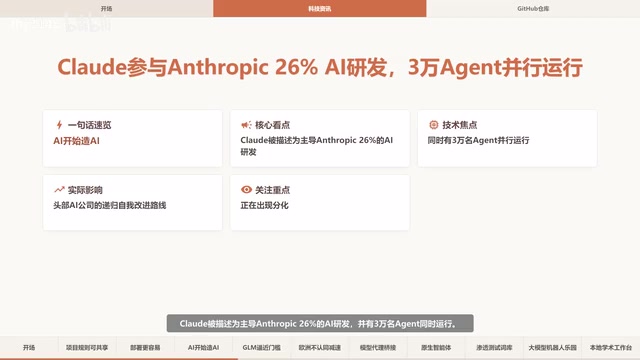
The way AI research is conducted is itself being rewritten by AI. Reports suggest Claude is responsible for roughly 26% of Anthropic's AI R&D, with approximately 30,000 agents running simultaneously. This case brings renewed attention to RSI (Recursive Self-Improvement) — and leading AI companies are pursuing different trajectories.
Tang Jie and the GLM team have disclosed their latest RSI developments, claiming that GLM's new version has "touched the threshold." Even more striking is the language they used to describe the process — "gradually moving toward replacing us." The conversation is no longer just about improving model capability; it's about whether AI will gradually replace the researchers themselves. These kinds of statements reflect the complex feelings within the industry toward self-improvement: excitement at a technical breakthrough, mixed with quiet anxiety about one's own role.
RSI (Recursive Self-Improvement) refers to the mechanism by which an AI system can modify or optimize its own algorithms, architecture, or training process, continuously improving its capabilities with minimal human intervention. The core concern is the "feedback loop": once AI participates in its own improvement, each generation of models may become better at improving the next, potentially turning a linear capability curve into an exponential one. This is closely tied to the "Intelligence Explosion" hypothesis — I.J. Good proposed as early as 1965 that a machine surpassing human intelligence would be able to design superior successors, triggering an unpredictable acceleration. Current RSI practices at major companies are still in the "engineering assistance" stage — using AI to accelerate code generation, experimental design, and paper writing — rather than letting models directly modify their own weights. But as AI's share of the R&D process grows, debate is intensifying over when and how to establish meaningful human oversight checkpoints.
Should We Slow Down? A Growing Transatlantic Divide
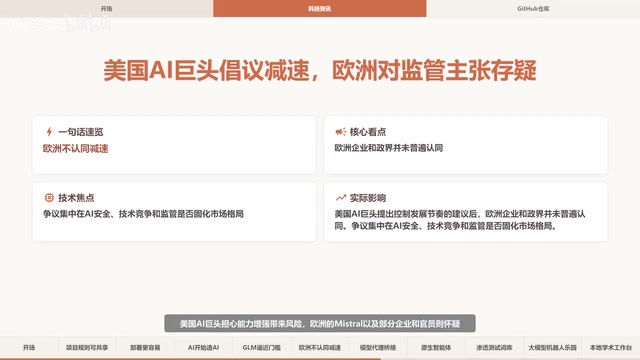
A clear divide has emerged between Europe and the United States over whether AI development should slow down. American AI giants, concerned about safety risks from rapidly increasing capabilities, advocate for caution; while Europe's Mistral and some companies and officials suspect that the "slow down" argument may be used to entrench existing market players.
For Europe, this debate also involves questions of model autonomy and dependence on American tech companies. The safety narrative and competitive dynamics are intertwined here — whether slowing down is genuinely about managing risk or a veiled moat-building strategy has become an unavoidable point of contention.
The structural context of this divide is worth unpacking. Leading US AI companies (such as OpenAI, Anthropic, and Google DeepMind) hold a lead in the global model capability race. Their calls for "cautious progress" often come with higher compliance thresholds and safety evaluation requirements, which objectively create barriers for challengers — and that's precisely where the skepticism from European players like Mistral originates. Mistral CEO Arthur Mensch has explicitly stated that if Europe follows the US regulatory pace, it will only widen the existing technology gap. Meanwhile, the EU AI Act formally took effect in 2024, attempting to balance risk-tiered regulation with preserving space for innovation — though many implementation details remain in a gray zone. The tension between "safety" and "competitiveness" makes it nearly impossible to view any regulatory position as purely technically neutral.
Open-Source Tool Roundup: Codex, Desktop Agents, and Security Testing
Several noteworthy open-source projects also appeared this week:
RepoPilot
Built on the OpenAI Codex SDK, it aims to help developers more efficiently manage project development and maintenance, embedding AI coding capabilities into everyday engineering workflows.
Native Desktop Agent
A native desktop agent built on GPUI. Though in early stages, it prioritizes genuine creative and practical experiences over raw feature accumulation.

Security Testing Wordlist Library
A project covering 2,500+ wordlists and payloads for penetration testing, bug bounties, red team operations, and AI security testing — a ready-made arsenal for security researchers.
Research Workflow Tool
A tool that chains together literature tracking, paper transcription, abstract summarization, and research journaling into a complete workflow. Runs locally with zero dependencies for the core service, ideal for researchers building a private research assistant.
Summary
Several threads from this edition converge on a shared trend: AI agents are moving from "can we build it?" to "how do we engineer it, make it interoperable, and deploy it safely?" The standardization push behind AGENTS.md, the production-oriented thinking of AgentKit, along with industry soul-searching sparked by RSI and the transatlantic regulatory divide — all of this signals that agents have entered a stage where their influence deserves to be taken seriously.
Related articles

Chain of Thought Isn't Just for AI: How Humans Can Use CoT to Improve Thinking Quality
Chain of Thought isn't just a prompt trick for large models. Starting from a Hacker News discussion, this article analyzes why CoT works for human thinking too, breaks down actionable ways to transfer it, and highlights the key differences between human CoT and machine CoT.
Cloudflare Teams Up with OpenAI: Closi…
Cloudflare Teams Up with OpenAI: Closing the Loop from Vulnerability Discovery to Defense with AI
Cloudflare uses OpenAI Daybreak to investigate security vulnerabilities and generate reviewable remediation plans, while developers use Codex to boost coding efficiency and quality.

Orca Multi-Agent Orchestration in Practice: A Guide to Parallel Collaboration with Claude and Codex
Orca is Stable AI's free open-source agent workbench supporting 34 agents like Claude Code and Codex in parallel. Learn its Git worktree isolation, multi-model orchestration, and mobile management.