Claude Code Open Source Analysis: 510K Lines of Code Reveal Industrial-Grade Agent Architecture

Claude Code source leak reveals the design essence of industrial-grade AI agent architecture.
The accidental leak of Claude Code's 510K lines of source code reveals top-tier industrial-grade agent engineering practices. Its core architecture employs a dual-loop system (user interaction layer + tool execution layer), built on a Harness protection framework philosophy. It layers over a dozen protective mechanisms atop a simple Function Call loop, including permission security, token budget management, context compression, and streaming parallel tool execution — transforming a toy-level loop into a reliable industrial system. This event signals explosive growth in the Agent space in 2025.
A "Passive Open-Source" Event Sparking an Agent Revolution
The open-sourcing of Claude Code is yet another landmark event in the AI field. Looking back at history, ChatGPT ushered in the era of large language models, and LLaMA's open-source release ignited the "Hundred Models War" in China; the O1 model pioneered the deep reasoning paradigm, and DeepSeekAd R1's emergence popularized chain-of-thought models.
The LLaMA series of models was released by Meta AI in 2023, and its open-sourcing triggered a global wave of large model replication and fine-tuning. Dozens of derivative models based on the LLaMA architecture emerged domestically as a result. This phenomenon reveals the unique propagation mechanism of open source in the AI field: once top-tier engineering practices are made public, the community's reproduction speed is often measured in weeks rather than years. The first two cases were intentional open-source releases, but Claude Code represents a form of passive open-sourcing — the source code was unexpectedly leaked, though its impact mechanism is similar to intentional open-sourcing: the disclosure of industrial-grade implementation details often carries more propagation value than papers, because it solves the question of "how to do it" rather than "whether it can be done." It has laid bare top-tier industrial-grade agent engineering practices for everyone to see.
What does this mean? Predictably, a flood of high-fidelity replications will soon emerge, and domestic agent development capabilities will rapidly catch up with international standards. This is a tremendous opportunity for AI practitioners, but it also raises a practical question: when companies set their R&D direction, should they build or not? Invest significant effort in development only to have someone open-source the same thing, rendering it all wasted; but if you don't build it, what happens if no one open-sources it?
Regardless, 2025 will undoubtedly see explosive growth in the Agent space. Claude Code, combined with the earlier OpenClawAd, will push the intelligence level of the entire agent ecosystem to new heights.
Dissecting the Overall Architecture of 510K Lines of Code
Claude Code comprises over 510,000 lines of code, with the permission security module accounting for the largest proportion of the overall structure, followed by various UI components, server-side logic, tool command-line interfaces, and more. This is a highly engineered project.
From a design philosophy perspective, Claude Code embodies six key decisions:
- Platform over single product: Callable via CLI, SDK, MCP, and other methods — it's essentially an open platform
- Strict tool governance pipeline: Permission management and execution operations for tools are taken to the extreme
- Institutionalized behavior: All specifications must be written into documentation (e.g., claude.md), preventing the model from improvising
- Context compression and memory system: Keeping the context window manageable
- Specialized sub-agent division of labor: Seven or eight types of sub-agents each handle their own responsibilities
- Ecosystem-aware extensibility: New tools, MCPs, and Skills can be automatically registered and discovered
This is essentially a standard Harness (agent protection framework). In the AI Agent domain, Harness specifically refers to a set of protective and orchestration infrastructure built around large models — its core idea being: large models inherently have randomness and unpredictability, and the Harness compensates for this by layering deterministic engineering layers outside the model. A typical Harness includes input filtering and prompt injection protection, permission sandboxing for tool calls, output format validation and post-processing, and rollback and recovery mechanisms for anomalous states. Claude Code's design philosophy is precisely about taking the Harness to the extreme — not relying on the model's own "self-discipline," but using code to enforce constraints on every execution step. This is the fundamental reason why its permission security module has the highest proportion. Its design approach holds extremely high reference value for any AI Agent development.
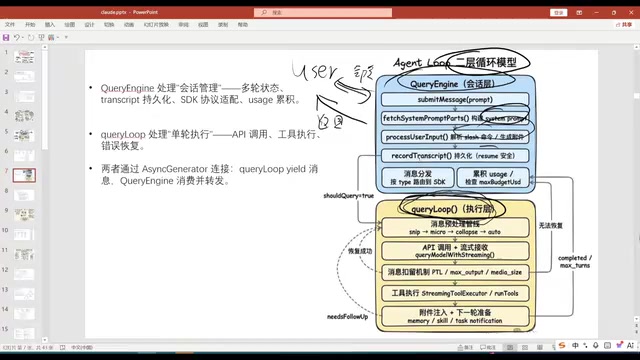
Dual-Loop: Core Execution Engine Explained
Outer Loop: User Interaction Layer
At the core of Claude Code is a dual-loop system. The outer loop interacts directly with users — the user asks a question, the system responds. Before each interaction, the input passes through a security layer that includes permission verification, sandbox checks, and more.
The outer loop handles the following key tasks:
- Building and injecting prompts (static + dynamic system prompts)
- Parsing commands, generating configuration files and attachments
- Data persistence
- Token budget management: Users can set token limits; when exceeded, the system automatically terminates or prompts for confirmation
Inner Loop: Tool Execution Layer
The inner loop is the tool execution layer. When a user assigns a task (e.g., "implement this code feature for me"), the system may need to repeatedly call multiple tools, which cycles within the inner loop. From the user's perspective, they simply issued one command and await a response, but multiple rounds of tool calls may occur in between.
Function Call is the fundamental skeleton of modern AI Agents. Its basic loop pattern is: send the user request and available tool list to the model → the model returns tool call parameters → the host program executes the tool → appends results to the context → calls the model again to determine whether to continue. Early frameworks like LangChain and AutoGPT were all built on this pattern. However, bare loops have obvious flaws: infinite loop risks, tool misuse, context explosion, permission overreach, and more. The simplest Agent is essentially just such a Function Call loop: call the LLM → determine if finished → invoke tools → continue looping. What makes Claude Code impressive is that it layers over a dozen protective mechanisms on top of this simple loop, transforming a toy-level loop into a reliable industrial system that runs stably.
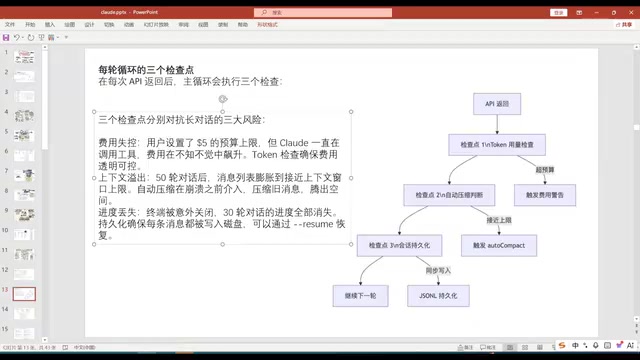
Three Checkpoints Per Loop Iteration
Each loop iteration triggers three checkpoints:
- Cost check: Whether token consumption has exceeded limits
- Context overflow check: Proactive compression when conversations grow too long
- Progress saving: Writing to disk to prevent accidental loss
Tool System: Seven-Step Execution Pipeline and Streaming Parallelism
Streaming Parallel Execution Strategy
Claude Code introduces an important innovation in tool execution — streaming execution mode. Traditional approaches (like LangChain) use a "batch processing" mode: wait for the LLM to output the complete tool call plan, then uniformly enter the execution phase. This approach has clear logic but introduces obvious latency — users must wait for the model to finish thinking completely before seeing any execution progress. Claude Code, however, begins execution as soon as the LLM emits the first tool call, without waiting for subsequent tool generations to complete. This "generate-while-executing" semi-parallel strategy can reduce total elapsed time by 30%-50% in multi-tool tasks, significantly improving response speed and user experience. The tradeoff is significantly increased implementation complexity — requiring precise parsing of tool call boundaries within the streaming token stream and handling state synchronization issues during concurrent execution.
Tools are divided into two categories:
- Concurrency-safe (e.g., reading files): Can be executed in parallel
- Non-concurrency-safe (e.g., writing files): Must be executed serially
Seven-Step Security Pipeline Flow
Every tool execution passes through a seven-step pipeline:
- Parameter compliance validation
- Security audit
- Hook scripts
Related articles
Meta Muse Hits 900K Downloads in Six D…
Meta Muse Hits 900K Downloads in Six Days: The AI Agent Era Has Officially Arrived
Meta's AI agent Muse hit 902K downloads in 6 days, topping US App Store and Google Play charts above ChatGPT and Claude. A deep dive into Muse's capabilities and the AI Agent race.
 Industry Insights
IRS Fully Embraces Claude AI, Accelerating Federal Government's AI Adoption
The IRS is recruiting staff with 24/7 Claude AI access, marking Anthropic's breakthrough into the federal government. Explore the strategic implications and tax use cases.
 Industry Insights
The IRS Mobile App Debate: A Trust Crisis in Government Digital Transformation
The IRS's proposed mobile app has sparked heated debate. This article analyzes the core arguments, exploring data security, privacy, and the trust crisis in government digital transformation.