Claude Code Plugin Team Collaboration: Sharing, Enforcing, and Locking Down

Claude Code v2.1.295 upgrades plugin management from a personal toy to team infrastructure with a three-layer mechanism: Git marketplace, managed settings, and allowlist.
Claude Code v2.1.295 introduces team-oriented plugin management mechanisms to address source confusion, version inconsistency, and uncontrolled plugin access to sensitive codebases. The solution has three progressive layers: distributing a plugin marketplace via Git repositories so sources are traceable and versions pinnable; enforcing required plugins through managed settings, upgrading plugins from suggestions to environment dependencies; and using a source allowlist to restrict installation to reviewed sources, changing "allow by default" to "deny by default" to defend against supply chain attacks. The three layers correspond to sharing, enforcement, and locking down, and teams can enable them progressively based on maturity. This reflects AI coding assistants evolving from personal tools to team platforms.
Claude Code's plugin system is evolving from a personal toy into team infrastructure. The latest version, v2.1.295, introduces a set of team-oriented plugin management mechanisms: distributing plugin marketplaces via Git repositories, enforcing installations through managed settings, and supporting source allowlists. This combination solves a core tension—how to let an AI coding assistant be flexibly extensible within a team without spiraling out of control.
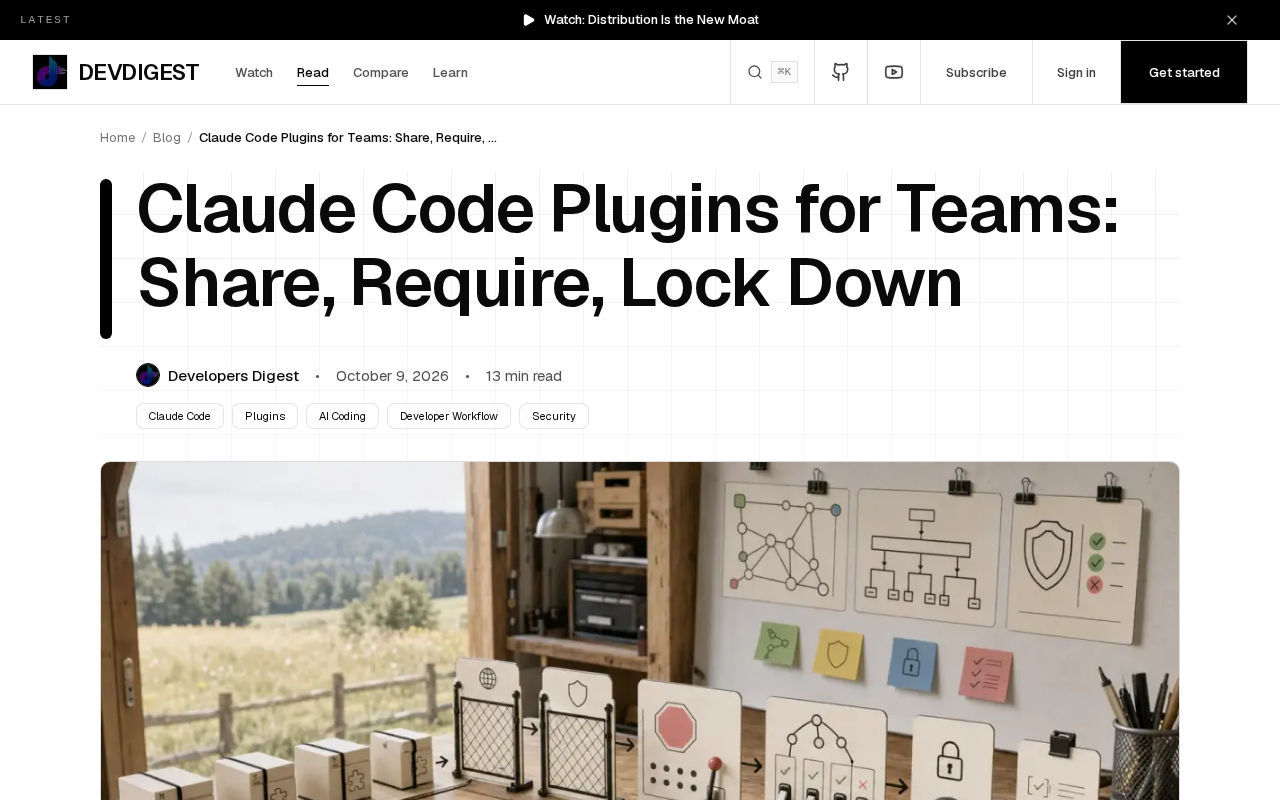
Why Teams Need Plugin Management
Claude Code plugins can extend commands, agents, hooks, and more. When used individually, installing a few plugins here and there isn't a problem. But in team scenarios, chaos quickly emerges: someone installs an unverified plugin, plugin versions vary across members, and sensitive codebases get accessed by uncontrolled third-party plugins.
The traditional approach is to write a "recommended plugin list" on a wiki, but recommendations carry no enforcement. What's truly needed is a mechanism that is executable, auditable, and enforceable. The v2.1.295 approach turns plugin sources, installation requirements, and access control into configuration-as-code.
Distributing Plugin Marketplaces via Git Repositories
The starting point for team plugin management is a centralized plugin marketplace repository. You can maintain a marketplace manifest in a Git repository listing team-approved plugins and their sources. Members point to this repository to obtain plugins, rather than each searching the public marketplace on their own.
The benefits are straightforward: plugin sources are traceable, versions can be pinned, and updates go through the normal code review process. The marketplace repository itself is just an ordinary Git project—it can be branched, PR'd, and rolled back. For teams requiring compliance audits, this means every plugin change leaves a record.
Enforcing Required Plugins in Managed Settings
A marketplace alone isn't enough, because members can still choose not to install anything. Managed settings solve this problem: administrators can declare which plugins are required in a centralized configuration, and Claude Code checks and enforces these requirements at startup.
This effectively upgrades plugins from "suggestions" to "environment dependencies." When new members join, they don't need to configure anything manually—once they clone the configuration, the required plugins are automatically in place. For security-sensitive teams, enforcing specific plugins (such as code scanning or access control plugins) ensures baseline security capabilities aren't missing due to individual oversight.
Managed settings are a type of configuration issued centrally by administrators, with higher priority than users' local configurations and typically not overridable by regular members. This pattern has a long history in enterprise software: browsers enforce extension allowlists through enterprise policies (such as Windows Group Policy and Chrome Enterprise Policy), and operating systems push security baselines through MDM (Mobile Device Management). Claude Code's managed settings follow the same idea—turning "what should be installed" from a personal preference into an organizational policy. The key difference here lies in the deployment method: for local standalone deployments, managed settings might just be a protected configuration file within a project; for enterprise-managed deployments, they're issued uniformly by the server and can't be bypassed by the client. This is precisely why the original text cautions that "availability may vary by deployment method": before planning an enforcement policy, teams should first confirm what level of enforcement their deployment model supports.
Locking Down the Supply Chain with Source Allowlists
The strictest layer is the source allowlist. Administrators can restrict Claude Code to installing plugins only from specified sources. Any source not on the allowlist is rejected.
This is a direct defense against supply chain attacks. AI coding assistants can access codebases and execute commands; once compromised by a malicious plugin, the consequences far exceed those of ordinary tools. The allowlist mechanism narrows the trust boundary to a handful of team-reviewed sources, turning "allow by default" into "deny by default."
Supply chain attacks refer to attackers indirectly achieving intrusion by poisoning the upstream components that targets depend on—libraries, dependency packages, build tools, plugins—rather than directly breaching the target system. In AI coding assistant scenarios, the risks are significantly amplified: these tools typically hold read-write access to codebases, can invoke Shell commands, and can access secrets in environment variables. A malicious plugin only needs to read .env during initialization or modify the CI configuration to steal credentials or plant a backdoor. Historically, ecosystems like npm and PyPI have experienced similar incidents multiple times (such as the event-stream poisoning and the xz-utils backdoor), all sharing the common trait of bypassing users' default assumptions about "trusted sources." Therefore, the core value of the allowlist mechanism isn't about intercepting known malicious plugins, but about elevating trust decisions from "each user's on-the-spot judgment" to "centralized team review," narrowing the attack surface from infinite to enumerable.
The Synergistic Logic of the Three-Layer Mechanism
These three capabilities aren't isolated—they form a progressive control gradient:
- Sharing (Git marketplace): solves the consistency problem of "everyone using the same set of plugins"
- Enforcement (managed settings): solves the compliance problem of "must be installed"
- Locking down (source allowlist): solves the security problem of "only install from trusted sources"
Teams can choose which layer to enable based on their own maturity. Small teams may only need a shared marketplace; enterprises with compliance requirements will stack on enforced installation; security-sensitive teams will deploy all three layers. This progressive design is more practical than a one-size-fits-all policy.
Implications for the Team-ification of AI Coding Tools
This mechanism in Claude Code reflects a trend: AI coding assistants are undergoing a transformation from personal tools to team platforms. Personal tools pursue flexibility and low friction; team platforms must introduce governance. Plugins, as extension points, are both a source of capability and an entry point for risk.
Making plugin management configuration-as-code, enforceable, and allowlistable is essentially bringing the mindset of software supply chain security into the AI assistant domain. For developers who are introducing Claude Code or similar tools into their teams, the v2.1.295 mechanism is worth using as a reference template for plugin governance.
It's worth noting that the specific configuration syntax and the availability of managed settings may vary by deployment method (local vs. enterprise-managed). It's advisable to refer to the official documentation and actual version behavior.
One-line Summary
Claude Code v2.1.295 uses a three-layer mechanism—Git marketplace, managed settings, and allowlist—to upgrade plugin management from a personal toy to team infrastructure.
Paragraph Summary
Claude Code v2.1.295 introduces team-oriented plugin management mechanisms to address issues such as source confusion, version inconsistency, and uncontrolled plugin access to sensitive codebases when using plugins individually. The solution progresses in three layers: first, distributing a plugin marketplace via Git repositories, making plugin sources traceable, versions pinnable, and updates subject to code review; second, enforcing required plugins through managed settings, upgrading plugins from suggestions to environment dependencies, ensuring new members are automatically set up and security baselines aren't missing; third, using a source allowlist to restrict plugin installation to reviewed sources only, changing "allow by default" to "deny by default," directly defending against supply chain attacks. The three layers correspond to sharing, enforcement, and locking down, and teams can enable them progressively based on maturity. This design reflects the trend of AI coding assistants evolving from personal tools to team platforms, essentially bringing software supply chain security thinking into the AI assistant domain.
Related articles

Chain of Thought Isn't Just for AI: How Humans Can Use CoT to Improve Thinking Quality
Chain of Thought isn't just a prompt trick for large models. Starting from a Hacker News discussion, this article analyzes why CoT works for human thinking too, breaks down actionable ways to transfer it, and highlights the key differences between human CoT and machine CoT.
Cloudflare Teams Up with OpenAI: Closi…
Cloudflare Teams Up with OpenAI: Closing the Loop from Vulnerability Discovery to Defense with AI
Cloudflare uses OpenAI Daybreak to investigate security vulnerabilities and generate reviewable remediation plans, while developers use Codex to boost coding efficiency and quality.

Orca Multi-Agent Orchestration in Practice: A Guide to Parallel Collaboration with Claude and Codex
Orca is Stable AI's free open-source agent workbench supporting 34 agents like Claude Code and Codex in parallel. Learn its Git worktree isolation, multi-model orchestration, and mobile management.