Claude Code Projects In-Depth: Coordinators, Threads, and Limitations

Claude Code Projects turns AI coding into a project-level parallel development environment with coordinators and cloud threads, but quotas and coordination overhead remain key constraints.
Claude Code Projects is now open to waitlisted Pro and Max users, upgrading Claude Code from a single-session assistant into a project-level environment with multi-threaded collaboration and cloud orchestration. A coordinator handles task splitting, dependency management, and project state, while cloud threads execute in parallel with independent context windows. Throughput rises, but so do coordination costs, cross-thread conflicts, and context drift. Thread limits vary by plan, and every thread consumes quota.
Title
Claude Code Projects In-Depth: Coordinators, Threads, and Limitations
Meta Description
Claude Code Projects is now open to Pro and Max users. This article breaks down how coordinators and cloud threads work, plan limits and cost model, plus current known conflicts and dependency chain limitations.
Article Content
Claude Code Projects has now opened to all waitlisted Pro and Max users. This feature expands Claude Code from a single-session coding assistant into a project-level development environment that supports multi-threaded collaboration and cloud task orchestration. Based on official release information and early user feedback, this article outlines its core mechanisms, cost model, and known limitations.
How Coordinators and Cloud Threads Work
Coordinator: A project-level task allocation hub
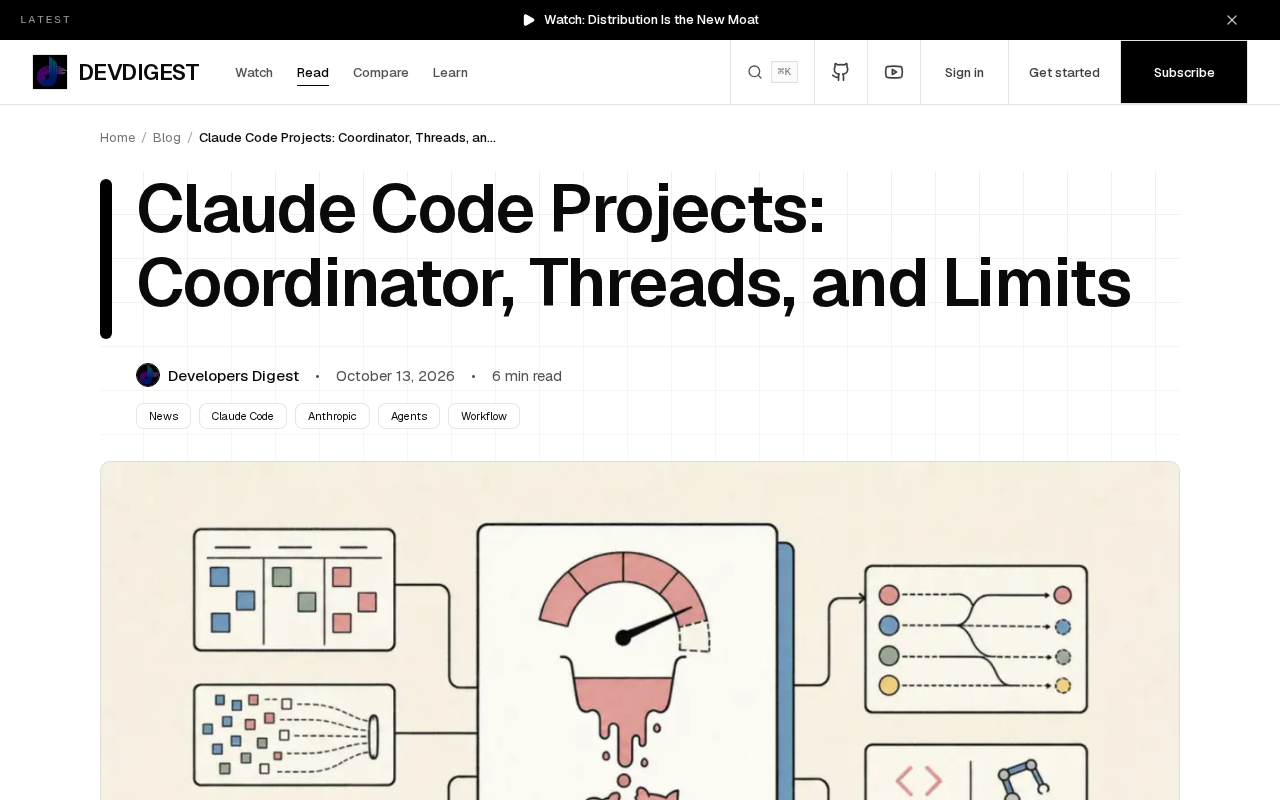
Claude Code Projects introduces a "Coordinator" role. It no longer merely responds passively to a single query, but is responsible for assigning tasks within a project context and managing dependencies among multiple cloud threads. You can think of it as a lightweight project steward: after you define goals in a Project, the coordinator breaks tasks down and dispatches them to different threads for execution.
The goal of this design is to reduce the manual work developers do copying and pasting context between multiple Claude Code sessions. The coordinator maintains project-level memory and state, allowing code changes across threads to remain consistent.
Multi-Agent Collaboration refers to multiple AI entities with autonomous decision-making capabilities working together to complete a complex task, coordinating their actions through message passing, shared state, or task queues. Unlike the traditional "one model handles one request" setup, multi-agent systems must additionally solve three problems: how tasks are split, how the split results are merged, and how conflicts among multiple agents are arbitrated. The coordinator in Claude Code Projects essentially plays this kind of "orchestrator" role, while cloud threads are the executors. Common multi-agent architectures in the industry also include decentralized peer-negotiation models (agents communicate directly), and hierarchical master-worker models (the coordinator + threads approach used here falls into this category). The advantage of a hierarchical architecture is centralized scheduling logic that is easy to monitor, while the downside is that the coordinator itself may become a bottleneck—when task dependencies are complex, its decision latency can slow overall throughput.
Cloud Threads: Parallel execution units
Cloud Threads are the units that actually execute coding tasks. Each thread has an independent context window and can process different subtasks in parallel—for example, one thread refactors a module while another writes corresponding tests at the same time. Threads run in the cloud, meaning tasks can continue even if you close your local editor.
The direct benefit of multi-threaded parallelism is increased throughput, but the cost is coordination overhead. Code conflicts between threads, context synchronization, and dependency order all require the coordinator to intervene. At present, this mechanism still struggles with highly coupled tasks.
Context window is the upper limit on the amount of information a large language model can process in a single pass, usually measured in tokens. The model's attention mechanism determines that when generating a response it can only "see" content within the window—anything beyond that is truncated or forgotten. This directly explains why each cloud thread needs an independent context window: if two subtasks shared the same window, their conversation history, code snippets, and intermediate conclusions would compete for space, both wasting capacity and easily causing semantic confusion. Independent windows let each thread focus on its own subtask, but the cost is that threads cannot automatically perceive each other's latest state and must explicitly synchronize through the coordinator. This is also the root of the "context drift" problem: when a thread runs for too long and accumulates a large number of intermediate steps, the relative weight of the original task goal in the window gets diluted, and the model gradually deviates from the original intent. In practice, drift is usually controlled by periodically restating goals, compressing history, or splitting tasks.
Cost and Plan Limits
Claude Code Projects is open to Pro and Max users, but it is not unlimited. According to official descriptions and user testing, the main limits appear in two areas:
- Thread count cap: The number of simultaneously active cloud threads is constrained by plan tier; Pro users have fewer parallel threads available than Max users.
- Plan quota consumption: Execution of each thread consumes the corresponding usage quota. Although multi-threaded parallelism speeds up task completion, it also consumes your plan allowance faster.
For heavy users, it is necessary to weigh the relationship between "parallel speedup" and "quota consumption." If your task is inherently linear with strong dependencies, the gains from multithreading are limited and may even reduce efficiency because of the coordinator's scheduling overhead.
Known Limitations and Breaking Points
Claude Code Projects is not currently a cure-all. According to early user feedback, the following scenarios are prone to problems:
- Cross-thread code conflicts: When two threads modify the same file, the coordinator's conflict resolution strategy is not yet mature, which may lead to lost changes or require manual intervention.
- Tasks with long dependency chains: The more complex the dependencies between tasks, the more noticeably the coordinator's scheduling efficiency declines.
- Context drift: Long-running threads may deviate from the project's original goals, requiring developers to check periodically.
These limitations are not surprising—multi-agent collaboration is itself an engineering challenge. The value of Claude Code Projects lies in bringing this capability into everyday development workflows, not in providing a perfect fully automated solution.
What It Actually Means for Developers
Claude Code Projects represents a direction: AI coding tools are moving from "single conversation" to "project-level orchestration." The coordinator + cloud threads architecture is essentially an attempt to solve context fragmentation and task parallelization in AI programming.
But at this stage, it is better suited to scenarios with clear task boundaries that can be split naturally, such as batch code migration, multi-module test generation, and synchronized updates of documentation and code. For core business logic that requires deep reasoning and frequent human judgment, the single-threaded mode is still more reliable.
If you are on the waitlist, it is worth trying as soon as possible and observing how it performs at the boundaries of your own projects. Understanding the coordinator's scheduling logic and thread limitations can help you allocate your plan quota more effectively.
One-line Summary
Claude Code Projects uses a coordinator plus cloud threads to expand AI programming into a project-level parallel development environment, but it is limited by quotas and coordination overhead.
Paragraph Summary
Claude Code Projects has opened to waitlisted Pro and Max users, upgrading Claude Code from a single-session assistant to a project-level environment supporting multi-threaded collaboration and cloud task orchestration. At its core, a "coordinator" handles task decomposition, dependency management, and project-level state maintenance, while "cloud threads" serve as parallel execution units, each with an independent context window, allowing tasks to continue even after the local editor is closed. Multithreading boosts throughput while introducing coordination overhead, and cross-thread code conflicts, inefficient scheduling of long dependency chains, and context drift are the main current limitations. On cost, the number of active threads is constrained by plan tier, Pro users have a lower cap than Max users, and each thread consumes plan quota, so parallelism accelerates quota depletion. The feature is better suited to scenarios with clear task boundaries that can be split naturally, while single-threaded mode is still recommended for core business logic.
Related articles

Felix Rieseberg Personal Homepage
Felix Rieseberg's personal homepage sparks attention on Hacker News. This article covers the Slack engineer's technical background, the rise and fall of nativefier, and the value of a developer homepage as a tech calling card.

@ai-sdk/vue 3.0.306 Patch Release Syncs with [email protected] Update
@ai-sdk/vue 3.0.306 released, synced with [email protected]. A routine patch release for the Vercel AI SDK ecosystem with no public API changes; the Vue adapter layer stays version-aligned with the core package.

Gemini 4 Argon API Launches: The Era of Million-Token Output Begins
Google launches Gemini 4 Argon with sparse MoE architecture, up to 1M output tokens, and a 68.90% Vals Index score, available across API, AI Studio, and the Gemini app.