Claude Code Projects vs. Cursor Projects: A Real-World Comparison

Claude Code Projects and Cursor Projects share an architecture but differ in access requirements, GitHub dependency, and coordinator design.
Claude Code Projects and Cursor Projects both use a coordinator-plus-parallel-cloud-agents architecture, but differ significantly in access requirements, code hosting, and coordinator responsibilities. Claude's version is limited to Pro/Max subscribers, requires GitHub integration, and caps new threads at 200 per day. Cursor's version covers all paid plans including Enterprise, with a coordinator that schedules tasks rather than writing code. OpenAI Codex Cloud offers a third parallel background coding path, confirming this pattern as an industry-wide trend. The key takeaway: rather than comparing raw power, choose the tool that best fits your existing code hosting setup and subscription plan.
Same Name, Different DNA: What Sets These Two "Projects" Features Apart
Claude Code Projects and Cursor Projects share a similar name, but their underlying design philosophies and use cases are quite different. Both adopt a "coordinator" mechanism — responsible for splitting tasks across multiple cloud-based agents running in parallel, maintaining shared context, and supporting execution on your local machine. On the surface they seem equivalent, but the differences in the details will determine which one is right for you.

This kind of "multi-agent parallel" architecture is quickly becoming the mainstream direction for AI coding tools: by breaking a complex task into multiple subtasks that can be tackled simultaneously and then consolidating the results, it theoretically delivers a significant boost to development efficiency. But different vendors make notably different trade-offs when it comes to access requirements, code hosting approaches, and coordinator responsibilities.
In a multi-agent architecture, the "coordinator" plays the role of the "brain": it receives a high-level task description from the user, decomposes it into independent subtasks, dispatches them to parallel agents, and then collects, integrates, and resolves conflicts in the results. The core advantage of this architecture is parallelism — work that would have to be done sequentially in a traditional single-agent model (such as modifying multiple modules simultaneously, or running tests and writing documentation in parallel) can now proceed concurrently, compressing overall completion time. The challenge lies in coordination overhead: if subtasks have dependencies, the coordinator must maintain the correct execution order; when multiple agents modify shared files at the same time, merge conflicts also need to be handled. The differences in how products design the coordinator's "intelligence" and "execution boundaries" directly affect the flexibility of task orchestration.
Claude Code Projects: GitHub-Bound, Higher Bar to Entry
Claude's version is still in Beta and is only available to Pro and Max subscribers. Code must be hosted on github.com and integrated via the Claude GitHub App. This means if your repository isn't on GitHub, or you're on the free tier, this option is currently off the table.

Another key constraint is the usage cap: Claude Code Projects can open a maximum of 200 new threads per day. For individual developers this is usually sufficient, but in high-intensity, large-scale parallel team scenarios, this hard ceiling can become a bottleneck.
The Claude GitHub App serves as the authorization bridge connecting Claude to your GitHub repositories. Once installed, it grants Claude read and write access to specified repos, enabling it to pull code directly, submit PRs, and trigger CI workflows. The advantage of this "deep platform integration" model is richer context — Claude can directly read Issues, PR history, and code change records. The trade-off is tight coupling to the GitHub ecosystem: teams using GitLab, Bitbucket, or self-hosted Git services currently cannot connect. The 200 new threads per day limit deserves special attention in high-concurrency scenarios: if a large refactoring task needs to be broken down into hundreds of subtasks simultaneously, the daily quota may fall short, requiring you to split execution across days or upgrade to a higher-tier plan.
Cursor Projects: Broader Coverage, but the Coordinator Doesn't Write Code
Cursor's version has broader availability — all paid plans, including Enterprise, can use it. However, it excludes the free Hobby plan and doesn't support legacy privacy mode. In short, as long as you're a paying Cursor user, you can access this feature, making the barrier to entry lower than Claude's.

One design difference worth noting: Cursor's coordinator is not responsible for writing code itself. It focuses on task scheduling and coordination, delegating actual code generation to the subordinate parallel agents. This separation of responsibilities differs from Claude's approach and may affect the flexibility of task orchestration and the consistency of results.
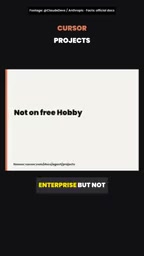
The "schedule only, don't write code" separation of responsibilities has sound engineering rationale behind it. When the coordinator is also responsible for writing code, it needs to frequently context-switch between "macro task planning" and "concrete code generation" — two very different levels of granularity — which can easily cause the context window to fill up with implementation details, degrading the quality of overall task planning. By fully delegating code-writing to sub-agents, the coordinator can maintain a "cleaner" context and focus on dependency management, progress tracking, and result integration. That said, this design also means the coordinator has less direct control over code details, and in scenarios requiring high consistency across subtasks (such as a unified code style or shared data structure definitions), additional coordination mechanisms may be needed to ensure coherent final output.
Don't Overlook the Third Option: OpenAI Codex Cloud
Beyond these two, OpenAI's Codex Cloud also supports running coding tasks in parallel in the background. This signals that "background parallel agent execution of coding tasks" is no longer any single vendor's exclusive trick — it's a pattern the entire industry is converging on. Developers evaluating their options should cast a wider net and not limit themselves to a single brand.
How to Choose: Follow Your Code and Your Subscription
The core selection principle is actually simple — choose the tool that best matches your existing code hosting location and subscription plan.
- If your code is on GitHub and you're already a Claude Pro / Max user, Claude Code Projects is the natural choice — just keep an eye on the 200 threads per day limit.
- If you're a paying Cursor user (especially on an Enterprise plan), Cursor Projects offers broader coverage with a lower barrier to entry.
- If your workflow is already deeply integrated with the OpenAI ecosystem, Codex Cloud is worth evaluating alongside the others.
Rather than debating which tool is "more powerful," prioritize migration costs and how well each option fits your existing infrastructure. Tools are just a means to an end — find the one that fits your current development environment, and you'll actually be able to unlock the productivity gains that parallel agents promise.
Related articles

Felix Rieseberg Personal Homepage
Felix Rieseberg's personal homepage sparks attention on Hacker News. This article covers the Slack engineer's technical background, the rise and fall of nativefier, and the value of a developer homepage as a tech calling card.

@ai-sdk/vue 3.0.306 Patch Release Syncs with [email protected] Update
@ai-sdk/vue 3.0.306 released, synced with [email protected]. A routine patch release for the Vercel AI SDK ecosystem with no public API changes; the Vue adapter layer stays version-aligned with the core package.

Gemini 4 Argon API Launches: The Era of Million-Token Output Begins
Google launches Gemini 4 Argon with sparse MoE architecture, up to 1M output tokens, and a 68.90% Vals Index score, available across API, AI Studio, and the Gemini app.