Claude Code Reportedly Leaks Secrets to GitHub, Sounding the Alarm for AI Coding Security

Claude Code leak warning meets model price cuts: calculate savings through delivery, check keys before granting permissions.
Claude Code was reportedly found exposing passwords and API keys to GitHub, reminding developers to check commit settings, search for sensitive data, and understand "don't ask again" authorization boundaries. Meanwhile, Anthropic's Claude Fable 5.2 and Mythos 5.2 cut API fees by 20%, but savings should be measured through delivery via small-scale tests. Other news: Meta's low-cost Muse Ember, Alter AI's 27 new languages, Logic Pro add-on AI usage, DeepSeek Harness at 1.54M DAU, and Code Rabbit's 20x delivery with Codex.
Incident Recap: Claude Code Carried Secrets Out the Door
According to a report from Ars Technica cited by Bilibili creator "A Bao," Anthropic's AI coding tool Claude Code was found to have accidentally exposed sensitive information such as passwords and API keys to GitHub. The news immediately set the developer community abuzz — after all, Claude Code is being used by more and more people to write projects and manage repositories, and GitHub is the main battleground for code hosting.
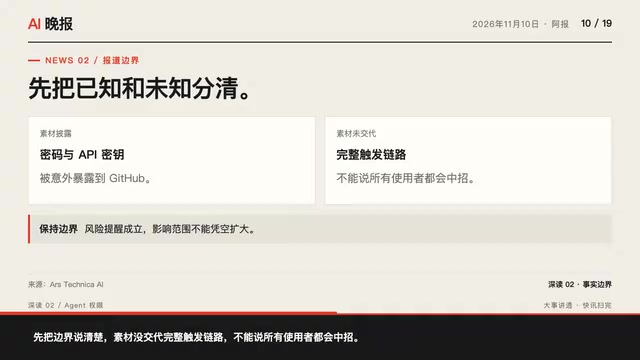
The core of the problem points to one detail: during interactions, Claude Code asks users whether to "don't ask again," and many users haven't truly understood the operational boundaries behind this prompt. The source material doesn't lay out the complete trigger chain, so we can't claim that all users will fall victim. But this incident is enough to remind every developer who lets an Agent do work on their behalf: letting AI interrupt you less isn't just about whether the operation feels smooth — you also need to see what it actually did.
What is Claude Code: Claude Code is a command-line AI coding Agent launched by Anthropic that can directly read and write project files in the terminal, execute shell commands, operate Git repositories, and create commits. Precisely because it has write permissions to the file system and Git, once it brings configuration files containing keys under version control and pushes them to GitHub, sensitive information becomes publicly visible along with the public repository.
Consequences of API key and password leaks: GitHub public repositories are continuously scanned by automated crawlers, and leaked API keys are often abused within minutes, resulting in high bills or data access risks. What's more troublesome is that once a key is written into Git history, even if the file is later deleted, it can still be retrieved from historical commits — you must rotate the key and clean the history; simply deleting the file is not enough.
The Price-Cut Wave Is Here, but Saving Money Must Be Calculated Through to Delivery
Alongside the leak news came a wave of good news about model price cuts. According to Geek Park sources, Anthropic released Claude Fable 5.2 and Claude Mythos 5.2, with API call fees dropping by 20%. For those who frequently call models to get work done, this is indeed a money-saving opportunity worth noting.
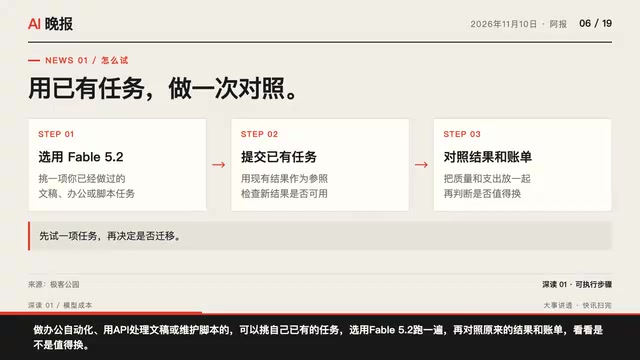
However, creator A Bao's judgment is clear-eyed: a price cut is only a reason to "try," and saving money must be calculated through to the delivery stage. He suggests that developers with needs for office automation, API-based document processing, or script maintenance pick an existing task, run it once with Fable 5.2, and then compare against the original results and bills to see whether switching is worthwhile. Don't move your entire workflow over right away, and don't treat a drop in call fees as a drop in total cost — if the results still need repeated revisions, human time remains a cost. The source material doesn't give a specific amount of savings or mention free quotas; this part can only be verified by developers themselves.
The difference between API call fees and total cost: API call fees are only the inference cost priced by token, whereas the total cost of delivering a task also includes retry counts, human review, rework revisions, and integration debugging. A 20% drop in unit price doesn't mean total cost drops in sync: if the new model's output requires more rounds of correction, human time may offset or even exceed the savings.
How to do a small-scale comparison test: Pick an existing task with clear boundaries and verifiable results, run it once each with the old and new models, record token consumption, actual bills, manual revision time, and final quality, then compare the unit delivery cost. Avoid migrating the entire workflow at once, lest problems be amplified and hard to attribute.
Other Developments: Small Models, Multilingual Support, and the Plugin Ecosystem
Besides the Claude-related news, this episode's briefs also cover several noteworthy developments:
- Meta launches Muse Ember: Positioned as its smallest and most efficient model, with an InfoQ headline claiming its cost is only one-third that of Claude Haiku 5.5. Developers running repetitive tasks can try it out on existing tasks for comparison.
- Alter AI adds 27 language support: Bringing the total to over 30 languages, but the feature for switching languages to follow the speaker is not yet live. Users holding cross-language meetings should first check the scope of support — don't mistake a preview for something already available.
- Apple Logic Pro adds a "Buy More Usage" option: $49.99 per purchase, used to extend usage of certain AI features. Current users should check the limits before deciding whether to buy more.
- DeepSeekAd Harness hits 1.54 million daily active users: The official team has started issuing Tokens to plugin authors; developers building plugins can check the specific participation requirements. The source material doesn't give a quota, so don't assume your own costs drop to zero.
- OpenAI customer case: Code Rabbit used Codex to make the same engineering team's software delivery volume reach 20x, and uses OpenAI models to govern AI code. Team leads can study its process, but don't schedule timelines based on those multiples.
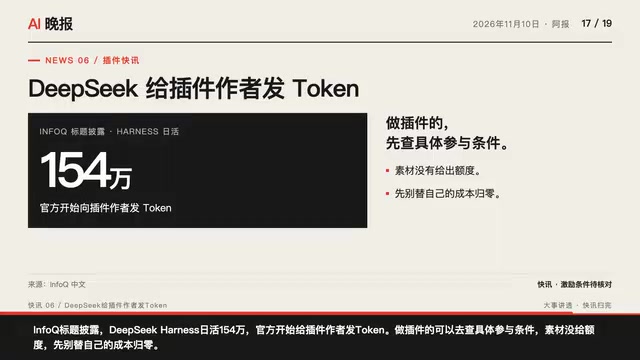
The significance of small models and the plugin ecosystem: "Smallest and most efficient" models like Muse Ember focus on low latency and low cost, suitable for repetitive tasks such as classification, extraction, and format conversion, but not good at complex reasoning — selection should be tiered by task difficulty. DeepSeek Harness issuing Tokens to plugin authors is an ecosystem incentive aimed at attracting developers to build extensions around its toolchain; before participating, confirm the quota, validity period, and usage limits, and don't assume costs are zero.
Security Boundaries: Writing Code Is Just a Skill — Knowing What Not to Carry Out the Door Is the Bottom Line
Back to the leak incident itself. For developers who are using Claude Code to write projects and also putting code on GitHub, the next step is clear: first check the configuration files you're about to commit, search for passwords and API keys, and verify what content will be committed along with them. When you encounter prompts like "don't ask again," read clearly what operation it corresponds to before deciding whether to allow it.
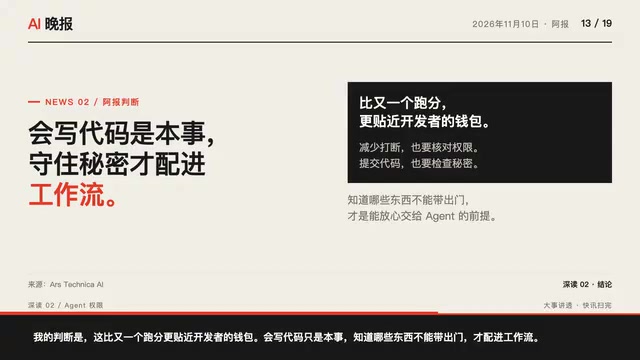
This judgment from the creator is worth remembering: writing code is just a skill — knowing what shouldn't be carried out the door is what qualifies something for your workflow. When models get cheaper, you can try them, but before granting permissions, take one more look — don't pay for the call fees you saved with a leaked key.
Pre-commit self-check list: First, use git status and git diff --cached to confirm what's staged; second, search the repository for keywords like password, api_key, secret, and token; third, use .gitignore to exclude .env, credential files, and local configuration; fourth, enable GitHub Secret Scanning or pre-commit hooks for automatic interception; fifth, use environment variables or secret management services instead of hardcoding wherever possible. For an Agent's "don't ask again"-type authorizations, confirm one by one the scope of file writes and network operations they correspond to before allowing them.
One-line Summary
Claude Code leak warning coincides with a wave of model price cuts — calculate savings through to delivery, and check keys before granting permissions.
Paragraph Summary
This episode's briefs center on two pieces of news from Anthropic: Claude Code was found to have accidentally exposed passwords and API keys to GitHub. Although the trigger chain hasn't been fully disclosed, it reminds developers to check commit settings, search for sensitive information, and understand the operational boundaries behind "don't ask again"-type authorization prompts. Meanwhile, Anthropic released Claude Fable 5.2 and Claude Mythos 5.2 with API call fees down 20%, but the article emphasizes that savings must be calculated through to delivery and suggests first running a small-scale real test on an existing task before deciding whether to migrate. Other developments include Meta launching the low-cost small model Muse Ember, Alter AI adding 27 languages, Logic Pro offering add-on AI usage, DeepSeek Harness reaching 1.54 million daily active users and issuing Tokens to plugin authors, and Code Rabbit achieving 20x delivery volume with Codex. The core conclusion: when models get cheaper, you can try them, but before granting permissions, you must take one more look.
Related articles

Anthropic Releases Fable 5.2 and Mythos 5.2: Benchmark Dominance and Biorobotics Breakthroughs
Anthropic launches Claude Fable 5.2 and Mythos 5.2, leading nearly all benchmarks and breaking ground in protein design, gene therapy, and robot control.

Anthropic Launches Dual Flagships Claude Fable 5.2 and Mythos 5.2, Topping Coding and Science Benchmarks
Anthropic releases Claude Fable 5.2 and Mythos 5.2 dual flagships, with full upgrades in coding, 3D interaction, and life sciences, topping third-party intelligence index, integrated by GitHub Copilot and Cursor, API pricing lower than competitors.

Getting Started with LangChain: Core Concepts of the Agent Development Framework
Starting from the three major limitations of LLMs, this article explains LangChain's positioning and value as an Agent development framework: limited knowledge, external system interaction, and state retention, along with its official documentation system and learning path.