Anthropic Launches Dual Flagships Claude Fable 5.2 and Mythos 5.2, Topping Coding and Science Benchmarks

Anthropic releases dual flagships Fable 5.2 and Mythos 5.2, topping multiple benchmarks in coding, 3D, and life sciences.
Anthropic has simultaneously released two flagship models, Claude Fable 5.2 and Claude Mythos 5.2. The former focuses on coding, computer use, and 3D interaction, while the latter targets scientific research tasks such as life sciences. Both share clearer expression and output speeds up to 30% faster. Official and third-party data are strong: Frontier Code 2.0 rose from 32.4% to 49.1%, Artificial Analysis Intelligence Index topped at 65 points, and the 3D interaction benchmark at 1271 ELO leads second place by 67 points with non-overlapping confidence intervals. Mythos 5.2 successfully modeled 28 out of 34 protein capsids and ranked first in multiple of 17 life science evaluations. GitHub Copilot and Cursor integrated on launch day, and API pricing is about 20% lower than competitors. The article suggests this marks a shift from the "all-purpose model" approach to vertical depth competition.
Anthropic Launches Dual Flagships Claude Fable 5.2 and Mythos 5.2, Topping Coding and Science Benchmarks
Anthropic has released two flagship models at once—Claude Fable 5.2 and Claude Mythos 5.2—officially positioned to tackle "the most challenging technical tasks," with comprehensive improvements in coding, reasoning, and vision capabilities. According to a report by Bilibili creator Ponyo News, both models have been gradually rolled out since launch day, with GitHub Copilot and Cursor integrating them simultaneously.
This is not a routine minor version iteration. From official benchmark tables to third-party evaluations, Anthropic has simultaneously surpassed previous leaders on multiple hard metrics this time—even making Fable 5.2's confidence interval non-overlapping with any other model, which is a rather rare signal.
Dual Flagship Division: Fable for Technology, Mythos for Science
Anthropic has drawn clear boundaries between the two models. Fable 5.2 focuses on technical work, with emphasis on coding, computer use, and 3D interaction; Mythos 5.2 targets scientific tasks, especially complex problems in the life sciences.
What both models share is "clearer expression"—testers report that the new models are noticeably better than previous versions in output readability and instruction following. The official announcement also mentions output speeds up to 30% faster than the previous generation.

This division strategy is noteworthy. Over the past year, leading vendors have tended toward a single "all-purpose model" covering all scenarios, but Anthropic has chosen to split its product line: technical tasks pursue ultimate execution precision, while scientific tasks pursue domain depth. This may reflect a judgment that the marginal returns from general capabilities are diminishing, and deep optimization for vertical scenarios is the next stage of competition.
Hard Metrics Sweep: Coding, 3D, Multidisciplinary Reasoning
First, the official benchmark data. On the Frontier Code 2.0 intelligent coding benchmark, Fable 5.2 scored 49.1%, up from 32.4% for the previous Fable 5.1—an improvement of more than half. Computer use benchmark reached 89.3%, and the RoboDojo robot simulation benchmark reached 64.9%.
In multidisciplinary reasoning, it scored 74.2% on the "Humanity's Last Exam," and Mythos 5.2 achieved 85.1% on the protein design benchmark.
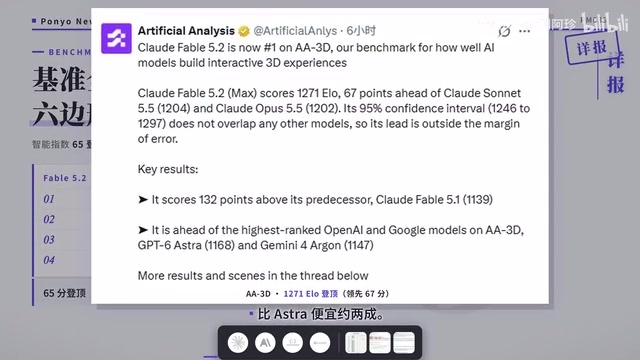
Third-party evaluations also gave high marks. On the Artificial Analysis Intelligence Index, Fable 5.2 Max topped the list with 65 points, surpassing OPUS 5.5's 59 points and GPT-6 Astra's 57 points. On pricing, API input is $8 and output $40 per million tokens, roughly 20% cheaper than Astra.
Even more striking is the AA 3D interactive benchmark: Fable 5.2 topped it with 1271 ELO, leading the second place by 67 points, with a confidence interval that does not overlap with any model. This means that in statistical terms, its performance is not on the same level as competitors.
Officially, multiple one-shot generated 3D scenes were demonstrated—Tai Chi spirit, fire-breathing dragon, starship launch and recovery—all runnable directly in the browser. Such capabilities have direct practical value for game development, interaction design, and simulation training.
Understanding ELO and "non-overlapping confidence intervals"
ELO is a rating system originating from chess, used to quantify relative strength in pairwise comparisons (such as model-vs-model battles, with human or AI judges voting for the better), where a larger score difference indicates a more pronounced win-rate advantage. In recent years, evaluations like Chatbot Arena and the AA 3D interactive benchmark have widely adopted ELO rankings, so "1271 ELO" itself only reflects relative standing and needs to be understood in conjunction with score differences.
"Non-overlapping confidence intervals" refers to statistical confidence intervals that do not overlap. Third-party evaluations typically provide a score interval for each model (e.g., based on multiple sampling or bootstrap estimation) to express measurement uncertainty. If two models' intervals overlap, one cannot assert which is stronger; but Fable 5.2's interval does not intersect with any other model, meaning it can be statistically asserted with reasonable confidence that it leads. This is why the article calls it a "rare signal"—at a time when large model scores are generally converging and gaps have narrowed to the noise level, achieving a statistically significant difference is uncommon.
Mythos 5.2: Bringing AI into the Laboratory
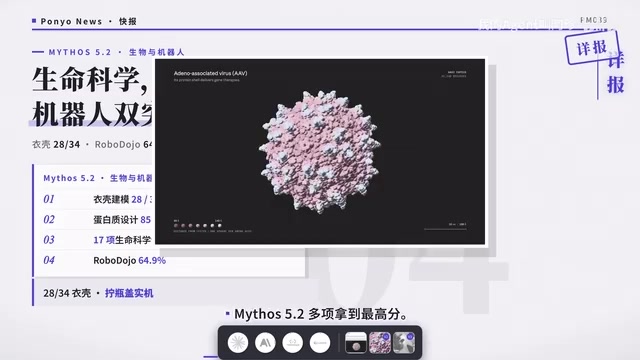
Mythos 5.2's highlights are concentrated in biological sciences. Gene therapy requires packaging drugs into protein shells (capsids), and Mythos 5.2 found a new method to predict entire capsid structures: in testing, 28 out of 34 capsids were successfully modeled. For researchers, this means designing capsid systems can be faster and cheaper.
The official announcement also provided 17 life science evaluations covering pharmaceuticals, chemistry, biology, imaging analysis, and protein design, with Mythos 5.2 achieving the highest scores in multiple categories.
There are also breakthroughs in robot control. In official demonstrations, Claude autonomously unscrewed a bottle cap, completed gear assembly and nickel bonding tests. The RoboDojo simulation benchmark scored 64.9%, surpassing many specialized systems, and the official statement claims stable performance even on tasks not specifically trained for.
From "can write code" to "can operate the physical world," this path is being gradually paved. Unscrewing a bottle cap may seem simple, but it involves coordination of visual recognition, force control, and motion planning—a typical challenge in embodied intelligence.
Protein capsids and structure prediction
A capsid is the protein shell that encases viral genetic material, repurposed in gene therapy as a "delivery container"—packaging therapeutic genes and safely delivering them to target cells. The commonly used adeno-associated virus (AAV) vector relies on engineered capsids for targeted delivery, so designing capsids that are stable, assembleable, and not easily cleared by the immune system is a key engineering step in gene therapy.
Traditionally, determining capsid structure relies on experimental methods like cryo-electron microscopy, which are time-consuming and costly. Computational structure prediction (the path pioneered by AlphaFold) attempts to infer three-dimensional structure directly from amino acid sequences. The significance of "28 out of 34 capsids successfully modeled" in the article is that the model can provide credible structures for entire assemblies rather than single protein chains, thereby partially shifting the design-validation cycle from the bench to computation and significantly compressing R&D time and costs. However, note that successful structure prediction does not equal successful functional validation; subsequent wet-lab experiments are still needed for confirmation.
Ecosystem Sync: Copilot and Cursor Integrate Immediately
For developers, the value of model capabilities ultimately depends on whether they can be used. GitHub announced that Fable 5.2 is fully available on Copilot, with early tests showing more tasks completed in fewer steps; Cursor launched simultaneously, topping CursorBench at 60% in the largest tier, 56.9% in the default tier, up from 49.2% for the previous Fable 5.1.

This means that on launch day, mainstream AI coding tools could already call the new models, and developers do not need to wait for an adaptation cycle.
CursorBench and the limitations of coding evaluations
CursorBench is a coding capability evaluation set built by the Cursor team, typically constructed from real user interactions such as editing, multi-file refactoring, and agent-style tasks, making it closer to daily development than pure algorithm problems. The "60% in the largest tier, 56.9% in the default tier" in the article refers to scores under different reasoning budgets or model configuration tiers.
Note that vendor-built benchmarks have inherent conflicts of interest, and coding task evaluations are highly sensitive to scaffolding (prompts, toolchains, context management)—the same model can score considerably differently under different harnesses. Therefore, the CursorBench numbers in the article should be cross-referenced with other third-party evaluations. For developers, a more practical basis for judgment is often actual trial on their own codebase, not leaderboard rankings.
Same-Day News: Meituan and Meta's Open-Source Moves
There were several other noteworthy announcements the same day. Meituan released LongCat 2.5, with 1.6 trillion total parameters and approximately 48 billion activated, natively multimodal, merging visual understanding and intelligent coding into one model, covering everything from complex coding projects to creative design to 3D tasks, with open-source weights under the MIT license and available on Hugging Face.
Meta released its smallest model to date, Muse Ember, scoring 36 on the Artificial Analysis Coding Intelligence Index, close to its largest model Spark 1.3's 37 points, at roughly 1/17 the price. This data shows that small models' cost-effectiveness is rapidly approaching large models, with direct implications for cost-sensitive deployment scenarios.
Additionally, The Wall Street Journal reported that Anthropic plans to proceed with an initial public offering later this month, despite recent volatility in the AI investment market. This would be the company's first foray into public markets.
Total parameters, activated parameters, and MoE
The article's "1.6 trillion total parameters, approximately 48 billion activated" describes a Mixture-of-Experts (MoE) architecture. Such models consist internally of many "expert" subnetworks, with only a small subset routed and activated during each forward pass—so total parameter count determines capacity ceiling, while activated parameter count determines computational cost and memory overhead per inference. 1.6 trillion total parameters with 48 billion activated means the model has enormous knowledge capacity, but each call consumes computing power close to a medium-sized dense model—this is precisely the mainstream approach for balancing performance and cost in current large models.
Additionally, the MIT license is a relatively permissive open-source license that allows commercial use, modification, and redistribution with only copyright notice retention, making it relatively friendly for enterprise integration; weights on Hugging Face mean direct download for self-deployment, bypassing API dependency.
Summary
Anthropic's dual-flagship strategy this time splits "technical execution" and "scientific discovery" into two product lines, simultaneously delivering leading data in coding, 3D, and life sciences. For developers, the most direct change is that Copilot and Cursor can already use the new models; for the industry, what's more noteworthy is the trend toward model specialization—as general capabilities gradually converge, vertical depth may be the deciding factor in the next round of competition.
One-line Summary
Anthropic releases dual flagships Fable 5.2 and Mythos 5.2, topping multiple benchmarks in coding, 3D, and life sciences.
Paragraph Summary
Anthropic has simultaneously released two flagship models, Claude Fable 5.2 and Claude Mythos 5.2. The former focuses on coding, computer use, and 3D interaction, while the latter targets scientific research tasks such as life sciences. Both share clearer expression and output speeds up to 30% faster. Official and third-party data are strong: Frontier Code 2.0 rose from 32.4% to 49.1%, Artificial Analysis Intelligence Index topped at 65 points, and the 3D interaction benchmark at 1271 ELO leads second place by 67 points with non-overlapping confidence intervals. Mythos 5.2 successfully modeled 28 out of 34 protein capsids and ranked first in multiple of 17 life science evaluations. GitHub Copilot and Cursor integrated on launch day, and API pricing is about 20% lower than competitors. The article suggests this marks a shift from the "all-purpose model" approach to vertical depth competition.
Related articles

1,000 AI Agents Formalize Fermat's Last Theorem in 30 Hours, Anthropic Releases New Claude Models
Anthropic releases Claude Fable 5.2 and Mythos 5.2: 1,000 agents formalize Fermat's Last Theorem in 30 hours, coding costs halved, plus hardware design and physics.

Claude Fable 5.2 Released: A Thousand AI Agents Build a Bootable OS in 8 Days
Anthropic releases Claude Fable 5.2 and Mythos 5.2—same model, two safety tiers. Demo shows 1,000 AI agents build a bootable OS in 8 days, formalize Fermat proof in 30 hours, score 64.6 beating Gemini 4 Carbon, price cut 20%.

Claude Fable 5.2 Release Analysis: The Strongest Model Deliberately Weakened?
Analysis of Claude Fable 5.2 and Mythos 5.2: Anthropic deliberately restricted accelerator kernel optimization and architecture improvements during training, drawing a line before recursive self-improvement. The video also reconstructs a 1,000-agent, eight-day OS-building experiment and discusses whether open-source models will overtake.