Claude Code's Extra 50% Rate Limit May Expire August 19th — How Developers Should Prepare

Claude Code's bonus 50% rate limit likely expires August 19th — here's how developers can prepare.
Reports from Reddit suggest that Anthropic's temporary 50% extra usage quota for Claude Code may not continue past August 19th. This could significantly impact heavy users who depend on Claude Code for daily development. The article analyzes the cost implications, explores why AI vendors are tightening quotas industry-wide, and offers practical strategies including multi-tool workflows and local model alternatives.
Background
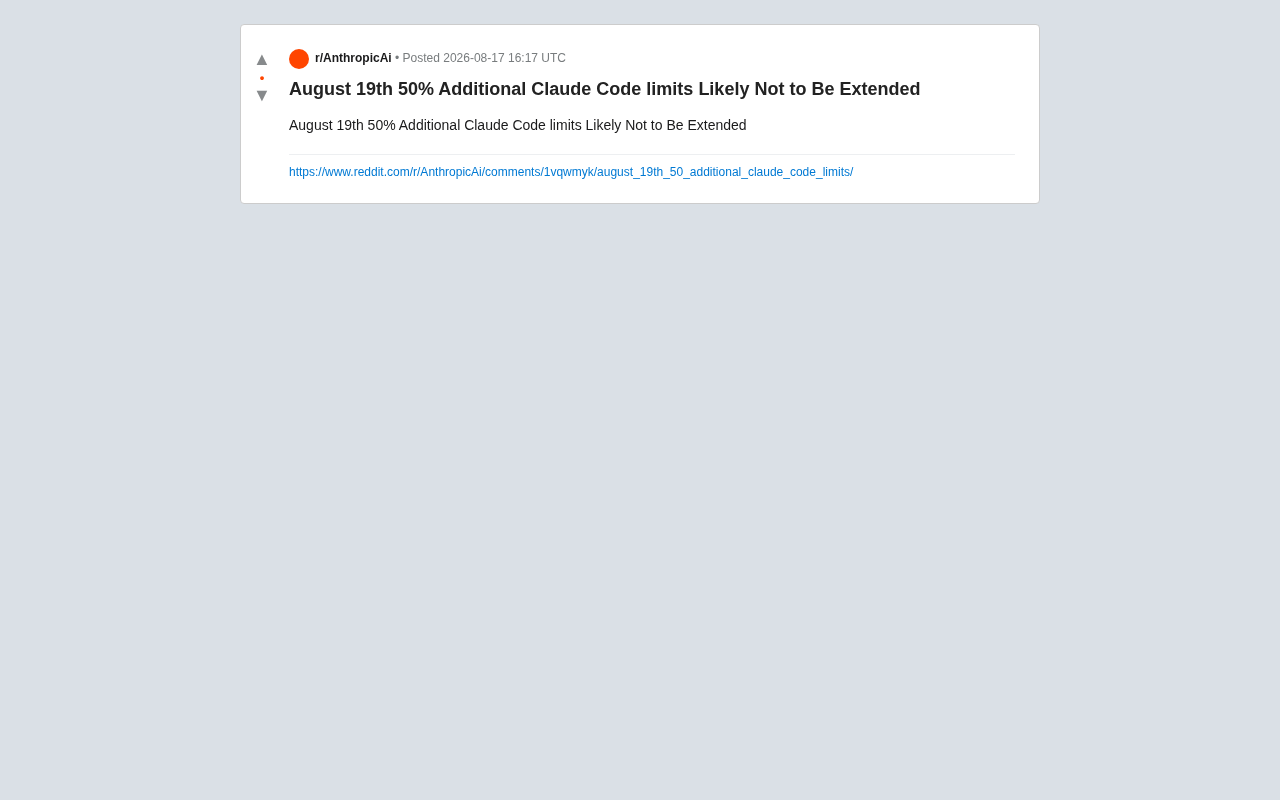
Recently, a post circulating on Reddit suggests that Anthropic's extra 50% usage rate limits for Claude Code — previously offered to users as a temporary bonus — will likely not continue beyond August 19th. This potential change has sparked significant discussion among heavy users, particularly programmers who rely on Claude Code for their daily development work.
For many developers who have deeply integrated Claude Code into their workflows, this isn't just a quota adjustment — it could directly impact their coding efficiency and cost structure. It's worth noting that this information primarily comes from community-level discussion and speculation, with no official confirmation from Anthropic yet, so it remains in the "likely" category.
What Is Claude Code's Extra 50% Rate Limit?
Origins of the Temporary Quota Boost
Claude Code is Anthropic's terminal-based (command-line) AI programming assistant that allows developers to invoke Claude models directly within their development environments for code generation, refactoring, debugging, and other tasks. Unlike traditional IDE plugin-based AI coding assistants (such as GitHub Copilot), Claude Code uses a command-line interface (CLI) as its interaction entry point, conversing with developers directly in the terminal. This design gives it a larger context window and deeper project comprehension capabilities — it can read an entire code repository's file structure, understand project dependencies, and perform complex cross-file refactoring operations. Under the hood, it calls Anthropic's Claude Sonnet or Opus series models, whose per-inference costs are significantly higher than traditional API calls, especially when processing large code contexts where token consumption can reach tens of times that of a typical conversation.
Due to the high cost of large model inference, Anthropic has set corresponding usage limits (rate limits) for different subscription tiers to balance server load and user experience. Rate limits, as a standard governance mechanism for API services, are typically controlled along two dimensions: "requests per minute" (RPM) and "tokens per minute/per day" (TPM/TPD). For deeply integrated programming tools like Claude Code, quota calculation is more complex: each interaction may include thousands or even tens of thousands of input tokens (project context) plus hundreds to thousands of output tokens (generated code). This means a seemingly simple code refactoring request can consume computing resources equivalent to dozens of regular chat conversations. Anthropic's subscription tiers include Pro ($20/month) and Max ($100-200/month) among other levels, with significant differences in token quotas across tiers.
The so-called "extra 50% rate limit" typically refers to higher quotas temporarily opened to users during specific promotional periods, beta testing phases, or when computing capacity is relatively abundant. This practice isn't unusual among AI products — relaxing restrictions in the short term to attract users, encourage deep trial usage, and collect real-world usage data.
What the Expiration Means
If the extra quota is not renewed after August 19th, users' available quota will fall back to baseline levels. For light users, the impact will be minimal, but for heavy developers who make extensive daily calls to Claude Code, this means they may hit their daily or weekly usage caps more quickly, requiring them to wait for quota refreshes or upgrade to higher-paid plans.
To understand the severity of this impact, it helps to know the cost structure behind large model inference. Taking Claude 3.5 Sonnet as an example, inference requires deployment on high-end GPU clusters (such as NVIDIA H100/A100), with a single H100's rental cost at approximately $2-4 per hour. A typical long-context Claude Code interaction might process over 100,000 tokens, with corresponding compute costs ranging from $0.01 to $0.10. When hundreds of thousands of active developers make dozens of such calls daily, the average daily inference cost can reach millions of dollars. This explains why quota management is not merely a business strategy but a hard constraint on infrastructure capacity.
Practical Impact on Developers
Rebalancing Cost and Efficiency
The core value of AI programming tools lies in the seamless "on-demand" experience. Once rate limits tighten, developers need to reassess their usage habits:
- Task prioritization: Allocate limited high-value quota to the complex tasks that most need AI assistance;
- Combining local and cloud: For simpler tasks, consider using local lightweight models (such as CodeLlama, DeepSeek Coder, and other open-source models run via Ollama) or traditional tools as supplements;
- Subscription upgrade evaluation: Weigh the cost of upgrading subscriptions against the resulting efficiency gains.
This actually reflects a contradiction common to current AI tools: users expect unlimited intelligent assistance, while vendors must find a balance between computing costs and business sustainability.
Mixed Community Sentiment
Looking at the discussion atmosphere on Reddit, user reactions are clearly divided. Some users express understanding of the tightened limits, viewing the free or low-cost extra resources as always being a temporary benefit. Others — particularly heavy users — worry this will weaken Claude Code's appeal compared to competitors like GitHub Copilot and Cursor, especially in the fiercely competitive AI programming tools market.
The current AI coding assistant market has formed a multi-layered competitive landscape: GitHub Copilot, leveraging Microsoft's ecosystem and GitHub's code data advantage, commands the largest user base (over one million paying users); Cursor, as a standalone IDE, is known for its deep AI integration and smooth editing experience, with its recent valuation exceeding several billion dollars; additionally, there are emerging players like Windsurf (formerly Codeium), Augment Code, and Devin. Claude Code's differentiated advantage lies in its terminal-native interaction and Claude's excellent performance in code comprehension, but it still faces challenges in ecosystem integration and price competitiveness. Quota policy adjustments directly affect the product's value proposition and may shift how users allocate their time across different tools.
Industry Perspective on AI Tool Rate Limit Trends
The Inevitability of AI Commercialization
Quota adjustments are not unique to Anthropic — they're a microcosm of the entire generative AI industry maturing toward commercialization. From OpenAI to various AI coding assistants, nearly all vendors are transitioning from "subsidizing for growth" to "refined operations." The path is almost predictable: attract users early with generous free quotas and loose limits, then gradually tighten policies and guide users toward paid conversion as user scale grows and computing cost pressures mount.
The backdrop to this transition is industry-wide financial pressure. Between 2023 and 2024, most AI vendors rapidly acquired users through generous free quotas and aggressive pricing, but as capital markets raise profitability expectations and GPU costs remain elevated, this strategy has become unsustainable. OpenAI raised ChatGPT Plus from $20 to the $200 Pro tier in late 2024, and Google has gradually introduced usage limits in Gemini Advanced. As an AI company that has yet to achieve profitability (approximately $900 million in 2024 revenue, but with operating costs far exceeding this figure), Anthropic faces investor pressure for commercial returns, making quota tightening a necessary step toward financial sustainability.
A Test of User Loyalty
For Anthropic, maintaining user trust while tightening quotas is a delicate balance. Transparent communication, reasonable transition periods, and competitive paid plans are all key to retaining core users. If handled poorly, heavy developers may shift to alternatives — not good news for Claude Code during its market expansion phase.
Recommendations and Outlook for Developers
For developers currently relying on Claude Code, the following measures are recommended:
- Monitor Anthropic's official announcements: Before making major decisions, wait for official confirmation to avoid being misled by community rumors;
- Plan quota usage in advance: If the August 19th change proves real, adjust workflows ahead of time to reduce sudden disruptions;
- Evaluate a multi-tool combination strategy: Don't put all your eggs in one basket — build a resilient workflow incorporating Claude Code, GitHub Copilot, Cursor, and other AI programming tools;
- Explore local model alternatives: Use tools like Ollama or LM Studio to deploy open-source code models (such as DeepSeek Coder V2, CodeLlama 70B, etc.) as backup options when cloud AI quotas are exhausted. While not as capable as Claude, they can cover basic coding assistance needs.
Overall, although this Claude Code rate limit adjustment rumor has not been officially confirmed, it serves as a reminder: AI programming tools are in a period of rapid evolution, and users need to stay sensitive to quota and pricing changes while building more resilient development habits. For vendors, finding the optimal balance between business sustainability and user experience will continue to be the central challenge in AI product competition.
Key Takeaways
Related articles

Can AI Really Find Vulnerabilities While You Sleep and Earn Easy Money? The Truth About SRC Bug Bounties
Deep analysis of the viral "AI autopilot bug hunting for five-figure income" narrative, examining how SRC platforms actually work, AI's real role in vulnerability discovery, and the traffic schemes behind "packaged Skills."

Getting Started with AI/Machine Learning: How to Choose Between Bundles and Classic Textbooks
Should Python developers buy Humble Bundle's AI/ML pack or O'Reilly's classic textbook? We analyze resource type, learning path, and cost-effectiveness to help you decide.

Calibra: A Detailed Guide to the Open-Source Quality Inspection Tool for Robot Learning Datasets
Calibra is an open-source quality inspection tool for robot learning datasets that detects duplicate demonstrations, frozen frames, motion jitter, calibration drift, and more.