Getting Started with AI/Machine Learning: How to Choose Between Bundles and Classic Textbooks

A guide to choosing between ML ebook bundles and classic textbooks for Python developers starting out.
For Python developers entering machine learning, this article compares Humble Bundle's AI/ML ebook packages with O'Reilly's classic Hands-On Machine Learning textbook. It analyzes both options across resource quality, learning path coherence, and cost-effectiveness, ultimately recommending that beginners prioritize a single structured textbook over scattered bundles for more efficient learning.
A Common Learning Dilemma
Recently on Reddit, a developer with basic Python experience who wanted to get started with machine learning posed a very representative question: Humble Bundle is selling a resource package called "The Ultimate AI & Machine Learning Bundle" — is it worth buying? Or would it be more cost-effective to directly purchase O'Reilly's classic textbook Hands-On Machine Learning with Scikit-Learn and PyTorch?
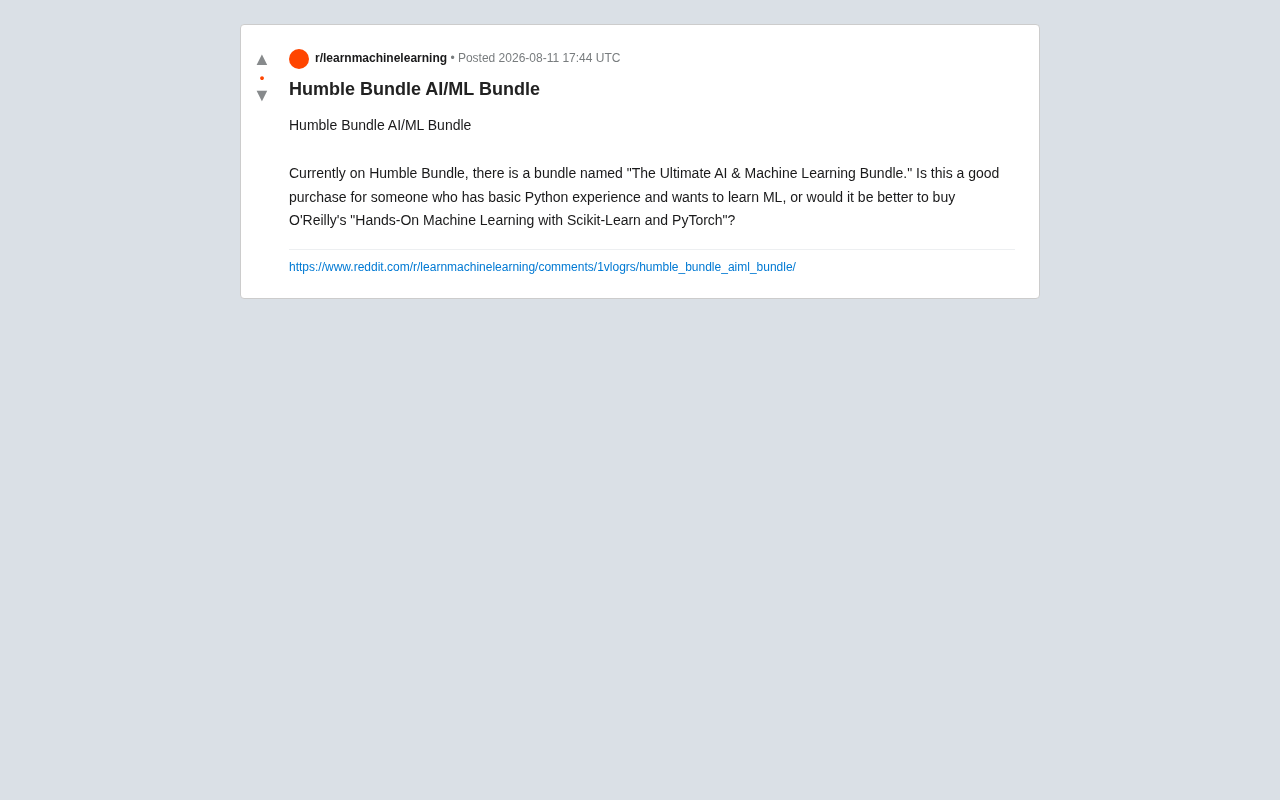
This question seems simple on the surface, but it touches on a core decision every technical learner faces: In an age of information overload, how do you choose the most suitable learning resources with limited budget and energy? This article will analyze this question from three dimensions: resource type, learning path, and cost-effectiveness.
The Fundamental Difference Between Bundles and Classic Textbooks
The Positioning and Hidden Costs of Bundles
The biggest appeal of ebook bundles like Humble Bundle lies in price and quantity. Typically, for around $20, you can get a dozen or even dozens of ebooks covering a wide range of topics from Python basics and data science to deep learning. For learners who like to stockpile materials and want to build a complete technical library all at once, this model is extremely tempting.
Humble Bundle was founded in 2010, originally starting with "Pay What You Want" indie game bundle sales before expanding into ebooks, software, and other digital content. Its business model allows buyers to customize how their payment is split — portions going to publishers, charities, and the platform itself. For publishers, the books in bundles have typically passed their peak sales period, and low-price bulk sales generate additional long-tail revenue. For consumers, this means an extremely low per-book cost. But precisely because of this, the book selection logic is based more on business partnerships than pedagogical design.
However, the hidden costs of bundles are often overlooked. These collections are typically cobbled together from multiple authors and different publishers, with uneven content quality and no coherent learning logic between chapters. A more practical issue: the vast majority of people who buy bundles will only actually read one or two books from them. The "richness" in quantity easily transforms into a psychological "burden."
Why Classic Textbooks Are Worth the Investment
In contrast, O'Reilly's Hands-On Machine Learning series is a universally recognized bible for machine learning beginners (it's worth noting that the original book typically pairs with Scikit-Learn, Keras, and TensorFlow — the PyTorch version may be a newer adaptation or a memory discrepancy from the user).
O'Reilly Media is one of the world's most influential technology publishers, famous for the animal sketches on their covers (known in the tech community as "animal books"). The publisher not only publishes books but also operates the O'Reilly Learning Platform (formerly Safari Books Online) — an online subscription platform containing tens of thousands of technical books and video courses. O'Reilly's editorial team is known for rigorous technical reviews, with their published books typically undergoing multiple rounds of expert review — the core source of their brand premium.
Its key advantages include:
- Strong systematicity: From traditional ML algorithms to deep learning, it follows a clear knowledge progression path.
- Practice-oriented: The "Hands-On" in the title lives up to its name, with runnable code examples accompanying every concept.
- Authoritative updates: Written by experienced practitioners, with version iterations keeping pace with mainstream framework evolution.
It's worth explaining the core frameworks referenced in the book title. Scikit-Learn is the most mature traditional machine learning library in the Python ecosystem, providing a unified API interface for classic algorithms like classification, regression, and clustering — ideal for structured data. TensorFlow was open-sourced by Google in 2015 and is the most widely deployed deep learning framework in industry, while Keras serves as its high-level API wrapper, significantly lowering the barrier to neural network development. PyTorch, developed by Meta (formerly Facebook), is known for its dynamic computation graphs and Pythonic programming style, and in recent years has surpassed TensorFlow in usage rates within academic research. The competition between these two frameworks has driven rapid evolution across the entire deep learning toolchain.
For beginners with clear goals, a single market-proven classic textbook offers far greater learning efficiency than a pile of scattered ebooks.
How Should a Python Learner with Basic Experience Choose?
Clarify Your Learning Goals
Returning to the questioner's specific situation — already has basic Python experience and wants to systematically learn machine learning. Under this premise, the key to choosing isn't "which is cheaper" but "which can better guide you through a complete learning path."
If your goal is to build a solid foundation and develop transferable skills, then prioritizing a structurally complete classic textbook is the safer approach. Hands-On Machine Learning provides a complete from-zero-to-one framework, allowing you to understand algorithm principles through hands-on practice rather than jumping back and forth between scattered knowledge points.
Who Are Bundles Best Suited For?
Bundles aren't without value — they're better suited for the following scenarios:
- Readers who already have a foundation and want to explore multiple sub-fields (such as computer vision, NLP, reinforcement learning);
- Those who enjoy broad exploration, using them as a reference library to consult as needed;
- Those extremely budget-sensitive who want to obtain as much content as possible at minimum cost.
For pure beginners, the sheer volume of content in a bundle may actually cause decision paralysis and learning anxiety.
A More Rational Strategy for Choosing Learning Resources
The "Less Is More" Learning Principle
In technical learning, a counterintuitive but extremely important principle is: the quantity of learning resources is often inversely proportional to learning outcomes. What truly determines whether you can master machine learning isn't how many books you've bookmarked, but how much content you've completely studied and practiced hands-on.
This phenomenon can be explained by Cognitive Load Theory, proposed by educational psychologist John Sweller. The theory states that human working memory capacity is limited, and excessive information input causes "cognitive overload," which actually reduces learning efficiency. In technical learning scenarios, this manifests as the "Tutorial Hell" phenomenon — learners continuously consume new tutorials and books yet fail to convert knowledge into practical ability. Research shows that deeply processing a small amount of high-quality material (such as repeated practice and building projects) is more conducive to long-term memory formation and skill transfer than shallowly browsing large volumes of content.
Rather than being attracted by the "value" of a bundle, it's better to concentrate your budget on one or two high-quality resources, supplemented by official documentation, open-source projects, and online courses (such as Andrew Ng's courses, fast.ai, etc.) to build a streamlined yet deep learning loop.
A few more words about these two widely recommended online courses: Andrew Ng is a Stanford University professor and Coursera co-founder whose machine learning course has had over 5 million enrollments since launching in 2011 and is considered the "gold standard" for ML beginners. The course uses a bottom-up teaching approach, building intuition from mathematical principles. fast.ai, founded by Jeremy Howard and Rachel Thomas, takes the opposite "top-down" teaching approach — first having students run complete projects using high-level APIs, then gradually deconstructing the underlying principles. These two complementary teaching paths represent two major schools of technical education, and learners can choose based on their preferences.
A Practical Decision Checklist Before Buying
Before making a decision, ask yourself a few questions:
- Will I actually finish reading these books in the next three months?
- Do I need a systematic introduction or thematic expansion?
- Is the content of this book/collection in sync with mainstream frameworks?
- Are there free or more authoritative alternative resources?
Conclusion: Choosing the Right Resources Matters More Than Choosing Many
For this questioner, the answer is relatively clear: If the goal is to systematically get started with machine learning, prioritize a classic textbook like Hands-On Machine Learning. It provides a coherent learning path and high-quality practical guidance, making it a more reliable investment for beginners.
Humble Bundle's packages aren't bad, but they're better suited as supplementary reference libraries for those who've already gotten started, rather than primary learning material for newcomers. Ultimately, the philosophy of choosing learning resources is: quality over quantity, learn to apply. Spending money on content you'll actually finish and practice with — that's the true best value for money.
Related articles

Deep Dive into Cursor Origin: Why an AI Editor Is Building a Code Hosting Platform
Cursor launches Origin, a Git platform for the Agent era. Deep analysis of strategic intent, technical architecture, security audit mechanisms, and competition with GitHub, with practical migration advice.

AI-Powered Coding Efficiency: Find Existing Solutions First, Plan Second, Code Last
An efficient AI coding workflow: have AI research open-source projects on GitHub first, define an implementation plan, then code. Solves architectural chaos and endless revisions in Vibe Coding.

Surfdeck: The Productivity Tool That Pins Your Go-To Websites in the Mac Menu Bar
Surfdeck is a Mac menu bar tool that pins your most-used websites for one-click access, eliminating tab chaos. Learn about its features, target users, and advantages.