Claude Code's New Era: Breaking Down Anthropic's Next Moves

Anthropic upgrades Claude Code with Opus/Sonnet 5.5 and new ecosystem features, shifting AI coding competition from model smarts to full developer experience.
Anthropic is evolving Claude Code from a standalone coding assistant into a complete developer platform. Built on new Opus and Sonnet 5.5 models, the update adds Mods, Plugins, Projects, and Tags to help the tool adapt to real developer workflows. Plugin and Mod mechanisms provide open extensibility interfaces, while Projects solves the challenge of maintaining context across multiple tasks. Anthropic's "Pacing the Frontier" philosophy signals a deliberate balance between innovation speed and product stability — reflecting a broader shift in AI coding competition away from raw model capability toward depth of workflow integration and ecosystem stickiness.
Claude Code Enters a New Phase
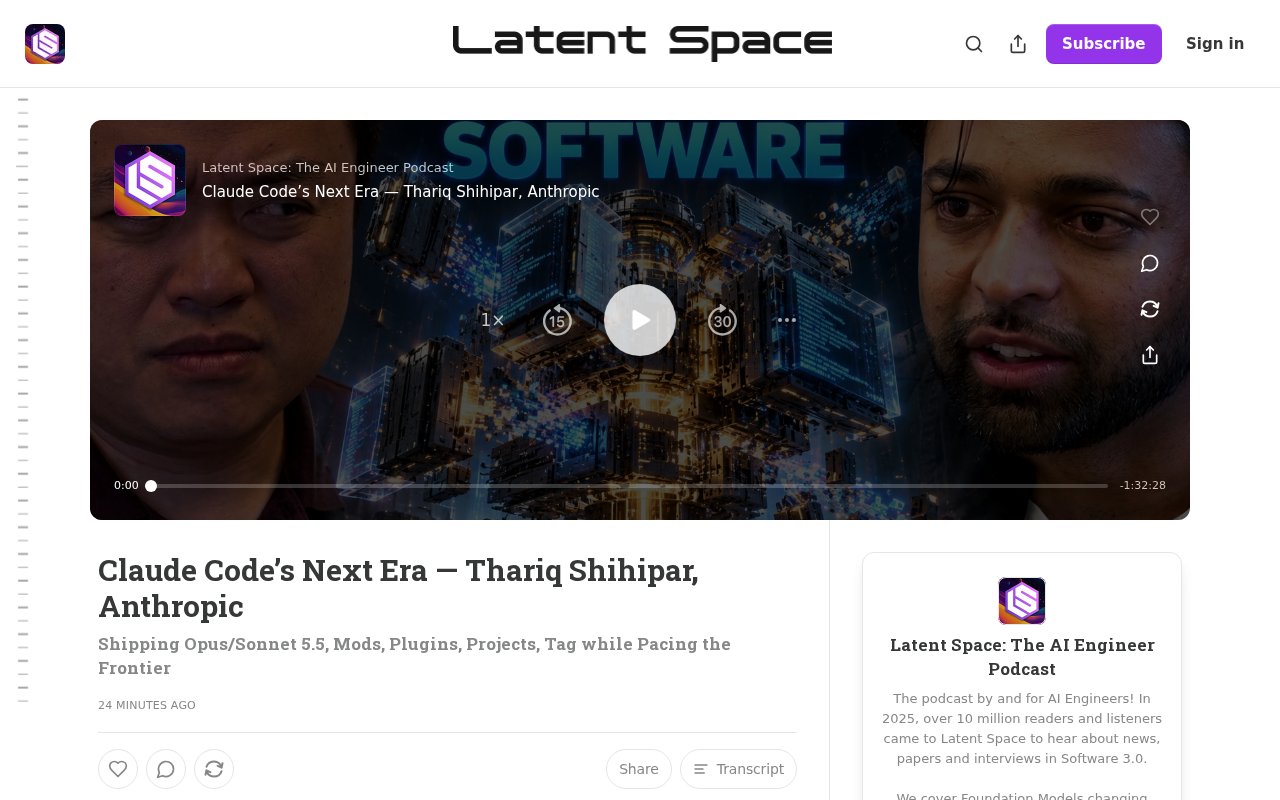
Anthropic's Thariq Shihipar recently shared the future direction of Claude Code, signaling that this AI coding tool is evolving from a standalone code assistant into a more complete developer platform. With the release of Opus/Sonnet 5.5 models and a wave of new features — including Mods, Plugins, Projects, and Tags — Anthropic is working to build a more systematic tool ecosystem in the AI coding space.
This move reflects the core competitive logic shaping today's AI coding tools: while improving raw model capability still matters, what truly determines long-term competitiveness is the workflow and extensibility system built around those models. This latest round of Claude Code updates is aimed squarely at that goal.
Model Upgrades: Opus and Sonnet 5.5
The release of the new-generation Opus and Sonnet 5.5 models forms the foundation of this update. As Anthropic's flagship and balanced-tier models respectively, they target different use cases — Opus typically handles more complex tasks requiring deep reasoning, while Sonnet strikes a balance between performance and cost, making it well-suited for everyday, high-frequency coding assistance.
Iterations in model capability directly determine the ceiling of what a coding assistant can do. Stronger code comprehension, more accurate context awareness, and more reliable multi-step task execution are the metrics developers care about most in practice. The advancement to version 5.5 means Claude Code now has a stronger foundation across all these core dimensions.
An Expanding Ecosystem: Mods, Plugins, and Projects
Beyond the models themselves, the more noteworthy aspect of this update is the extensibility layer being built around Claude Code. Mods, Plugins, and Projects all point toward a single goal: making the tool adapt to how developers actually work, rather than forcing developers to work around the tool.
Plugins and Modding
The Plugins and Mods mechanisms allow developers to extend Claude Code's functionality based on their own needs. This extensible architecture lets the tool integrate with different development environments, connect to third-party services, and support community-contributed customizations. For active developer communities, open interfaces like these tend to spark innovative use cases that even the official team couldn't anticipate.
Plugins and Mods are conceptually distinct: Plugins typically refer to officially or third-party developed, reviewed functional modules with a focus on stable integration interfaces (such as connecting to database tools, version control systems, or language-specific linters); Mods lean more toward lightweight, community-driven customization that lets developers change the tool's behavior or appearance without modifying the core system. This layered extension architecture is common in mature developer tools — VS Code's Extension and Settings Sync mechanisms and JetBrains' Plugin Marketplace both take a similar approach. The core value lies in this division of labor: the official team maintains consistency in the core experience, while long-tail needs are handled by the community. This keeps things stable while unleashing ecosystem vitality.
Project-Based Management
The Projects feature focuses on organizational capabilities at the workflow level. By managing context, configurations, and related resources on a per-project basis, developers can more easily switch between multiple tasks while keeping the AI assistant continuously informed about each project's background. This is especially valuable when working with large codebases or long-running maintenance projects.
Pacing the Frontier
The phrase "Pacing the Frontier" mentioned in the presentation carries significant meaning. It suggests that Anthropic, while pushing the boundaries of capability, is also deliberately controlling the pace and stability of its releases. In an era of rapid AI iteration, every frontier AI company faces the challenge of balancing innovation speed with product reliability.
For a developer tool like Claude Code, stability and predictability are often more valued than aggressive feature accumulation. Developers need tools they can trust, and frequent breaking changes only hurt the user experience. Anthropic's emphasis on "pacing" may reflect a mature product philosophy.
"Pacing the Frontier" carries specific meaning in AI safety and governance discussions, rooted in the idea that "the pace of capability diffusion should stay in sync with the pace of safety evaluation." As an AI company that places safety first — with a founding culture deeply influenced by effective altruism and AI alignment research — Anthropic has long advocated for building controllability and interpretability mechanisms in parallel with advancing model capabilities. Applied to product release strategy, this means new features aren't rushed out due to competitive pressure, but are only made public after internal validation confirms that their behavior is predictable and side effects are manageable. This stands in sharp contrast to some competitors' "iterate fast, test in public" approach, and explains why Anthropic's release cadence can sometimes seem more conservative than the market expects — yet its releases consistently earn a reputation for stability.
What This Means for the Developer Ecosystem
Taken together, this round of Claude Code updates outlines a clear evolutionary path: from model capability upgrades, to extensibility ecosystem development, to deep workflow integration. This aligns with the broader trajectory of the AI coding space — competition is shifting from "whose model is smarter" to "who can deliver a more complete and reliable development experience."
For developers, this means more choices and more flexible customization. For Anthropic, the ecosystem stickiness built through mechanisms like Tags and Plugins could become a significant competitive moat in an intensely competitive market. As these features roll out, whether Claude Code can truly deliver on its "next era" promise will ultimately be tested by real-world usage.
Related articles

How Big Can Stars Really Get? The Physical Limits of the Largest Stars
Red supergiants are the largest stars by volume, with radii up to 2,000 times the Sun, engulfing the inner solar system. But there is no precise upper limit on stellar size—models predict up to 15,000 solar radii. The most massive blue stars are far smaller than red supergiants—biggest and heaviest are two different things.

Apple HomeView Smart Display Full Feature Breakdown: Wall-Mount or Desktop, $299
Apple launches HomeView, a $299 smart display with wall-mount and desktop options, 12MP camera for facial recognition, smart home control, music playback, and recipe step-by-step cooking. Full breakdown of watch faces, apps, privacy, and cooking integration.

Where Did the Promised New Studio Go? Craft Computing Answers After Five Years
Craft Computing's host responds to viewer questions: the new studio promised five years ago was shelved as construction costs soared from $30,000 to $75,000, and was replaced by a 168-square-foot garage conversion.