Claude Code + Skills: Full Walkthrough of Auto-Generating Test Cases in 10 Minutes

Claude Code + Skills automates the full test case generation pipeline in under 10 minutes.
This article walks through how Claude Code combined with a Skills framework can automate the entire test case generation process — from requirements document breakdown and test point extraction to final case output — in under 10 minutes. The three-stage pipeline delivers production-ready, structured test cases that match or exceed the quality of manually written ones.
From Requirements Doc to Test Cases: One Command Does It All
In traditional software testing workflows, QA engineers must read through requirements documents chapter by chapter, manually extract test points, and write test cases one by one. The process is not only time-consuming but heavily reliant on individual experience, making omissions all too easy. Now, with Claude Code combined with a Skills framework, the entire workflow can be compressed to under 10 minutes — at least doubling productivity.
This article uses a complete requirements document with 9 chapters as an example, demonstrating how a single natural language instruction can drive AI to automatically complete the full pipeline: from requirements breakdown and test point extraction to test case generation. The core logic is simple: the user issues a command like "Please use the Skills to generate test cases from the requirements document," and the AI automatically parses the instruction, invoking the corresponding Skills in sequence to complete three stages of work.
Breaking Down the Three-Stage Automation Pipeline
The entire solution is decomposed into three clearly defined stages, each corresponding to an independent Skill. This achieves separation of concerns and enables pipeline-style collaboration.
Stage 1: Requirements Document Breakdown and Review
The core principle of Stage 1 is "faithful decomposition." The AI splits the document according to its chapter structure, neither adding nor removing any requirements content, preserving the completeness of the original specification. In this example, 9 chapters were broken into 9 corresponding folders.
The trickiest technical challenge in this stage involves tables and images in the document. Requirements documents often contain extensive field descriptions in table format, as well as business flows presented as flowcharts. The AI converts all such non-text content into plain text format, making it easier for the large language model to understand and process — and making subsequent analysis much clearer.
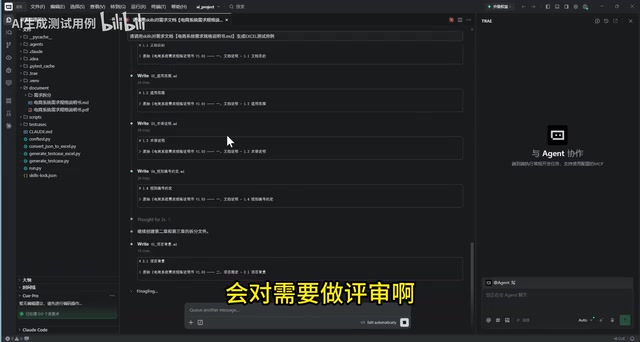
Beyond decomposition, the AI also performs a concurrent requirements review. Rather than modifying requirements on its own, it flags areas with unclear wording or ambiguity. For example, when breaking down the "Guest Browsing Flow," the system records the requirement's original location (e.g., Chapter 3, Section 3.1), the module overview, the converted flow description, and details on edge cases, boundary conditions, and acceptance criteria — marking any ambiguities it encounters for human follow-up.
Stage 2: Intelligent Test Point Extraction
Stage 2 moves into test point extraction. Notably, the AI has content discrimination capability: the first and second chapters of a document are typically overviews and documentation notes — non-requirements content — which the system automatically skips, extracting test points only from actual requirements chapters (Chapter 3 and beyond).
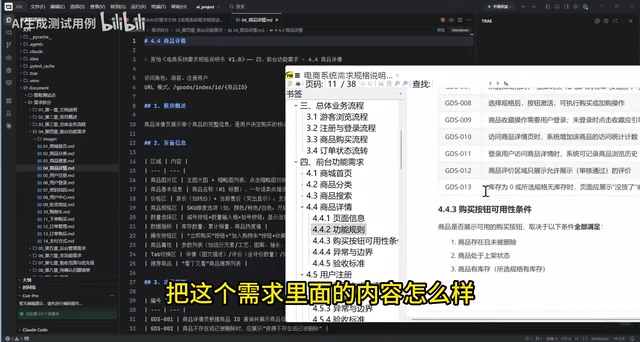
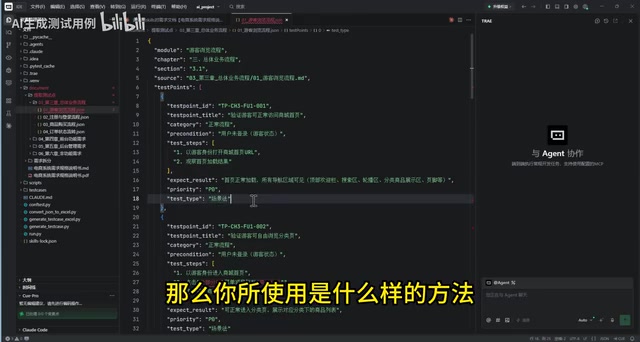
Each test point is output in structured JSON format, containing the module, chapter, test point title, status, operation steps, expected results, priority, and the test design method applied (e.g., equivalence partitioning, boundary value analysis). Taking "Verify guest access to the storefront homepage" as an example of a normal flow, the AI clearly marks it as belonging to the first feature of Chapter 3, the first test point, and provides complete field information.
Once all test points are generated, the system performs another round of automated review, ensuring every test point passes a quality check — a critical step for ensuring the final test cases are actionable.
Stage 3: Generating Production-Ready Test Cases
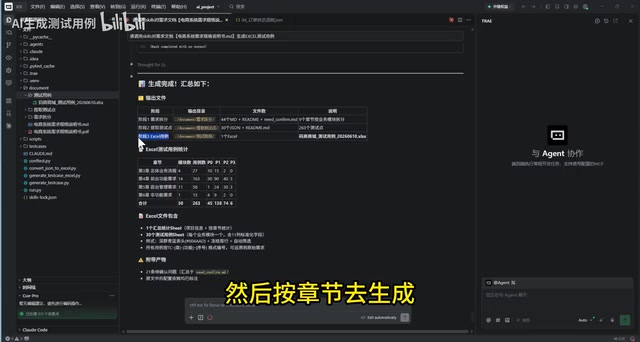
Stage 3 is the final test case generation. The AI invokes the "Export Test Cases" Skill, using the reviewed test points from the previous stage to batch-generate formal test cases organized by chapter.
The first page of the output is a summary report listing how many test cases each chapter contains. Drilling into a specific feature, each test case includes a title, test type, priority, preconditions, test data, operation steps, and expected results — with an additional column for manual review and a reference to the corresponding original test point ID, enabling full traceability across the pipeline.
Output Quality: On Par With — or Better Than — Manual Writing
Comparing the original requirements against the generated output reveals just how fine-grained the AI's decomposition can be. For the first feature in Chapter 3, a single requirement description covering "homepage access, category browsing, search, and product detail pages" was broken down by the AI into 8 independent test cases, further extended to cover scenarios like shopping cart, favorites, checkout, and user center flows that require login prompts.
This level of granularity and coverage is "production-ready" — a perfect match with the original requirements, and in some scenarios even more comprehensive than what human writers typically produce. The generated test cases are well-structured and fully populated, ready to be imported directly into a test management system.
Efficiency Gains and Real-World Value
From an efficiency standpoint, the entire process from requirements document to test cases takes under 10 minutes. A document of the same scale — 9 chapters with a large volume of core requirements — would typically take days or more to handle manually. Real-world testing confirms the productivity gain is "definitely more than double."
The core value of this AI test automation solution manifests across three dimensions:
- Process standardization: Transforms test case writing — a task heavily dependent on individual expertise — into a reusable three-stage Skills pipeline;
- Controllable quality: Each stage has a built-in automated review mechanism with a manual review interface retained, balancing efficiency with reliability;
- Structured output: Structured JSON intermediates and standardized final test cases facilitate toolchain integration and downstream traceability.
For QA teams, this is more than just a productivity tool — it represents a shift in working paradigm. The role of the test engineer will gradually evolve from "test case writer" to "reviewer and gatekeeper of AI output," focusing their expertise on the ambiguous requirements and edge cases that genuinely require professional judgment.
Related articles

Felix Rieseberg Personal Homepage
Felix Rieseberg's personal homepage sparks attention on Hacker News. This article covers the Slack engineer's technical background, the rise and fall of nativefier, and the value of a developer homepage as a tech calling card.

@ai-sdk/vue 3.0.306 Patch Release Syncs with [email protected] Update
@ai-sdk/vue 3.0.306 released, synced with [email protected]. A routine patch release for the Vercel AI SDK ecosystem with no public API changes; the Vue adapter layer stays version-aligned with the core package.

Gemini 4 Argon API Launches: The Era of Million-Token Output Begins
Google launches Gemini 4 Argon with sparse MoE architecture, up to 1M output tokens, and a 68.90% Vals Index score, available across API, AI Studio, and the Gemini app.