Claude Code Team: AI Turns Code Review into Real-Time Error Correction

The Claude Code team uses AI to turn code review from a final PR gate into real-time proofreading during coding.
Three core members of Anthropic's Claude Code team shared their internal practice of implementing AI code review. The core view is that "has a human read the code" is the wrong quality metric; the real question is which check best catches a specific risk. Review thus shifts from a final PR gate to continuous operation during coding, similar to document spell-check. Most changes complete at least one round of Claude review and fixes before a human looks, freeing human reviewers from finding low-level errors to focus on architectural judgment and edge cases. This practice aligns with tools like GitHub Copilot and Cursor and is becoming an engineering consensus. But some teams worry AI review creates a false sense of security, and this question remains unresolved.
Anthropic's Claude Code team members Addy Osmani, Morgan Westlee Lunt, and Qing Wang recently shared their internal practice of implementing AI code review. This seemingly minor engineering adjustment touches on the most fundamental collaboration pattern in software development—when should code review happen, and who should do it?
"Has a human read the code" is the wrong question
In traditional code review processes, the most critical quality gate is an implicit judgment: has a human looked at this code? The team believes this way of asking the question is itself flawed.
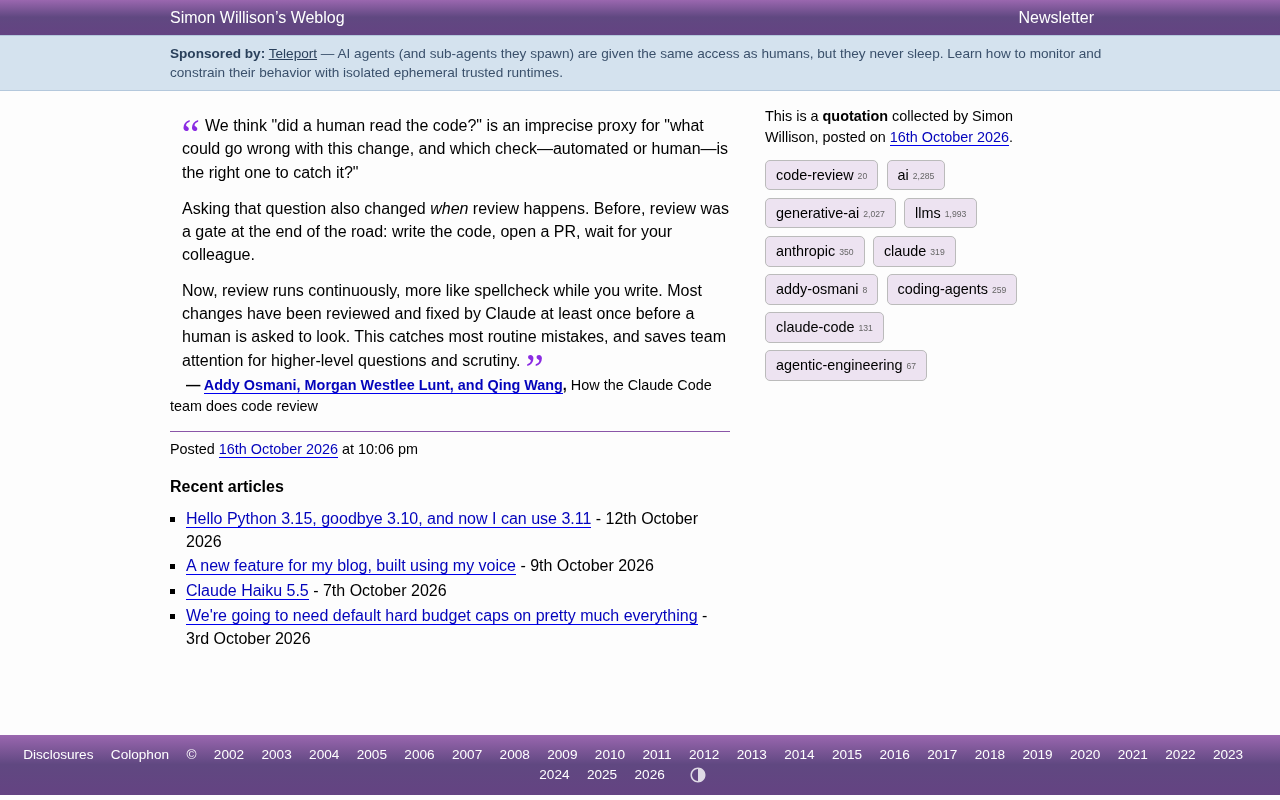
In their words: "We think 'has a human read the code' is an imprecise proxy. The real question is: what could go wrong with this change, and which check—automated or human—is best suited to catch it?"
The significance of this perspective shift is that it pulls review away from "going through the motions of confirmation" and back to "risk matching." Different types of changes correspond to different risk levels—low-risk formatting changes and high-risk concurrency logic modifications should never be handled with the same review resources. AI's involvement makes this fine-grained allocation possible.
Review shifts from "finish-line gate" to "real-time proofreading while writing"
A more fundamental change happens along the time dimension. In the past, code review was a finish-line gate: write code, submit a PR, wait for a colleague to have time to look. The bottleneck in this process isn't technical—it's that human attention is always a scarce resource.
The Claude Code team's practice is to let review run continuously, like spell-check while writing a document. Most changes have already gone through at least one round of Claude review and fixes before a human is invited to look. Routine errors get caught at this layer, freeing up team members' energy to focus on higher-level architectural judgment and key decisions.
This model changes not just efficiency, but also the psychological experience of review. When a human opens a PR, they're no longer facing raw, unexamined code—they're looking at a version that's already been through one round of cleanup. Reviewers are freed from the pressure of "finding low-level errors" and can truly do the things only humans can do.
Shift Left is a core principle in software engineering, referring to moving quality assurance activities as early as possible in the development lifecycle. In traditional models, testing and review are concentrated after development is complete—the later a defect is found, the higher the cost to fix it. The industry often cites the empirical rule that "defect fix costs grow exponentially as stages progress." Advancing AI code review into the coding process is precisely the concrete implementation of the shift-left philosophy in the review stage: catching issues before code is submitted and while context is still fresh in the developer's mind, preventing problems from flowing downstream.
Continuous Integration (CI) is another related thread. CI emphasizes developers frequently merging code into the main branch, with each merge triggering automated builds and tests. AI review can be seen as an extension of the CI pipeline in the "semantic checking" dimension—traditional CI excels at catching compilation errors and test failures, but is powerless when it comes to code intent and design consistency, which is exactly the layer large models can fill in. Embedding AI review into editors or commit hooks is essentially moving part of CI's capability from "after push" to "while writing."
Multi-source observation: AI code review is becoming an engineering consensus
This practice is not an isolated case. GitHub Copilot's code review feature, Cursor's Agent mode, and various open-source AI programming tools are all evolving in the same direction—embedding AI into the stage before code submission.
Analyses from different sources point to similar conclusions: the value of AI code review isn't in replacing human judgment, but in freeing humans from repetitive review. Addy Osmani himself has long focused on developer experience in the front-end engineering field, and his involvement itself shows that this approach has gained recognition among senior engineers.
Of course, disagreements exist. Some engineering teams worry that AI review may create a false sense of security—if AI says it's fine, will humans let their guard down? There's no definitive answer to this question yet; more practical data is needed to respond.
False Sense of Security is a long-studied phenomenon in the security and quality field: when some automated protective measure is introduced, human operators may lower their own vigilance because "the system has their back," ultimately causing overall risk to rise rather than fall. Similar cases have appeared in aviation autopilot and medical alert systems. In the context of AI code review, this risk specifically manifests as: reviewers see that AI has marked "passed" and stop reading the diff line by line, thereby missing logic flaws or security vulnerabilities that AI failed to identify.
Automation Bias is a related cognitive bias, referring to humans' tendency to over-trust the output of automated systems, especially when the system performs well in most cases. Common approaches to mitigating this problem include: retaining manual spot-check mechanisms, clearly marking confidence levels in AI review results, and positioning AI as "initial screening" rather than "final judgment." Tools like GitHub Copilot typically display AI comments alongside human comments in the PR interface rather than replacing human approval, precisely for this reason.
What this means for development teams
For teams considering introducing AI code review, the Claude Code team's practice offers several reference points.
When review happens matters more than review itself. Moving AI review earlier into the coding process, rather than triggering it after the PR is submitted, can significantly reduce rework.
Human attention should be used where it matters most. When AI handles routine checks, teams can raise their review standards—no longer getting stuck on variable naming and formatting, but focusing on design consistency and edge cases.
On tool selection, Claude Code, GitHub Copilot, and Cursor are all rapidly iterating their respective review capabilities, and teams can choose the solution with the highest integration level based on their existing tech stack.
The essence of code review is quality control, not process ritual. When AI can take on the mechanical parts, human reviewers have the space to do the things that truly require judgment.
Related articles

Chain of Thought Isn't Just for AI: How Humans Can Use CoT to Improve Thinking Quality
Chain of Thought isn't just a prompt trick for large models. Starting from a Hacker News discussion, this article analyzes why CoT works for human thinking too, breaks down actionable ways to transfer it, and highlights the key differences between human CoT and machine CoT.
Cloudflare Teams Up with OpenAI: Closi…
Cloudflare Teams Up with OpenAI: Closing the Loop from Vulnerability Discovery to Defense with AI
Cloudflare uses OpenAI Daybreak to investigate security vulnerabilities and generate reviewable remediation plans, while developers use Codex to boost coding efficiency and quality.

Orca Multi-Agent Orchestration in Practice: A Guide to Parallel Collaboration with Claude and Codex
Orca is Stable AI's free open-source agent workbench supporting 34 agents like Claude Code and Codex in parallel. Learn its Git worktree isolation, multi-model orchestration, and mobile management.