Claude Code Token-Saving Guide: Practical Tips to Cut Costs from $30 to $3
Practical tips to slash Claude Code token costs by 10x through caching, context management, and sub-agents.
This guide breaks down Claude Code's billing mechanics — where output tokens cost 5x more than input — and explains how conversation history accumulates costs over time. It covers practical strategies including prompt caching (which cuts input costs to 1/10th), streamlining context references, controlling command output verbosity, and using sub-agents to isolate large tasks. These techniques can reduce single-task costs from $30 to $3.
Anthropic Speaks Up: Stop Burning Tokens for Nothing
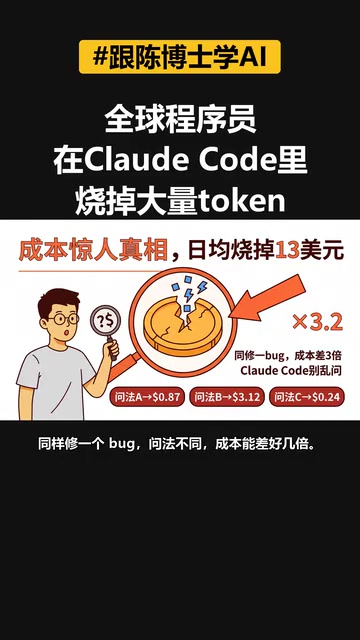
Anthopic recently published a blog post with a very straightforward message — stop wasting tokens in Claude Code. There's real cost pressure behind this reminder: according to official estimates, developers spend an average of about $13 per day on Claude Code, which adds up to $150 to $250 per month.
Here's a telling detail: fixing the same bug can cost several times more depending on how you phrase the request. This means understanding Claude Code's billing logic is itself a money-saving skill. For developers and teams who rely heavily on AI coding tools, this isn't an optional topic — it's the key to keeping budgets under control.
Claude Code Billing Logic: Output Tokens Cost Five Times More Than Input
To understand why costs can vary so dramatically, you first need to understand Claude Code's billing mechanism. Each request involves two steps:
Prefill: The model reads in the entire request and conversation history at once. This counts as input tokens.
Decode: The model generates text one token at a time, including intermediate reasoning and tool calls. This counts as output tokens.
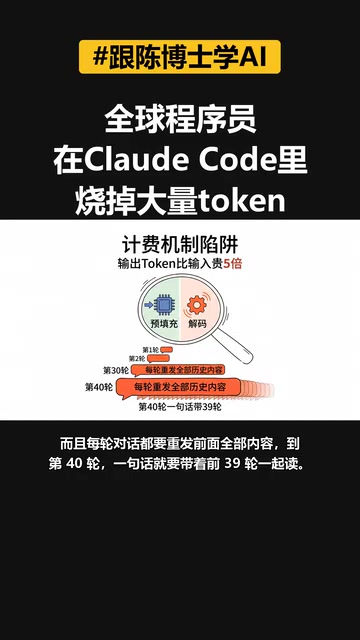
The critical point is that output tokens cost five times more than input tokens. This explains why verbose reasoning and repeated tool calls can quickly drive up costs.
It's worth explaining why output is so much more expensive than input. Tokens are the basic units that large language models use to process text — one token roughly corresponds to 3-4 characters in English or 1-2 characters in Chinese. The huge price difference between prefill and decode comes down to computational architecture: during prefill, all input tokens can be processed through highly parallel matrix operations with excellent GPU utilization. During decode, however, it's an autoregressive process — the model can only generate one token at a time and must wait for the previous token to be completed before computing the next one. The GPU spends much of its time idle, making compute efficiency far lower than during prefill. Simply put, the hardware resource consumption during output is much higher than during input, so the pricing naturally reflects that.
Even trickier is the cumulative effect of conversation history. With each turn, the model needs to resend all previous content. By turn 40, even if you've only typed a single sentence, the system has to include and re-read all 39 previous turns. As conversations grow longer, per-request input costs increase linearly — this is the hidden reason many people unknowingly burn through massive amounts of tokens.
This cumulative effect stems from the stateless nature of the Transformer architecture — the model itself retains no session memory. All "memory" is achieved by re-inputting the complete conversation history with each request. Claude's context window supports up to 200K tokens, which theoretically accommodates extremely long conversations, but the larger the window used, the higher the cost of re-inputting everything each turn. Assuming each turn averages 500 tokens, by turn 40 the history alone has accumulated roughly 20,000 tokens of input overhead — and that's before counting system prompts and code file contents.
The Core of Token Saving: Leverage the Prompt Caching Mechanism
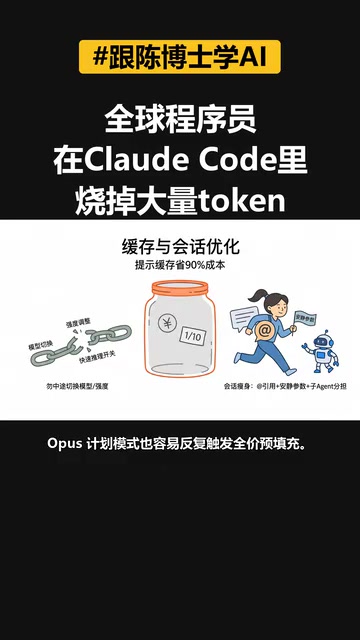
The key weapon for saving money is Prompt Caching. When the beginning of a request matches a previous one, the server can read directly from cache at just one-tenth the normal input token price.
The underlying principle of prompt caching is closely related to the KV Cache (Key-Value Cache) mechanism in the Transformer architecture. During attention computation, each token generates corresponding Key and Value vectors. When the conversation prefix is exactly the same, these pre-computed KV vectors can be loaded directly from server-side cache without re-running the forward pass. Anthropic's prompt caching mechanism requires the prefix to reach a minimum length (typically 1,024 tokens or more) before triggering a cache write. The cache is usually valid for 5 minutes, during which repeated requests enjoy the one-tenth discount.
However, the caching mechanism is quite "fragile" — it requires continuous matching from the very beginning. This is dictated by the technical characteristics of KV Cache: if any token in the middle changes, the attention computation results for all subsequent tokens will differ, and the entire cache must be invalidated. The following operations all cause cache invalidation:
- Switching models
- Switching reasoning intensity
- Toggling fast reasoning mode
- Compressing conversations
- Resuming after cache expiration
Any single interruption means the cache benefit vanishes instantly, and you're back to paying full price for the entire context. That's why the official recommendation is to lock in your model and reasoning intensity at the start of a task and avoid frequent mid-task switching.
It's also worth noting that OPUS's Plan Mode tends to repeatedly trigger full-price prefills. Frequently entering and exiting Plan Mode breaks cache continuity, invisibly increasing costs.
Practical Token Optimization Tips
Beyond preserving cache, the official blog offers several specific "trimming" suggestions:
Streamline Context References
When referencing files, use explicit symbolic references (like @filename) to specify exactly what's needed, rather than letting Claude search through and read the entire codebase. Having the model "aimlessly hunt for files" consumes large amounts of unnecessary tokens.
Control Command Output Length
When running test commands, add quiet flags so the command only outputs a few summary lines instead of stuffing the entire verbose log into the context. The longer the log, the more input tokens consumed.
Use Sub-Agents to Isolate Large Tasks
For tasks that generate massive output, delegate them to a sub-agent that runs independently within its own context, completing the work in isolation and bringing only the conclusions back to the main conversation. This prevents the main conversation's context from being polluted by large volumes of intermediate tokens, and makes it much easier to maintain cache.
The sub-agent pattern borrows from the process isolation concept in software engineering. In the agentic programming paradigm, a complex task can be split into multiple independent subtasks, each with its own context window, working within its own "sandbox." This architecture offers two core advantages: first, the sub-agent's intermediate reasoning, tool call logs, and other voluminous tokens don't pollute the main conversation's context — the main conversation only receives a final summary; second, the main conversation's token prefix stays stable, dramatically improving cache hit rates. In essence, this is a "Map-Reduce" approach — distributing tasks (Map) to multiple sub-agents and aggregating results (Reduce) back to the main conversation, balancing task completion with cost control.
A Deeper Shift: The Ability to Master AI Tools Is Becoming More Valuable
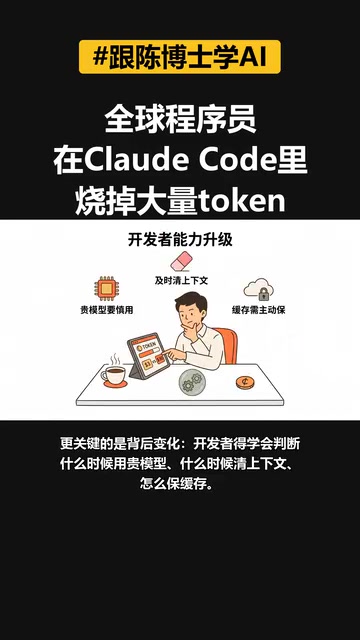
On the surface, this blog post is about saving money, but it reveals a deeper industry shift: developers need to learn when to use expensive models, when to clear context, and how to preserve cache. These decisions directly determine whether a task costs $3 or $30.
The data is compelling: Anthropic says 80% of its code is now written by AI, and code merge volume has increased 8x in one year. At that level of usage, if you don't actively manage token costs, AI tool expenses will quickly consume the entire development budget.
Putting these numbers in industry context makes the trend even clearer: Google revealed in late 2024 that over 25% of its new code is AI-generated, and Microsoft's CEO stated that GitHub Copilot assists in writing about 30% of code. Anthropic's 80% is far above the industry average, which relates to its unique position as an AI-native company — its development team naturally has higher acceptance and proficiency with AI tools. But this also points to where the entire industry is heading: as AI coding tools mature, code productivity will shift from "how fast humans write code" to "how efficiently humans direct AI to write code," and token cost management will become an indispensable variable in that efficiency equation.
In other words, the more powerful AI coding tools become, the more mastering them effectively becomes a core competitive advantage. The barrier to using the tools themselves is dropping, but the "brain that knows how to use the tools" is becoming even more valuable. For developers, understanding billing logic and optimizing context management is evolving from an optional skill into essential engineering literacy for the AI era.
Final Thoughts
Anthopic's blog post is less a money-saving manual and more a mindset reminder about "how to collaborate with AI." When AI can write 80% of our code, human value is gradually shifting from "writing code" to "designing how AI writes code" — including controlling costs, managing context, and orchestrating task workflows. These capabilities are the true moat for developers of the future.
Related articles

Chain of Thought Isn't Just for AI: How Humans Can Use CoT to Improve Thinking Quality
Chain of Thought isn't just a prompt trick for large models. Starting from a Hacker News discussion, this article analyzes why CoT works for human thinking too, breaks down actionable ways to transfer it, and highlights the key differences between human CoT and machine CoT.
Cloudflare Teams Up with OpenAI: Closi…
Cloudflare Teams Up with OpenAI: Closing the Loop from Vulnerability Discovery to Defense with AI
Cloudflare uses OpenAI Daybreak to investigate security vulnerabilities and generate reviewable remediation plans, while developers use Codex to boost coding efficiency and quality.

Orca Multi-Agent Orchestration in Practice: A Guide to Parallel Collaboration with Claude and Codex
Orca is Stable AI's free open-source agent workbench supporting 34 agents like Claude Code and Codex in parallel. Learn its Git worktree isolation, multi-model orchestration, and mobile management.