Claude Code Usage Surges 8x: Error Retries Count Against Paid Quota, Anthropic Refuses Compensation
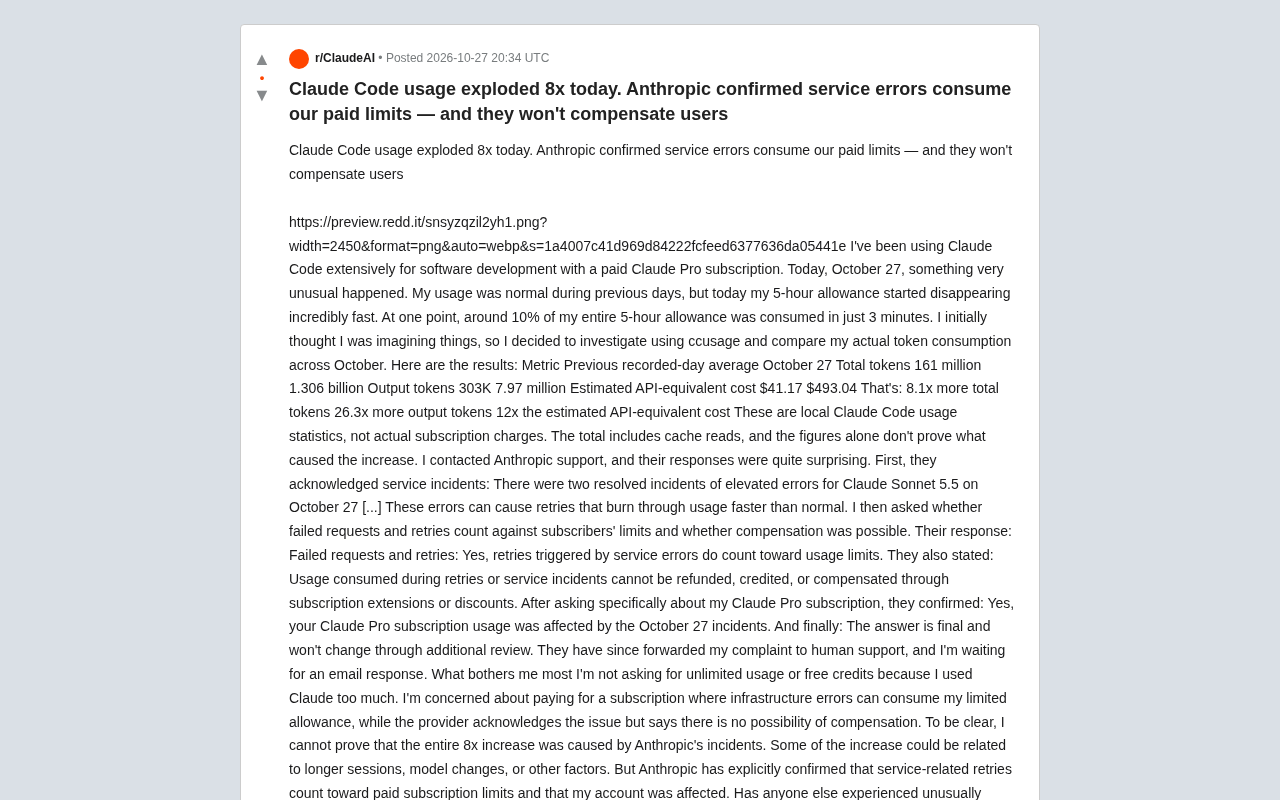
Anthropic support confirmed that retries triggered by service errors count against subscription quotas with no compensation, raising developer concerns about cost shifting for platform failures.
A heavy Claude Pro user found their single-day token consumption had surged abnormally—total tokens about 8.1x the daily average, output tokens about 26.3x, and API-equivalent cost about 12x. Anthropic support confirmed that Claude Sonnet 5.5 experienced two high-error-rate incidents that day, that retries triggered by service errors count against subscription quotas, and explicitly stated that no refunds, credits, or compensation are possible. The author acknowledges that local data cannot fully prove the entire increase stems from the failures, but the provider has confirmed their quota was affected. The incident exposes gaps in subscription-based AI coding tools regarding failure liability and metering transparency: the less stable the platform, the less usable quota users actually get, with the risk borne entirely by the paying party. The article advises developers to establish usage baselines with tools like ccusage, split long sessions, preserve evidence, and calls for community cross-validation of similar anomalies.
A developer on a Claude Pro subscription recently went public with their usage data: single-day total token consumption jumped from an average of roughly 161 million the previous period to 1.306 billion, output tokens climbed from about 303,000 to 7.97 million, and the API-equivalent cost rose from roughly $41 to about $493. According to their own account, at one point about 10% of a 5-hour quota was consumed in just 3 minutes. This isn't a routine case of "using too much"—it's a dispute over whether failed-request retries should count against your bill.
Event Recap: Abnormal Consumption Within a Single Day
The poster describes themselves as a heavy Claude Code user with a long record of stable daily usage. On the day in question, they noticed the 5-hour rolling quota draining unusually fast, so they pulled their entire month of local usage records with the ccusage tool for comparison.
The three comparisons they provided: total tokens about 8.1x, output tokens about 26.3x, and API-equivalent cost about 12x. It's important to note that these are locally recorded Claude Code usage figures, not actual subscription charges; the totals also include cache reads. The author themselves acknowledges that the numbers alone cannot prove the entire increase stems from service failures.
What actually escalated the situation was their correspondence with Anthropic support.
ccusage is an open-source command-line tool built specifically for tracking Claude Code's local usage data. It parses the session logs Claude Code stores locally (typically in a hidden folder under the user's home directory) and aggregates daily and monthly token consumption, request counts, and API-equivalent cost based on Anthropic's published API pricing. Because the data comes entirely from local logs, ccusage's statistics don't depend on server-side billing, so they reflect the actual volume of calls the user made—but they can't distinguish successful requests from retries triggered by errors. This makes it a common tool for developers auditing their own usage and establishing baselines, and it was the core evidence the poster relied on in this incident.
Official Response: Retries Count Against Quota, No Compensation
According to the poster, Anthropic support confirmed two things in their reply: that day, Claude Sonnet 5.5 experienced two resolved high-error-rate incidents, and those errors trigger retries, which consume quota faster than normal.
When pressed on whether failed requests and retries count against subscriber quotas and whether compensation was possible, support's answer was: retries triggered by service errors do indeed count toward usage limits; quota consumed by retries or service incidents cannot be refunded, credited, or compensated through subscription extensions or discounts. After the author explicitly asked about their own Claude Pro subscription, the representative confirmed that their subscription quota had indeed been affected by that day's incidents, and stated that this was a final determination that would not change upon further review.
Support later escalated the complaint to human support, and the author is still waiting for an email reply.
Why This Matters
The core of this dispute isn't about whether unlimited usage should be allowed. The poster themselves says they aren't asking for free quota—they're questioning a structural problem: when infrastructure fails, the limited quota users paid for gets consumed by errors, and while the provider acknowledges the problem exists, it explicitly refuses to take responsibility for compensation.
Subscription-based AI coding tools universally use rolling-window quota models, and failed model calls, timeouts, and rate-limit retries are routine from an engineering standpoint. If those failed calls also count against quota, then service reliability translates directly into users' economic costs—the less stable the platform, the less usable quota users actually get, with the risk borne entirely by the paying party.
Another detail worth discussing is metering transparency. Most subscribers can't directly see "which tokens were spent on failed requests" and can only estimate totals through third-party tools. The lack of itemized billing means users have a hard time making their case in a dispute, and the platform is hard to audit externally.
The rolling-window quota model is the billing approach currently common across AI coding subscription services. With Claude Pro, for example, quotas don't reset on a calendar-month basis; instead, there's a 5-hour rolling window with a cap on messages or tokens available within it, and once you exceed it you must wait for the window to roll forward and release quota. This design aims to smooth peak load and prevent abuse, but it also means quota burn rate is directly tied to request frequency and retry counts. When error rates rise, automatic client- or server-side retries rapidly consume window quota with almost no user awareness. Compared with fixed monthly quotas, rolling windows offer weaker buffering against sudden failures, and users are more likely to hit the cap in a short period.
Practical Advice for Developers
Until platform policy changes, heavy users can take some self-protective measures. First, continuously log local usage with tools like ccusage to establish a baseline, so you have something to compare against when anomalies occur. Second, split long sessions to avoid cascading consumption from retries within a single session. Third, when you encounter obvious anomalies, save screenshots and support correspondence as soon as possible to preserve evidence for later appeals.
For team users, the safer approach is to put critical tasks on enterprise-grade solutions with better observability, or to handle failed requests idempotently at the architecture level to reduce wasted retries.
Idempotent handling means that in a distributed system, executing the same request multiple times produces the same side effects as executing it once. In the context of AI coding tools, if a model call is retried due to a timeout or error, the client should ensure the retry doesn't trigger duplicate billing or produce duplicate side effects (such as writing a file twice or committing code twice). Implementation approaches include assigning a unique identifier to each request, deduplicating on the server side, or using idempotency keys. For team users, introducing idempotency mechanisms at the architecture level can reduce wasted retries caused by network jitter or service errors, thereby lowering quota consumption and cost risk.
The Bigger Question: Who Pays for Platform Failures
This incident exposes a gray area in the terms of AI subscription services. Traditional cloud services typically define availability floors and compensation mechanisms through SLAs, but developer-facing AI coding subscriptions currently lack clear rules for allocating responsibility for failures.
At the end of their post, the author asks the community to verify: has anyone else experienced similar abnormal quota consumption on the same day, especially in the afternoon, and they hope users with local logs will share their data. This kind of cross-validation matters—if multiple independent users report the same pattern, the nature of the problem shifts from an individual experience to a reproducible systemic phenomenon.
Until the platform provides further explanation, this incident serves as a reminder to all paying users: your quota depends not only on how much you use, but also on how stable the service itself is.
Related articles
One Year of Dioxus Fullstack in Production: Gains and Pain Points
A developer shares a year of real-world experience running the Dioxus fullstack framework in production, covering type-safety gains in fullstack Rust, plus pain points like compile times and ecosystem maturity, as a reference for technology selection.

The Hidden Faith of AGI Leaders: Humans Are Nothing Special?
Vergecast podcast reveals the hidden belief within AGI leadership circles: humans are nothing special, consciousness is just computation. Exploring how computational functionalism shapes the worldview of tech elites and the future of AI.
GM Shifts Toward Hybrids: From an All-Electric Bet to a Pragmatic Parallel Strategy
GM once skipped hybrids to bet on pure EVs; now it plans hybrid SUV versions. This article analyzes the strategic shift, its significance for SUVs, and consumer impact.