Claude Code v2.1.276 Released: Fixes Proxy/Gateway 400 Error Regression
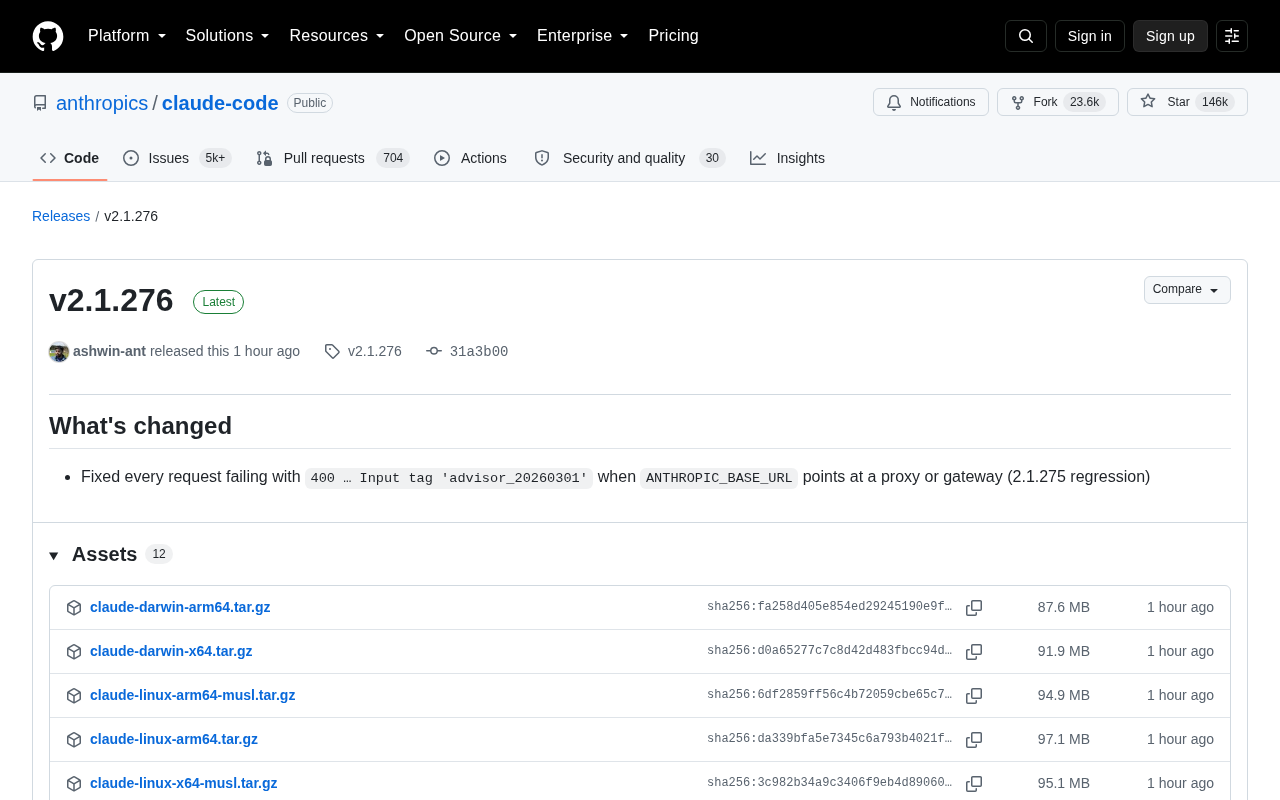
Claude Code v2.1.276 urgently fixes a regression that caused 100% request failures for proxy/gateway users.
Claude Code v2.1.276 is a targeted hotfix that resolves a regression introduced in v2.1.275. The bug affected all users routing requests through a custom `ANTHROPIC_BASE_URL` to a third-party proxy or enterprise gateway, causing every request to return HTTP 400 with an `advisor_20260301` tag error. The root cause was a newly added client-side request field incompatible with proxy validation logic — effectively breaking the entire toolchain for enterprise users. The rapid response from discovery to patch release reflects the team's focus on stability. Affected users should upgrade to v2.1.276 immediately.
Release Overview
Anthropic has released Claude Code v2.1.276. This is a small but critical patch release focused entirely on fixing a regression bug introduced in the previous version, v2.1.275.
As Anthropic's official command-line coding assistant, Claude Code has accumulated over 146,000 Stars and 23,600 Forks on GitHub, making it one of the most popular AI programming tools available today. The team's rapid release cadence reflects their ongoing commitment to stability and user experience.
The Core Fix
This update contains a single change — but it's a critical one for anyone using a proxy or gateway:
Fixed an issue where every request would fail with
400 … Input tag 'advisor_20260301'whenANTHROPIC_BASE_URLwas pointed at a proxy or gateway (a regression introduced in v2.1.275).
In plain terms: in v2.1.275, any user who had configured a custom ANTHROPIC_BASE_URL environment variable to route requests through a third-party proxy or internal enterprise gateway would experience a 100% request failure rate. The advisor_20260301 tag in the error message suggests the root cause was a newly added field in the API request body that was incompatible with the validation logic in intermediate proxy layers, causing the server to return HTTP 400 (Bad Request).
Who Is Affected
- Developers using third-party API proxy services to access Claude
- Teams managing AI API traffic through a centralized enterprise gateway
- Anyone who has configured
ANTHROPIC_BASE_URLto point to a non-default endpoint
If you connect directly to Anthropic's official API endpoint, you are not affected by this bug. However, for the large number of enterprise users who deploy proxy layers for compliance, auditing, or access control purposes, this regression was essentially a showstopper — it rendered the entire toolchain completely non-functional.
ANTHROPIC_BASE_URL is an environment variable provided by Claude Code that allows users to redirect API requests to a custom endpoint instead of Anthropic's default servers. This mechanism is extremely common in enterprise deployments: teams can run a reverse proxy or API gateway on their own infrastructure to centrally manage authentication keys, log requests, enforce access control, or serve as a relay when direct access to external services is restricted. Common implementations include Nginx reverse proxies, cloud provider API gateway products, and AI API aggregation platforms like LiteLLM or OpenRouter. These intermediate layers often perform strict validation on request body formats — so when the official client adds a new field that the proxy doesn't recognize, a 400 error can be triggered. This is precisely the root cause of this regression.
Lessons from a Regression
A "regression" refers to a feature that worked correctly before being broken by a change in a newer version. This is not uncommon in fast-moving software projects, especially one with as high a release frequency as Claude Code.
The tight turnaround from v2.1.275 to v2.1.276 shows that the team responded quickly once the issue was identified. Users relying on proxy-based access should upgrade to v2.1.276 as soon as possible to restore normal functionality. This incident also serves as a reminder to both the team and third-party proxy developers: when the official API client adds new fields to the request body (such as the advisor_20260301 tag here), strict validation policies in intermediate layers can become a source of compatibility issues.
The advisor_20260301 tag in the error message is worth noting. Its naming format is consistent with the style of feature identifiers commonly seen in the Anthropic API — date suffixes like 20260301 typically represent a version anchor for a specific capability or behavior, similar to tool tags like computer_use_20241022 found in Claude model system prompts. These tags are generally attached to the request body as JSON fields to declare to the backend which feature set or protocol version the client is using. When an intermediate proxy uses a whitelist-based validation strategy rather than a pass-through approach, any unexpected new field will cause the request to be rejected. This highlights a best-practice recommendation for proxy developers: favor "pass through unknown fields" over "filter unknown fields" to achieve better forward compatibility.
Upgrade Recommendations
For current Claude Code users — especially those with proxy or gateway configurations — here's what to do:
- Upgrade from v2.1.275 to v2.1.276 immediately
- After upgrading, verify that requests through your proxy are working normally again
- If you maintain a proxy middleware layer, review whether it passes through or filters new request fields
Community response to this release has been positive, with multiple favorable reactions on the release page. For engineers who have integrated Claude Code into their daily development workflow, staying on top of these stability patches is the best way to avoid unexpected disruptions.
Related articles

27B Dense Model Tops Hugging Face All-Time Likes: Frontier-Level Agentic Ability on 16GB VRAM
A 27B dense model from Hangzhou tops Hugging Face's all-time likes chart. Quantized to 16GB VRAM, a single RTX 4090 delivers frontier-level Agentic performance locally.

Andrew Ng on Agentic AI: Cutting Through the Hype to Find Real Value in Agent Development
Andrew Ng's Agentic AI course intro: separating hype from real value, exploring agent workflows in customer service, research, law, and healthcare, and why evals and error analysis define expert-level agent development.

The Netflix Microservices Myth: An Architecture Migration Misunderstood by an Entire Industry
The real story behind Netflix's cloud migration and microservices transformation — and why the entire industry copied the solution while missing the actual problem.