Claude Code v2.1.281 Update Deep Dive: Security Hardening and Stability Overhaul

Claude Code v2.1.281 delivers a dense maintenance update focused on enterprise gateways, security hardening, session reliability, and interaction polish.
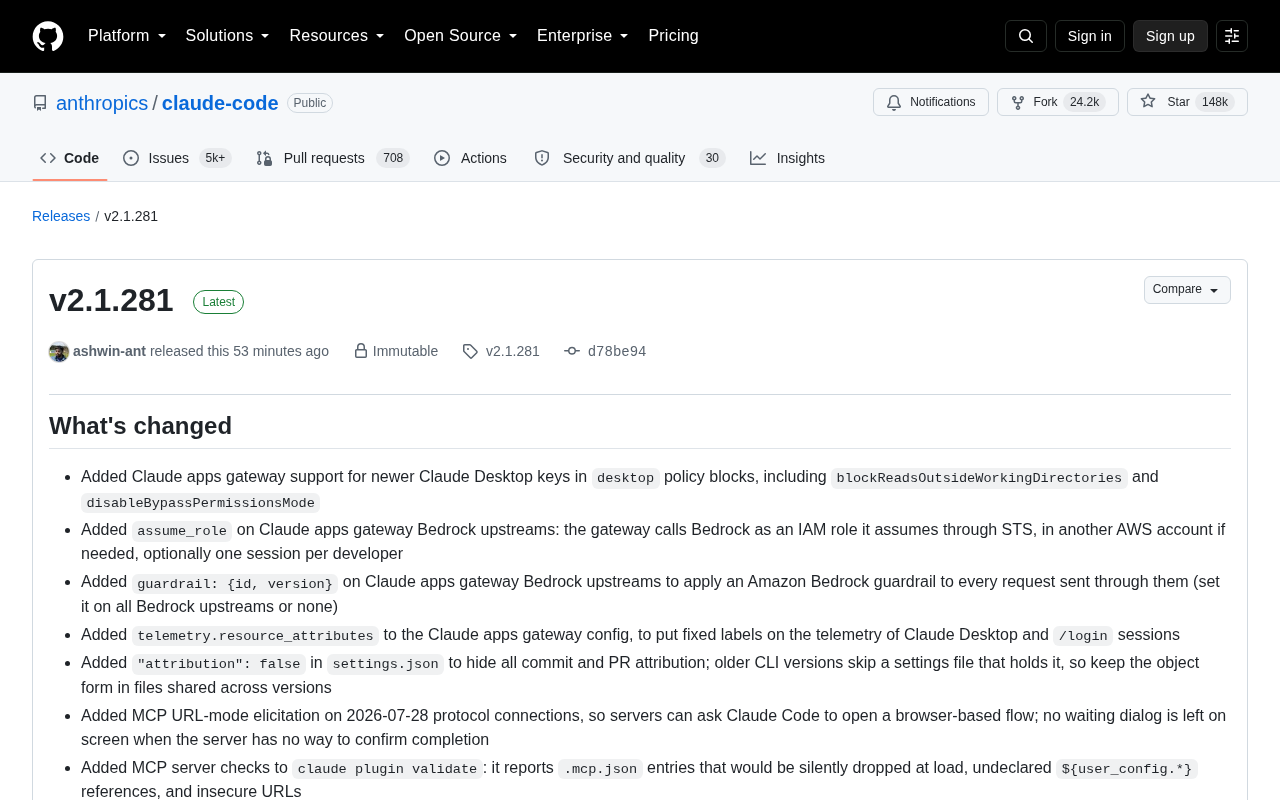
Claude Code v2.1.281 brings no headline features but covers an exceptionally broad set of production-grade fixes. Enterprise additions include Bedrock `assume_role` IAM support, Guardrails configuration, and telemetry labels. Security patches close the silent recursive-delete loophole in command substitution and fix NUL-byte permission rules being misread as wildcards. Session recovery is systematically overhauled to prevent history mutation, prompt cache invalidation, and large-session truncation, while network fault tolerance improvements prevent truncated responses from being treated as complete and stop tool calls from running twice.
Anthropic's command-line AI coding tool Claude Code has received its v2.1.281 update. While this release doesn't come with flashy new feature announcements, it's an exceptionally dense maintenance upgrade — covering enterprise gateway support, permission security hardening, session recovery reliability, and a large number of interaction detail fixes. For teams that rely on Claude Code for daily development, this update addresses the kind of subtle issues that genuinely impact productivity.
Enterprise Gateway Capabilities Continue to Expand
This update adds several enterprise-oriented capabilities at the Claude apps gateway layer, reflecting Anthropic's commitment to controlled deployments in large organizations.
The most notable addition is assume_role support for the Bedrock upstream: the gateway can assume an IAM role via STS to invoke Bedrock, even across AWS accounts, with the option to assign each developer an independent session. This is extremely valuable for enterprises that require strict permission isolation and cost attribution.
Complementing this is the guardrail: {id, version} configuration, which allows Amazon Bedrock Guardrails to be applied to every request passing through the Bedrock upstream, enabling unified content compliance controls. Additionally, the new telemetry.resource_attributes lets administrators attach fixed labels to telemetry data for Claude Desktop and /login sessions, making monitoring and auditing much easier.
For desktop policy blocks, the new version adds support for policies like blockReadsOutsideWorkingDirectories and disableBypassPermissionsMode, further tightening behavioral boundaries in managed environments.
AWS STS (Security Token Service)'s
assume_rolemechanism allows an AWS entity to temporarily acquire the permissions of another IAM role without holding long-term credentials. In Claude Code's gateway context, this means enterprises can set up granular Bedrock access permissions for different teams or developers — for example, restricting a team to only certain models, or automatically attributing a project's costs to its corresponding account — without issuing individual AWS keys to each user. Cross-account operations further allow centralizing AI call budgets into a dedicated AWS account, with primary business accounts accessing it via role delegation, fundamentally decoupling permission management from cost tracking. Amazon Bedrock Guardrails is AWS's managed content filtering layer that lets you configure topic blocking, sensitive information redaction, and harmful content filtering on model inputs and outputs — enabling enterprise-wide compliance controls without modifying client code.
Security Fixes: Closing Permission Bypass Loopholes
Some of the most critical fixes in this update address security vulnerabilities in the permission system — several of which could cause real harm if exploited.
The most prominent is recursive deletion in command substitution scenarios. Previously, recursive delete commands like rm -rf "$(pwd)" — where the target came solely from command substitution output — would execute silently without prompting in auto mode and --dangerously-skip-permissions mode. After the fix, Claude Code will proactively ask even when a Bash allow rule is present, unless CLAUDE_CODE_DISABLE_SUBSTITUTION_RM_PROMPT=1 is explicitly set. This is a classic "secure by default" design adjustment.
Permission rule parsing has also been hardened: permission rules containing NUL bytes are no longer incorrectly expanded into wildcard matches — they now match nothing. Additionally, permission dialogs and attachment checks on macOS no longer read /.vol, /.nofollow, or /.resolve paths (which may touch network mounts) before approval.
For background sessions, claude --bg no longer starts sessions or runs project hooks in directories that haven't passed the workspace trust prompt — it now requests trust first, or exits in non-interactive scenarios. The --setting-sources restriction is also now correctly propagated to derived sessions, ensuring that sub-sessions in team collaboration, /bg, claude agents, and similar contexts inherit the parent session's constraints.
Reliability Overhaul for Session Recovery and Network Fault Tolerance
If there's one thread running through the entire update log, it's the systematic fixes to session resume and agent/gateway network failure handling.
On the session recovery side, multiple bugs that could corrupt conversation history have been fixed: resumed sessions could previously re-send earlier turns in altered forms (such as parallel tool calls, MCP tool call inputs, and tool search results mid-reconnect), causing the API to discard prior reasoning chains; resuming very large sessions might only restore the last few messages; and resuming a session after a restart during a pending permission prompt would send a different history, breaking the prompt cache. The shared consequence of these issues was model "amnesia" or cache invalidation, directly driving up costs and degrading quality.
Network fault tolerance fixes are equally dense. When an agent or gateway cleanly closes a stream, truncated responses were previously displayed as complete with no warning, and tool calls could even run twice on duplicate stream events; agents dropping stream events mid-response would trigger "Content block not found" errors. The new version now preserves partial responses, retains search results that have already arrived, and fixes stop reason loss when a gateway sends trailing usage-only frames. Retry logic in CLAUDE_CODE_RETRY_WATCHDOG and fast mode's handling of Retry-After: 0 have also been corrected.
Prompt Cache is a cost optimization mechanism in the Anthropic API: when consecutive requests share the same context prefix, the server can reuse already-computed KV cache, dramatically reducing the billing rate for input tokens (typically up to 90% for cache-hit portions). When resuming a session, any subtle change to the history — even just the format of tool call parameters or message order — causes the cache prefix to mismatch, forcing the API to recompute the entire context. This not only drives up costs but increases time-to-first-token. For large codebase analysis tasks that rely on long context windows, a single cache miss can mean several times the usual cost. This fix ensures that history messages are replayed in their original form when resuming a session, which is key to maintaining the economics of long-running development sessions.
MCP Protocol and Plugin System Polish
MCP (Model Context Protocol) improvements target users who deeply integrate external services. The new version adds MCP URL pattern elicitation on 2026-07-28 protocol connections, allowing servers to request that Claude Code open a browser-based flow; no waiting dialog will be left on screen when the server cannot confirm completion.
claude plugin validate now checks MCP server configurations, reporting .mcp.json entries that would be silently dropped on load, undeclared ${user_config.*} references, and unsafe URLs. Issues where multiple MCP connection duplicates or URL spelling differences (host casing, default ports, trailing slashes) caused the same server to be connected twice have also been fixed.
Plugin management (claude plugin command family) fixes a series of inconsistencies around project-scoped plugin uninstallation, updates, and disabled-state detection, making plugin lifecycle management more predictable.
MCP (Model Context Protocol) is an open standard led by Anthropic, designed to unify communication between AI models and external tools and data sources. Its core idea is to abstract "context provision" into standardized server-client interactions: MCP servers can expose Tools, Resources, and Prompts, and Claude Code as a client discovers and invokes these capabilities through a unified protocol without writing custom adapter code for each integration. The elicitation mechanism introduced in the 2026-07-28 protocol version allows MCP servers to proactively request that the client open a browser flow when user interaction is needed (such as OAuth authorization or multi-step configuration), solving the pain point of being unable to complete web-based authentication from a purely command-line environment. This is especially important for enterprise services that require OAuth flows, such as GitHub, Jira, and Slack.
Extensive Interaction Detail Fixes
The second half of the update log is almost entirely polish at the terminal interaction level — the sheer volume is impressive. Vim mode fixes cover operations like dj/dk/dG/dgg acting on half-lines, cw incorrectly modifying the next word, and word movement failing in scripts like Hindi and Bengali. Display and error handling for slash commands including /context, /model, /config, and /feedback have all been corrected.
There's also a batch of edge-case fixes for rapid keypresses: for example, pressing Ctrl+C or Ctrl+D twice in quick succession now exits the program rather than closing a dialog, and key sequences arriving all at once (such as an arrow key immediately followed by Enter) now act on the correct selection rather than the previous one. These seemingly trivial issues are exactly the kind of friction that becomes most distracting during long sessions.
Summary
v2.1.281 is a quintessential "under the hood" update. It has no marketing hooks, but each of its improvements — IAM role assumption in enterprise gateways, Bedrock Guardrails, security prompts for command-substitution deletions, and session recovery history consistency fixes — points directly to real production pain points. For teams that have incorporated Claude Code into their formal development workflow, upgrading promptly will significantly reduce headaches from accidental deletions, cache misses, and network anomalies.
Related articles

Chain of Thought Isn't Just for AI: How Humans Can Use CoT to Improve Thinking Quality
Chain of Thought isn't just a prompt trick for large models. Starting from a Hacker News discussion, this article analyzes why CoT works for human thinking too, breaks down actionable ways to transfer it, and highlights the key differences between human CoT and machine CoT.
Cloudflare Teams Up with OpenAI: Closi…
Cloudflare Teams Up with OpenAI: Closing the Loop from Vulnerability Discovery to Defense with AI
Cloudflare uses OpenAI Daybreak to investigate security vulnerabilities and generate reviewable remediation plans, while developers use Codex to boost coding efficiency and quality.

Orca Multi-Agent Orchestration in Practice: A Guide to Parallel Collaboration with Claude and Codex
Orca is Stable AI's free open-source agent workbench supporting 34 agents like Claude Code and Codex in parallel. Learn its Git worktree isolation, multi-model orchestration, and mobile management.