Claude Code v2.1.285 Deep Dive: Desktop Integration and Enterprise Controls Get a Major Upgrade

Claude Code v2.1.285 brings desktop integration, enterprise provider controls, and sweeping permission and security fixes.
Claude Code v2.1.285 is a major update focused on filling capability gaps. New features include `claude --desktop` for seamless terminal-to-GUI workflow switching and MCP plugin configuration at install time for easier bulk deployment. On the enterprise side, the new `allowedProviders` allowlist restricts which API providers can be used, and policy loading logic is now more robust. Bug fixes address long-standing pain points including permission inheritance, Artifact data overwrites, and URL password exposure in logs. Performance improvements include cached Bedrock/Vertex startup checks for faster cold starts and reduced long-session freezing.
Anthropic's AI coding tool Claude Code has released version v2.1.285. This is a substantial update covering new features, a large number of bug fixes, and strengthened enterprise-grade governance capabilities. Compared to previous versions that focused primarily on terminal interactions, this release clearly pushes in three directions: desktop integration, plugin ecosystem governance, and multi-cloud environment compatibility.
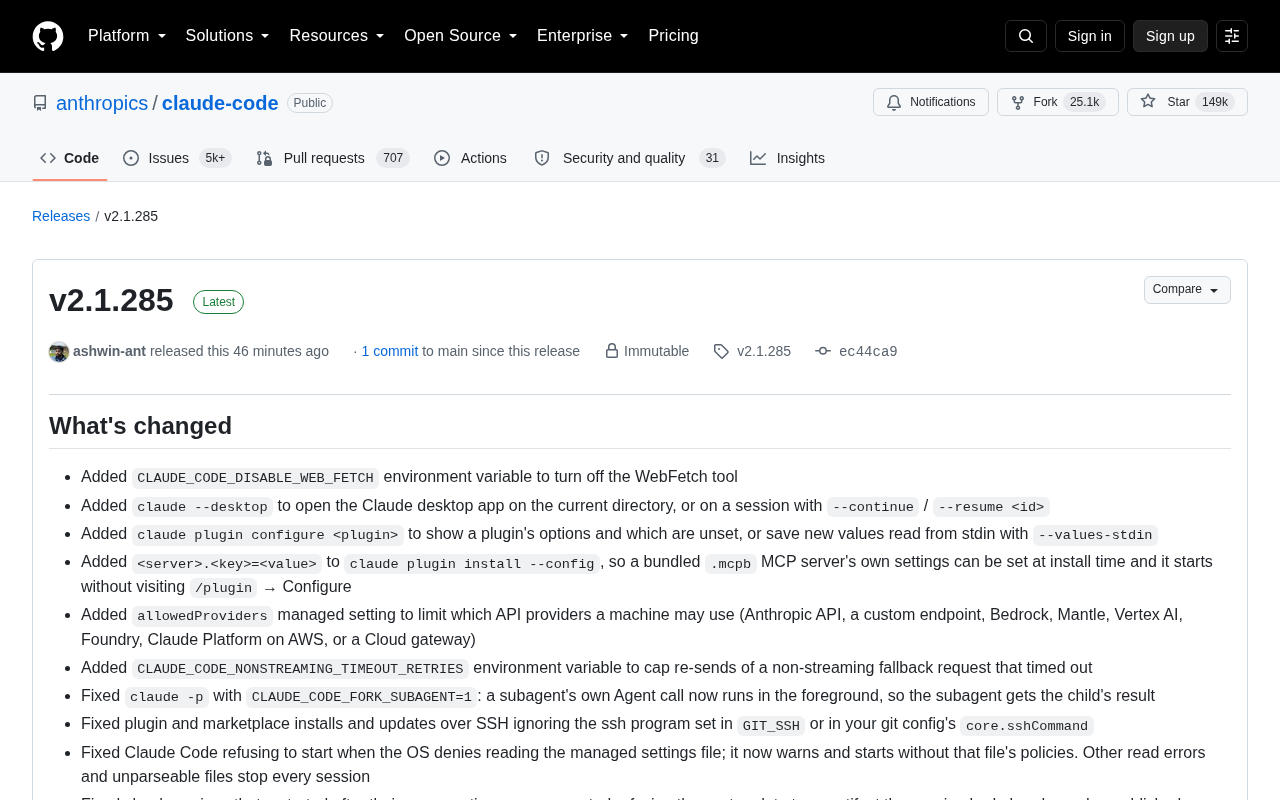
New Features: Desktop Integration and Plugin Configuration
The most notable addition in this release is the bridging of the command line and desktop application. Developers can now use claude --desktop to open the Claude desktop app directly in the current directory, with support for --continue / --resume <id> to resume a previous session. This significantly reduces the friction of switching between the terminal and GUI, enabling seamless workflow transitions between the two environments.
Plugin management also sees meaningful enhancements. The new claude plugin configure <plugin> command displays all available options for a plugin and highlights which values haven't been set yet. You can also pipe configuration in bulk via --values-stdin. Complementing this, claude plugin install --config now supports <server>.<key>=<value> syntax, allowing MCP servers packaged in .mcpb files to be configured at install time — eliminating the need to go into /plugin → Configure afterward. For teams that need to deploy plugins at scale, this is a meaningful efficiency gain.
Additionally, the new CLAUDE_CODE_DISABLE_WEB_FETCH environment variable allows WebFetch to be completely disabled, while CLAUDE_CODE_NONSTREAMING_TIMEOUT_RETRIES limits the number of retries for non-streaming fallback requests that time out. These fine-grained controls reflect Anthropic's commitment to controllability and cost management.
MCP (Model Context Protocol) is an open protocol introduced by Anthropic to standardize how AI models interact with external tools and data sources.
.mcpbis a plugin packaging format built on this protocol that bundles one or more MCP servers and their dependencies into a single distributable unit. Previously, teams deploying plugins at scale had to install them first, then manually fill in configuration fields (such as API keys and endpoint addresses) one by one through the GUI — a cumbersome process in CI/CD or automation script scenarios. The new--configand--values-stdinsupport makes the entire process completable via a single command-line step, significantly reducing the operational overhead of large-scale plugin distribution.
Enterprise Controls: allowedProviders and Policy Loading
For enterprise and team users, the most important improvement in this update is the addition of the allowedProviders managed setting. Administrators can now restrict which API providers are allowed on a given machine, with options spanning the Anthropic API, custom endpoints, Bedrock, Mantle, Vertex AI, Foundry, Claude Platform on AWS, and cloud gateways. As compliance and cost governance become increasingly critical, this kind of allowlist mechanism is exactly what enterprise procurement decisions demand.
The accompanying policy loading logic is also more robust. Previously, if the OS denied access to a managed settings file, Claude Code would refuse to start entirely; now it issues a warning and continues without that file's policies, while other read errors and unparseable files still abort the session. Team and enterprise sessions will delay WebFetch until organizational policies have fully loaded, closing the security window that existed before policies took effect.
Another noteworthy change: sessions behind a custom ANTHROPIC_BASE_URL will now use models that support 1 million context windows (Opus 4.7+, Sonnet 5+, Fable). If your gateway truncates at 200K, running /autocompact 200k will handle it. This provides clear guidance for large-context scenarios accessed through a gateway.
Bedrock and Vertex AI are managed AI service access methods provided by major cloud vendors: AWS Bedrock lets enterprises call multiple foundation models including Claude within their own AWS accounts, with data staying inside the enterprise's VPC; Google Cloud Vertex AI offers a similar managed access approach, suited for teams already deployed on GCP. The core motivations for enterprises choosing these paths are compliance (data never leaves their own cloud environment) and billing (managing AI spend through a unified cloud bill). The
allowedProvidersallowlist is designed precisely for this scenario: once an enterprise has purchased a specific cloud contract or signed a dedicated Data Processing Agreement (DPA), administrators can lock down model access to only approved, compliant channels — preventing employees from bypassing controls and directly using the Anthropic public API, thereby avoiding contract and data sovereignty risks.
Extensive Bug Fixes: Stability and Permission Consistency
The fix list in v2.1.285 is unusually long, concentrated around several high-frequency pain points. On the permissions front, forked sub-agents no longer fail to inherit the session's plan mode or dontAsk mode — forks now run under the parent's permission mode and cannot exit plan mode. Background sub-agents in auto mode no longer generate redundant secondary responses, and permission requests from background sub-agents under claude -p --permission-prompt-tool are now correctly routed to the prompt tool instead of being automatically rejected.
Artifact tool fixes are particularly dense and involve multiple data consistency issues: after session rewind (Esc Esc), Artifact publishing no longer overwrites newer content that Claude only read during the rolled-back turn — a re-read is now required before publishing. A prior bug where a single Artifact allow rule could let the tool publish files outside the working directory without prompting has also been tightened. These fixes collectively aim to prevent AI from accidentally overwriting or leaking content during multi-turn editing and session recovery.
Security-related fixes are equally important: sanitized logs and transcripts previously revealed portions of URL passwords around the @ symbol, even exposing everything when the password was written as %40 — this has been corrected. /ultrareview uploads now exclude credential files with colons in their names (e.g., server:8443.key). On the reliability side, API request retries on streaming failures used to reach as high as 21 attempts; non-streaming fallback requests now share the same retry budget as the original request, avoiding prolonged futile retries.
Artifacts in Claude Code refer to outputs generated by the model and written to the filesystem (such as code files and documents). The "publish" operation commits model output from a temporary state to the working directory. The previous bug meant that after a session rewind (Esc Esc to undo the current turn), the model could incorrectly treat "old content" read during the rolled-back turn as the latest state and overwrite-publish it, silently discarding the developer's existing changes. This type of issue is especially insidious during multi-turn interactive editing, since users often can't tell when content has been overwritten. The fix requires the model to re-read files within the current session state before executing a publish, fundamentally eliminating cross-turn state confusion.
Performance and Experience Improvements
Performance improvements address long-session scenarios. The full-screen ctrl+o transcript view no longer briefly freezes when opening turns that contain hundreds of file reads or searches, and still-running tool calls now have their results appended upon completion. Brief mid-session freezes (up to about one second) in non-fullscreen mode have also been fixed. Single-turn performance is optimized when a large number of permission deny rules and MCP tools are configured.
Bedrock and Vertex AI startup model checks now cache information about models unavailable in an account for up to one day, rather than rechecking on every startup, reducing cold start times. When an administrator removes default model access, sessions automatically fall back to an available legacy model at the same tier rather than failing outright. These changes make multi-cloud deployment experiences noticeably smoother.
Artifact tool result output has also been streamlined — update prompts are shorter and no longer repeatedly remind users where to find the published file after each publish, directly reducing token consumption. Additionally, /resume and claude --resume can now directly open sessions running in the background and send any attached prompt as the next turn, rather than rejecting the request outright.
Overall Assessment
Looking at this changelog, Claude Code has clearly entered a maturity-polishing phase. New features no longer chase disruptive breakthroughs — instead, they fill gaps in desktop integration, plugin configuration, and enterprise governance. The extensive fixes tackle real-world pain points in permission consistency, Artifact data safety, and multi-cloud stability. For individual developers, the desktop integration and session recovery improvements are the most immediately tangible; for teams and enterprises, allowedProviders and the hardened policy loading are the key highlights from a procurement and compliance perspective. Existing users — especially teams relying on MCP plugins, Bedrock/Vertex multi-cloud deployments, or Artifact workflows — are encouraged to upgrade as soon as possible.
Related articles

JobRunner MCP Server: AI Agents Can Now Fix Failed Java Jobs
JobRunner launches an open-source MCP server enabling AI agents to view cluster status, diagnose failures, and recover Java jobs—incident response from any cloud coding environment or existing agent.

MLAI Digital Launches 9 Security Agents: MCP Server Safeguards the Full Lifecycle of Agentic AI
MLAI Digital launches Security MCP Server with nine built-in specialized security agents covering vulnerability discovery, attack simulation, prompt injection detection, API and infrastructure assessment, and accelerated remediation—embedding security validation across the full Agentic AI lifecycle from development to production.

Running Isaac Lab on H100 GPUs: Exploring Better Approaches
Exploring optimization methods for running Isaac Lab on NVIDIA H100 GPUs, including MIG configuration, mixed precision, TensorRT acceleration, and community experience to improve robotics simulation and reinforcement learning efficiency.