Claude Code v2.1.296 Update Breakdown: Subagents, Permissions, and Cross-Platform Fixes

Claude Code v2.1.296 polishes subagent control, security, and cross-platform reliability with sweeping fixes.
Claude Code v2.1.296 is a polish-focused iterative update spanning the CLI, VS Code extension, cloud sessions, and Slack integration. New features include `autoCompactWindow` and `CLAUDE_CODE_WORKFLOW_SUBAGENT_MODEL` for fine-grained subagent context and model control, plus an `allow_large` option in the Read tool. Security fixes address Bash variable-based permission bypass, PreToolUse hooks failing to terminate turns, silent non-UTF-8 file corruption, and secret redaction gaps. Windows users gain a PowerShell command length limit raised to 32 KB and graceful MCP server shutdown. Sonnet 5.5 cache read pricing drops to $0.10 per million tokens, and numerous cloud session and Claude Tag fixes round out the release.
Claude Code has released version v2.1.296, an iterative update focused primarily on stability fixes with a number of meaningful feature enhancements. This release spans the CLI, Claude Desktop, VS Code extension, cloud sessions, and Slack integration (Claude Tag), delivering a large number of bug fixes alongside substantial improvements to subagent control, permission validation, and cross-platform compatibility.
Enhanced Subagent and Workflow Control
The most noteworthy additions in this update are the new fine-grained controls for subagents and workflows.
The new autoCompactWindow configuration can be written into a subagent's frontmatter and --agents definitions, allowing a specific subagent to trigger auto-compact earlier than the main conversation. This means developers can set independent context management strategies for different subtasks, avoiding context overflow in long sessions.
The companion CLAUDE_CODE_WORKFLOW_SUBAGENT_MODEL environment variable allows all workflow agents to run on the same model while other subagents retain their individual model configurations. This kind of model-level layered control is valuable for teams that need to balance cost against capability.
Additionally, the Read tool now has an allow_large option, enabling Claude to read an oversized text file in a single pass when context space is sufficient. This addresses the pain point of repeatedly reading large configuration or data files in chunks.
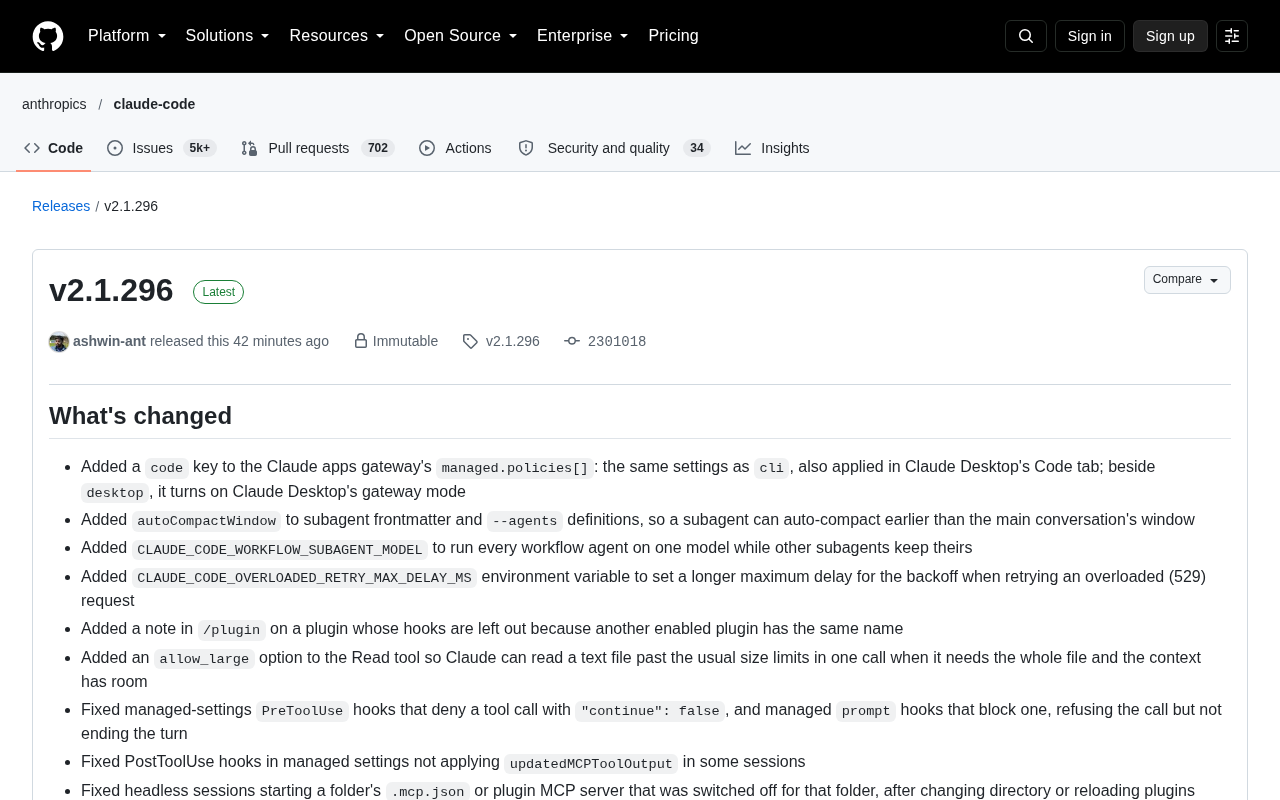
A subagent in Claude Code is a task decomposition mechanism: the main orchestrator agent can split complex tasks into multiple subtasks, delegating each to an independent subagent for parallel or sequential execution, with each subagent having its own context window and model configuration. Frontmatter is a YAML metadata block written at the top of an agent definition file (delimited by ---), used to declare the agent's name, description, model, permissions, and behavioral parameters — the first thing parsed when an agent is loaded. Auto-compact is Claude Code's context management mechanism: when a session's context approaches the model's token limit, the system automatically summarizes and compresses the conversation history to free up space, though this process may cause early details to be lost. autoCompactWindow lets developers set a separate trigger threshold for each subagent — for example, compressing a subagent handling large logs at 60% context usage while the main conversation waits until 90% — enabling a finer balance between overall task reliability and detail retention.
Permission and Security Fixes: The Details Matter
Security-related fixes occupy a prominent place in this update, with multiple fixes targeting edge cases in permission validation.
In managed-settings scenarios, PreToolUse hooks that previously rejected tool calls with "continue": false, and managed prompt hooks that blocked calls, had a bug: they would reject the call without terminating the current turn. This behavior has been corrected.
Bash permission checks have also been hardened — commands that previously received automatic approval by first assigning a value to the BASH_ARGV0 shell variable and then using it will now require user confirmation. This is a classic permission-bypass fix that reflects a serious regard for shell injection risks.
Secret redaction has also been fixed: in shared records and debug logs, certain values following a key with no value were not being properly masked, including values inside JSON embedded within shell strings. For teams that frequently share session logs, this is an important privacy improvement.
A notable encoding fix: the Edit and NotebookEdit tools previously replaced all non-ASCII characters in files that weren't valid UTF-8 (such as Windows-1252, Shift-JIS, or GBK). Now, such edits are rejected outright, preventing silent data corruption.
The PreToolUse hook is Claude Code's interception mechanism, allowing users or platforms to insert custom validation logic before Claude calls any tool (such as Bash or file read/write); returning "continue": false blocks the tool call. Managed-settings is a centralized configuration management mode for enterprise or team deployments, where administrators can uniformly define permission policies, hook rules, and model restrictions via managed config files, overriding individual users' local settings. The core issue fixed here was that the hook rejected the tool call but the current turn did not terminate accordingly, potentially allowing Claude to continue and try other paths around the interception. BASH_ARGV0 is a special Bash variable used to set the script name ($0); by first assigning a value then executing, an attacker could theoretically craft a call that looks like an already-authorized command. This fix closes the loophole that allowed bypassing whitelist validation through variable assignment.
Targeted Windows Platform Improvements
Cross-platform compatibility has always been a challenge for command-line tools, and this update is especially welcome for Windows users.
The PowerShell command length limit has been raised from approximately 1 KB to 32 KB, meaning longer commands can now have allow rules and read-only detection applied correctly without triggering a permission prompt every time. stdio MCP servers are also no longer forcefully killed on shutdown — stdin is now closed first, and the process tree is only terminated if the process is still alive after 300 milliseconds, reducing abnormal exits.
claude plugin install failing to install owner/repo-style plugins on machines without a GitHub SSH key has been fixed — the command now automatically retries using HTTPS cloning. Additionally, PowerShell commands can now read variables written to CLAUDE_ENV_FILE by hooks (when the file contains only plain assignments).
A security detail has also been addressed: rm -rf /c/Users/<name> in Git Bash no longer bypasses confirmation in bypass permissions mode.
Performance, Billing, and UX Improvements
Beyond fixes, this update includes adjustments to performance and cost.
On the billing side, the cache read price for Sonnet 5.5 has been reduced from $0.20 to $0.10 per million tokens, and the figures in /cost, the status bar, --max-budget-usd, and the SDK have all been updated accordingly. This is a direct cost benefit for workflows that make heavy use of caching.
On the UX side, links under the mouse cursor in full-screen mode now display an underline to indicate they're clickable; transcription toggling (ctrl+o) in code-heavy conversations is now faster thanks to cached syntax-highlighted code blocks; and --debug output is more informative, identifying unrecognized frontmatter fields in custom agent files and offering spelling suggestions.
The default character limit for MCP tool descriptions and server instructions has been raised from 2048 to 4096, giving tool definitions more room to express themselves.
Cloud Session and Collaboration Integration Fixes
Fixes for cloud sessions and Slack integration (Claude Tag) are also extensive in this release.
On the cloud sessions side, queue display for self-hosted environments has been improved — each session waiting for a runner now shows how many sessions are ahead of it in the queue, rather than all showing the same position. The Activity tab in management settings has a new status filter that supports selecting multiple statuses simultaneously.
On the Claude Tag side, fixes address broken URL links containing parentheses in Slack replies, six-digit numbers that resembled hex color codes (such as PR numbers) being incorrectly rendered as color swatches, and other detail issues. Members with Claude Tag Admin permissions also gain the ability to create, edit, and delete workspace and channel memory files from the Memory tab.
Overall, v2.1.296 is a quintessential polish update: no groundbreaking new features, but the wealth of detailed fixes in subagent control, permission security, and cross-platform consistency collectively improve the reliability of Claude Code in real-world development environments.
Related articles

Felix Rieseberg Personal Homepage
Felix Rieseberg's personal homepage sparks attention on Hacker News. This article covers the Slack engineer's technical background, the rise and fall of nativefier, and the value of a developer homepage as a tech calling card.

@ai-sdk/vue 3.0.306 Patch Release Syncs with [email protected] Update
@ai-sdk/vue 3.0.306 released, synced with [email protected]. A routine patch release for the Vercel AI SDK ecosystem with no public API changes; the Vue adapter layer stays version-aligned with the core package.

Gemini 4 Argon API Launches: The Era of Million-Token Output Begins
Google launches Gemini 4 Argon with sparse MoE architecture, up to 1M output tokens, and a 68.90% Vals Index score, available across API, AI Studio, and the Gemini app.