Claude Code v2.1.322 Update: Vertex Fast Mode Goes Live

Claude Code v2.1.322 adds fast mode to three Vertex AI regions with automatic fallback.
Claude Code released v2.1.322, with the only substantive change being fast mode for Vertex AI's global, us, and eu regions, plus automatic fallback to standard speed when Vertex rejects fast requests. The article views this as an infrastructure-layer change that lowers latency expectations and closes enterprise performance-consistency gaps. Fallback shifts the experience from "failure" to "slower but available," friendly to CI pipelines and automation. Marked as an Immutable release, it's a low-risk minor update; Vertex-dependent workflows benefit directly, other backends see no change.
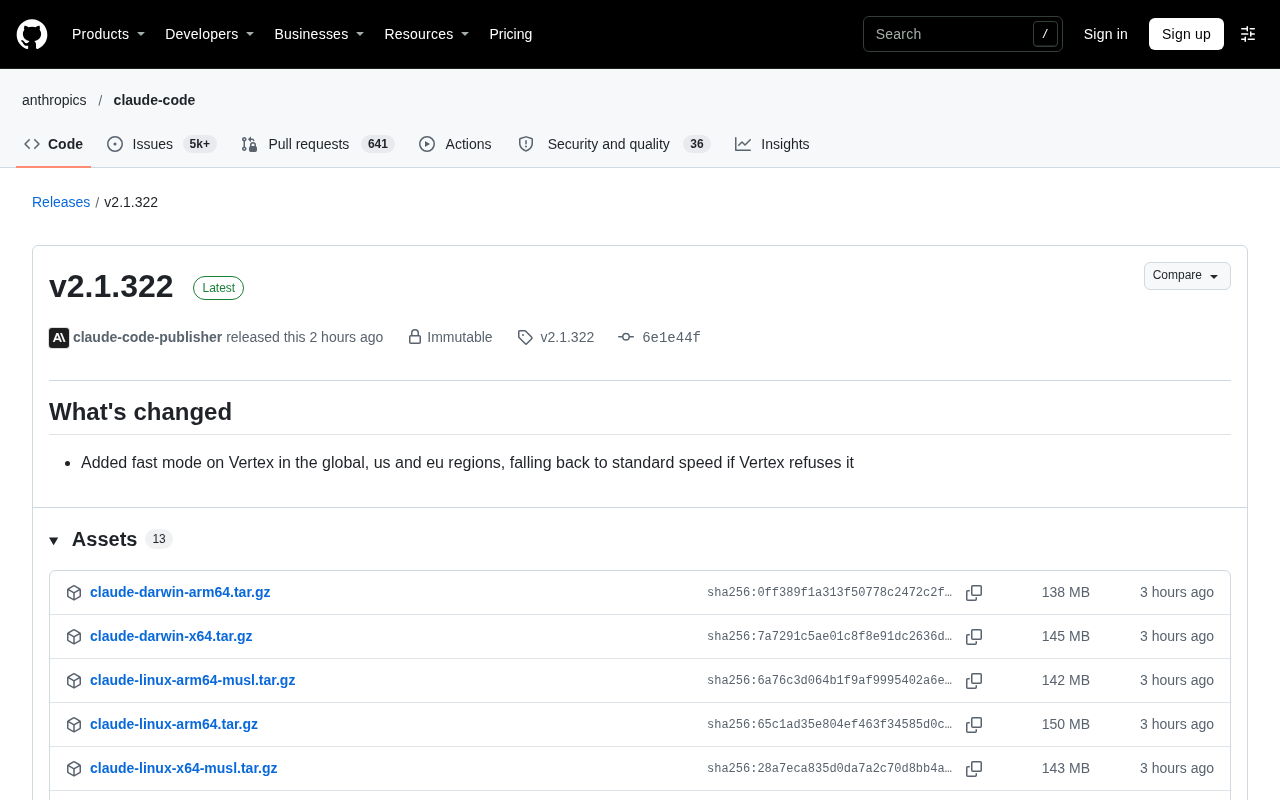
Claude Code has released version v2.1.322, and this update contains only one substantive change: a new fast mode on Vertex AI. The version number skips 2.1.321 entirely, jumping straight from the previous release—the cadence remains as brisk as ever.
What's New: Vertex Fast Mode Lands
According to the release notes, v2.1.322 adds fast mode to three Vertex regions: global, us, and eu. When Vertex rejects a fast request, the system automatically falls back to standard speed. This is an infrastructure-layer change; for end users, it means lower latency expectations and a clear degradation path.
Fast mode is not a new concept—Claude Code has previously offered similar capabilities on other inference backends. Extending it to three major Vertex regions suggests the team is closing gaps in performance consistency for enterprise deployments. The global region has the widest reach, while us and eu are where enterprise customers are most concentrated, so rolling out to these three first follows a sensible resource-allocation logic.
Vertex AI is Google Cloud's unified machine learning platform, where enterprises can call Gemini-series models and third-party models, and complete production-grade integration using Vertex's quota management, regional deployment, and IAM permission system. Claude Code's support for Vertex AI as an inference backend means enterprise customers can run Claude Code using their existing Google Cloud billing, compliance boundaries, and network configurations—without separately applying for an Anthropic official API key. The so-called global, us, and eu regions refer to the data center scope to which requests are actually routed: the global endpoint dispatches to the nearest available location, while us and eu restrict data and compute to their respective geographic boundaries, often used to satisfy data residency requirements. Launching fast mode in these regions effectively puts low-latency capability into the deployment forms enterprises care about most.
Design Considerations Behind the Fallback Mechanism
The phrase "falls back to standard speed when Vertex rejects" deserves a closer look. Fast mode typically depends on additional compute quotas or specific model endpoints; requests are rejected when quotas are insufficient, regional load is too high, or account permissions don't meet requirements. Without a fallback mechanism, users would see errors directly; with fallback, the experience shifts from "failure" to "slower but available."
This design isn't complex engineering-wise, but it reflects a prioritization judgment about availability: speed is a bonus, availability is the baseline. For teams integrating Claude Code into CI pipelines or automation scripts, silent degradation is friendlier than interruption—tasks complete, just taking slightly longer.
Fast mode in implementation typically corresponds to higher throughput quotas, priority scheduling, or dedicated inference endpoints, so it isn't an unconditionally available capability. Rejections on the Vertex side may come from quota exhaustion (such as exceeding requests per minute or token counts), regional capacity constraints, service accounts lacking the necessary permissions, or the region not yet offering the corresponding endpoint. At the HTTP level, these situations typically manifest as 429 (rate limiting) or 403 (permission) errors. The automatic fallback logic captures the rejection signal, then re-issues the request using a standard-speed model endpoint, transparent to the caller. Note that fallback introduces additional round-trip latency, and some clients may write degradation information to logs rather than prompting the user directly—worth watching for when troubleshooting performance issues, check the model identifier and latency distribution in responses.
Release Cadence and Signals
From the release record, this version is marked as an Immutable release—only the title and description can be edited, while the code assets themselves are locked. The publish time shows November 10 at 02:29, with commit hash 6e1e44f.
Single-feature version updates are common in Claude Code's iteration cycle. Such minor versions typically don't involve breaking changes, carry low upgrade risk, and are suitable for staying on auto-update. If your workflow depends on Vertex's global, us, or eu regions, this update directly delivers latency benefits; if you use other backends, this update has no perceptible impact for you.
Immutable release is a GitHub Releases setting: once a release is created, the associated tag and binary assets are locked—only the title and description text can be edited, and build artifacts cannot be replaced or re-uploaded. For users, this means the downloaded package is exactly identical to the build at release time, providing stronger reproducibility and reducing supply-chain tampering risk. The counterpart is mutable releases, where maintainers can replace assets without changing the version number. Combined with commit hash 6e1e44f, the code state corresponding to this version can be precisely located. However, immutable release does not equal a functional stability guarantee—it only ensures artifacts aren't overwritten; before upgrading, you should still review the changelog and compatibility with your own workflow.
Summary
v2.1.322 is a patch-style update focused on backend performance. Fast mode covers three major Vertex regions, and with the automatic fallback mechanism, it raises the speed ceiling while holding the availability baseline. For enterprise users and automation scenarios, this is a minor version worth following.
One-line Summary
Claude Code v2.1.322 adds fast mode to three Vertex AI regions with automatic fallback support.
Paragraph Summary
Claude Code released v2.1.322, with the only substantive change being the addition of fast mode to Vertex AI's global, us, and eu regions, along with automatic fallback to standard speed when Vertex rejects fast requests. The article views this as an infrastructure-layer change—for end users it means lower latency expectations and a clear degradation path, and it closes performance-consistency gaps for enterprise deployment scenarios. The fallback mechanism shifts the experience from "failure" to "slower but available," particularly friendly to CI pipelines and automation scripts. The version is marked as an Immutable release, a minor iteration with no breaking changes and low upgrade risk; workflows depending on these three Vertex regions benefit directly, while users of other backends see no change.
Related articles

Prompt Engineering for Beginners: From Writing Prompts to Engineering Thinking
Starting from the essence and four functions of prompts, this article systematically explains the six-step process, four success criteria, learning value, and practical limitations of prompt engineering to help you build a complete understanding.

Anthropic Launches Nasdaq IPO: AI Giant's Listing and Risk Disclosures
Anthropic officially launches its Nasdaq IPO under ticker ANT, with market valuation expected to potentially exceed SpaceX's record. The prospectus devotes nearly 100 pages to AI risks, while first-half revenue grew over 14x but net losses widened sharply, reigniting the AI bubble debate.

Rust cURL Clone Uses 4,832 unsafe Blocks—Is the Memory Safety Myth Broken?
A Rust cURL clone uses 4,832 unsafe keywords, challenging Rust's memory safety narrative. We analyze what unsafe really means, compare Fil-C, and examine rewrite motives.