Claude Code vs. Codex in Enterprise Projects: How AI Engineering Handles Complex Systems
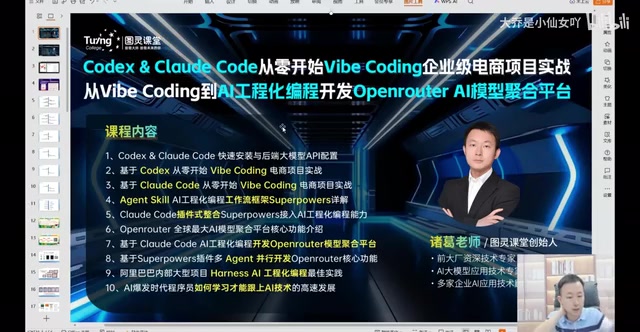
A seasoned instructor uses two real projects to map the path from Vibe Coding demos to enterprise-grade AI engineering.
This article summarizes a Bilibili instructor's hands-on AI programming course, focused on the limits of Vibe Coding and how to move beyond them. Using an e-commerce system and an AI model aggregation platform as vehicles, he outlines three progressive development modes — pure Vibe Coding, Plan Mode, and SuperPower-based AI engineering — arguing that only the engineering layer can handle true enterprise complexity. On tools and models, he rates Claude Code as the strongest but notes account suspension risks, while Codex is catching up fast; among domestic LLMs, GLM leads on experience and DeepSeek on value. The Open Router case study also illuminates AI industry economics: compute, chips, and token distribution are where real profits live, while consumer apps mostly still burn cash.
The rise of AI coding tools is reshaping how developers work — but one question keeps coming up: how far can Vibe Coding actually take you? In a hands-on course published on Bilibili, a seasoned instructor broke down the complete journey from toy-level demos to enterprise-grade applications using two real projects — an e-commerce system and an AI model aggregation platform. He also shared his firsthand assessments of Claude Code, Codex, and domestic Chinese LLMs.
The Limits of Vibe Coding: Why Demos Work but Enterprise Projects Fall Apart
Vibe Coding originated overseas and centers on a simple premise: product managers or non-technical users describe what they want, and AI coding tools generate the code. The instructor freely admits this approach can spin up a rough e-commerce prototype in minutes — but once a project grows in scale and complexity, problems start piling up fast.
The most telling issue is maintainability. Code produced through Vibe Coding tends to become a mess that's nearly impossible to maintain. When a bug hits production, someone without a technical background can't effectively guide an AI to diagnose and fix it — and the project grinds to a halt. The instructor was blunt: many AI bloggers claiming that "Claude Code will replace programmers" are, on closer inspection, showcasing ultra-simple tools — overseas micro-sites, Pomodoro timers, ring light controllers. High-concurrency, distributed, microservices-based enterprise systems are a different beast entirely, and Vibe Coding simply can't handle them.
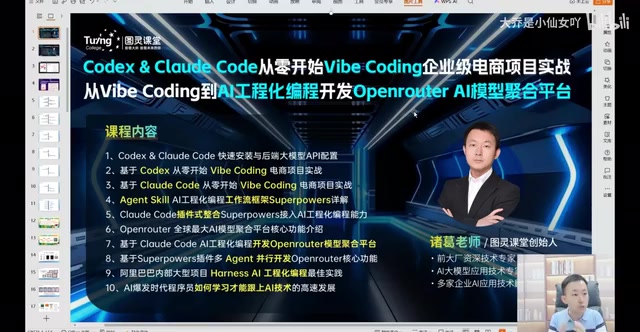
Enterprise-grade projects are defined by business complexity, technical complexity, and architectures that typically involve distributed systems and microservices. These demands raise the bar for both the AI coding tools and the technical depth of the person using them — which is exactly the gap this course aims to close.
Three Progressive Modes: From Web Coding to AI Engineering
The course's core methodology breaks each project into three development modes of increasing depth, so learners at different skill levels can follow along.
The first is pure Web Coding (Vibe Coding) — spinning up an e-commerce demo in minutes, ideal for absolute beginners. The second is Plan Mode, a built-in capability in both Claude Code and Codex, where the AI first creates a structured plan before writing code. This reduces wasted effort from blind generation and works well for moderately complex projects built on simple requirements.
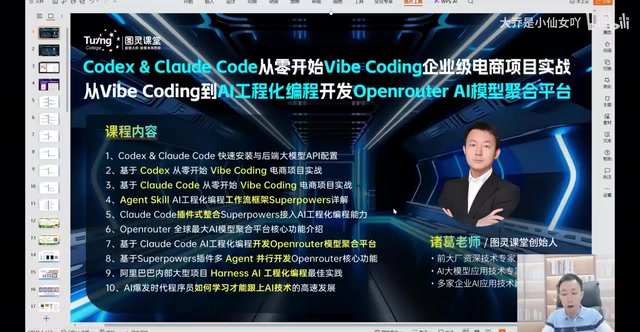
The third — and most important — mode is AI Engineering using the SuperPower plugin for Claude Code. The instructor describes SuperPower as a collection of AI engineering skills, containing anywhere from a dozen to several dozen individual skills that span the full development lifecycle: requirements analysis, development, testing, deployment, and launch. It shares the same philosophy as the Spec Kit approach (Specification-Driven Development, or SDD) that has been gaining traction recently — and both represent how many small-to-mid-sized companies are actually building software today. According to the instructor, only when you reach this level can you genuinely claim to be developing enterprise-grade projects with enterprise-grade processes.
Spec Kit (Specification-Driven Development) is an engineering methodology that has emerged in the AI-assisted programming space in recent years. The core idea: before asking an AI to generate code, you first produce structured documentation — often called an SDD (Software Design Document or Spec Document) — that fully captures requirements, architecture decisions, interface contracts, and data models. The AI then uses this as its authoritative reference when generating code. This approach significantly reduces "hallucination"-style outputs because the AI has clear constraints rather than free rein. SuperPower's skill-collection approach follows the same philosophy — packaging the key checkpoints of the full software development lifecycle (requirement decomposition, technology selection, test strategy, deployment standards) into reusable skill templates, so the AI follows a defined process at each stage rather than improvising. This converts the randomness of Vibe Coding into controllable, engineering-grade output.
Tool and Model Selection: The Backend Model Comes First
On the Claude Code vs. Codex question, the instructor has a clear stance: the most important factor in any AI coding tool's capability is the backend model powering it — the tool itself is secondary.
He considers Claude Code the most widely used among professional developers and the strongest overall, crediting its internal Harness system — a sophisticated AI engineering framework optimized for professional coding. Reading the Claude Code source code reveals it is itself a comprehensive Harness engineering system, heavily tuned for professional programming tasks. Codex was initially weaker than Claude Code, but with the latest GPT releases and internal optimizations, the gap is closing quickly.
There's also a practical concern worth noting: the instructor mentioned that his Claude account has been suspended multiple times due to network environment issues on his teaching platform, and the reinstatement process is cumbersome. As a result, he now leans more toward Codex, or uses the Claude Code frontend connected to a domestic Chinese LLM backend.
Domestic LLM Rankings from Real Testing
In his side-by-side comparison of domestic models, the instructor shared his top-tier picks: GLM (Zhipu AI) is his overall best experience among the domestic models he tested; DeepSeek offers the best price-to-performance ratio — capable and cheap; Kimi, MiniMax, Xiaomi MiMo, and models from Alibaba and Tencent Hunyuan are all viable options. These are personal assessments based on hands-on testing, offered as reference points rather than definitive rankings.
Harness, in the context of AI programming, refers to an engineering scaffold built around a large language model — not the model itself. It typically includes: context management strategies (how to feed codebase information to the model), prompt engineering standards (how to structure instructions so the model produces code that meets engineering standards), multi-step task orchestration (breaking complex development tasks into sub-tasks the model can execute incrementally), and error feedback with auto-correction loops. Claude Code's core competitive advantage comes largely from how deeply its internal Harness system is optimized for code generation — for example, it can proactively read codebase structure, track dependencies across files, and automatically run tests after making changes to verify results. The AI engineering workflows being rolled out inside major companies like Alibaba are essentially the same concept: building a proprietary Harness system in an enterprise environment to standardize how AI capabilities plug into existing development processes.
Open Router and the Profit Logic of the AI Industry
The course's second hands-on project is building an AI model aggregation platform — modeled after Open Router, which the instructor calls the world's largest LLM aggregation platform. Open Router covers virtually every major model on the market, including a number of free options, and provides rankings of leading models by capability and price.
This project becomes a lens for examining how money actually gets made in the AI industry. The instructor's take: consumer-facing AI applications (like Doubao or Tencent Yuanbao) are mostly burning cash right now. The real money is upstream — selling compute, chips and semiconductors, and tokens. Aggregation platforms like Open Router that "resell tokens under a wrapper" are also quite profitable: they secure tokens at favorable bulk rates and redistribute them, with low operating costs and lean teams. He mentioned that friends running similar overseas-facing applications with teams of around fifteen people are generating RMB 100–200 million annually.
This is a useful frame for thinking about AI startup strategy: rather than burning money competing in the consumer layer, look for cash flow in infrastructure and distribution.
Open Router's business model is a classic API aggregation and resale play. The platform negotiates bulk purchasing agreements with major model providers, securing token quotas at wholesale rates, then offers them to developers at prices at or slightly below the providers' retail rates — profiting on volume and margin. The core value proposition: developers integrate a single unified API and can flexibly switch between underlying models without maintaining separate SDKs and API keys for each provider. For small-to-mid-sized AI application developers, this "model routing" layer significantly reduces both technical and commercial overhead. The "token reselling wrapper" the instructor references is precisely this layer — no model training, no end-user application, just infrastructure distribution. Low marginal cost, stable cash flow, and one of the more predictable business positions in the AI supply chain.
How Big Tech Approaches AI Engineering
The instructor also noted that leading domestic tech companies are actively building out Harness systems. Alibaba, for example, has established an internal AI engineering workflow covering self-closing loops, defensive mechanisms, and continuous evolution. While it's not feasible to fully replicate a big-tech-scale workflow in a course, the instructor said he would walk through the overall philosophy so learners understand the general framework these companies use.
On development environments, the instructor recommends VS Code and was candid that traditional IDEs like IntelliJ are showing their age in the AI era. His reasoning: AI coding tools are playing out the same disruption that IDEs once brought to Eclipse — and now the IDEs themselves are being disrupted by AI coding tools. His typical workflow is installing the Claude Code plugin inside VS Code and developing through either the chat interface or the CLI. Codex similarly supports both a desktop client and CLI.
A note on sourcing: this article is based on a single instructor's course content. Assessments of tool quality, model rankings, and industry dynamics reflect personal experience and should be treated as informed opinion rather than objective fact — readers are encouraged to test against their own contexts.
Related articles
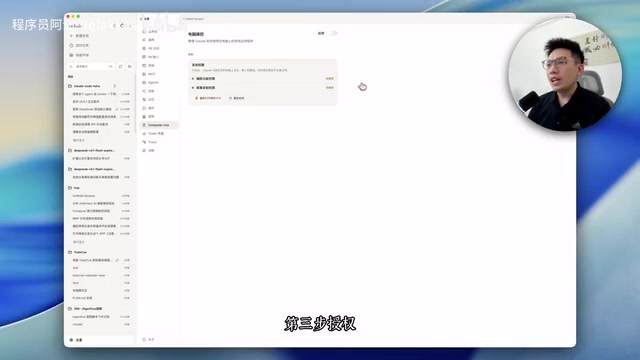
Hands-On with Open-Source Desktop Client CC-HAHA: Let AI Automatically Control Your Computer
CC-HAHA is an open-source desktop client with computer use support, letting AI control your GUI via virtual mouse. Learn the 3-step setup and model comparisons.

Claude Code Desktop: A Complete Guide to Chinese Localization, Account-Free Use, and DeepSeek Integration
Step-by-step guide to installing Claude Code Desktop, enabling account-free use, adding Chinese UI, connecting DeepSeek via CC Switch, and importing custom Skills.
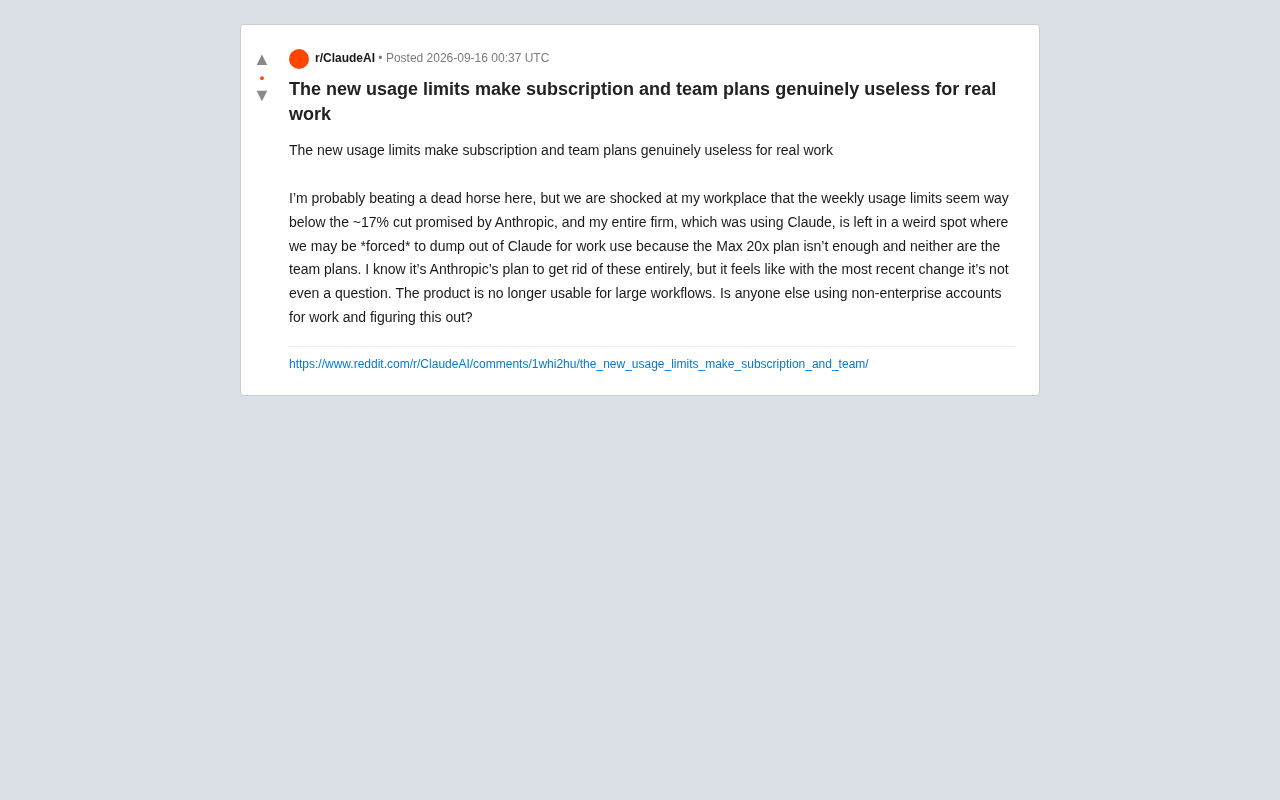
Claude's New Usage Limits Spark Backlash: Pro and Team Plans Falling Short for Real Workloads
Anthropic's latest Claude usage limits are drawing user backlash, with Max 20x and Team Plan subscribers reporting they can't support large workloads. Here's what it means for the AI subscription market.