Claude Comes to Azure: Three Enterprise-Grade Advantages of Microsoft Foundry's Anthropic Model Integration

Microsoft Foundry now offers Anthropic's Claude models natively on Azure with full enterprise integration.
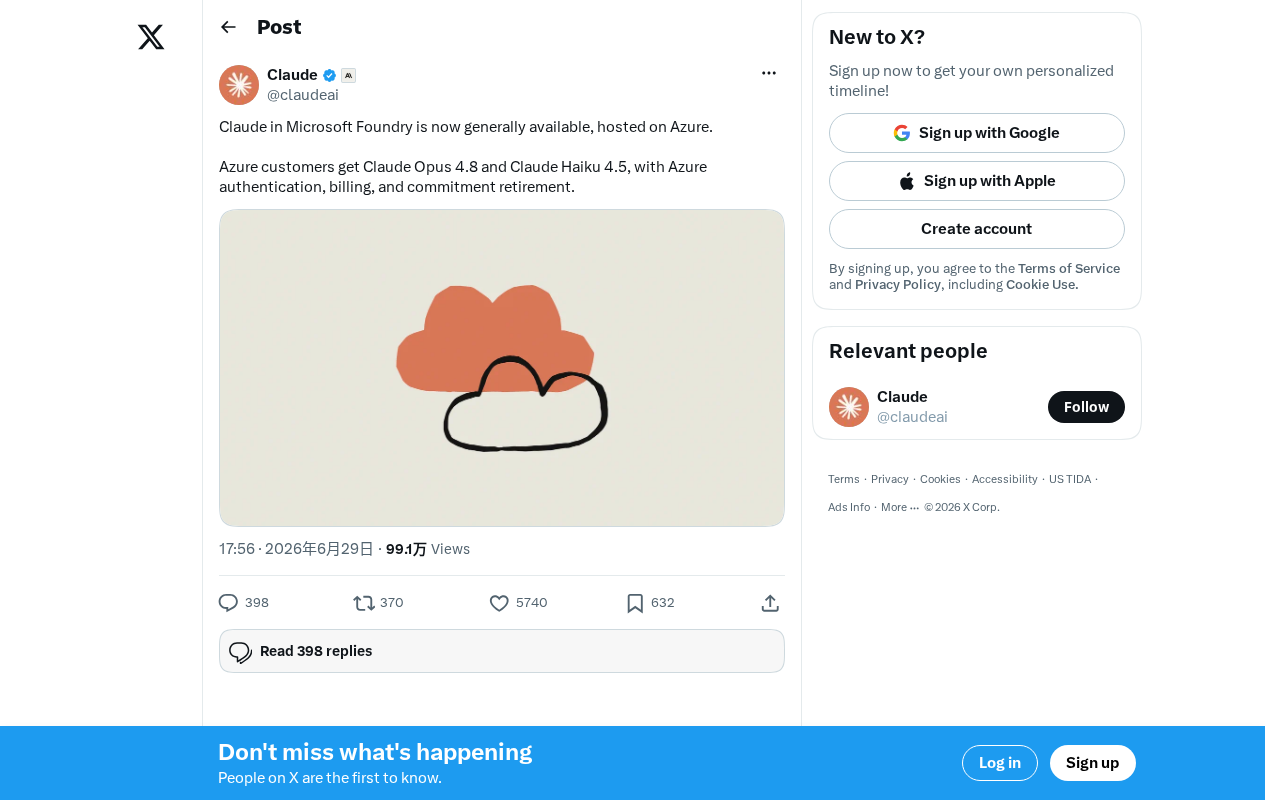
Microsoft has made Anthropic's Claude Opus 4.8 and Claude Haiku 4.5 generally available on its Foundry platform, hosted on Azure infrastructure. The integration delivers three key enterprise advantages: native Azure Active Directory authentication, unified billing through existing Azure accounts, and the ability to draw down Microsoft Azure Consumption Commitment (MACC) credits for Claude usage. This move signals the enterprise AI market's shift toward multi-model orchestration and positions Microsoft as a neutral AI infrastructure platform.
Microsoft and Anthropic's Deep Integration
Microsoft recently announced that Anthropic's Claude model series is now generally available (GA) on the Microsoft Foundry platform, hosted on Azure cloud infrastructure. This milestone marks a critical step in Microsoft's enterprise AI service strategy: moving beyond a single vendor to offer Azure customers richer choices through a multi-model approach.
About Microsoft Foundry: Microsoft Foundry (formerly Azure AI Foundry) is a unified AI development platform officially launched by Microsoft in late 2024, integrating model catalog, prompt engineering, evaluation tools, and deployment pipeline capabilities. Its predecessor was a functional merger of Azure OpenAI Service and Azure Machine Learning, positioned to enable enterprises to manage the entire lifecycle—from model selection, fine-tuning, and testing to production deployment—within a single unified interface. Notably, Foundry's creation itself signals the maturation of Microsoft's AI infrastructure strategy. During the earlier Azure OpenAI Service phase, Microsoft's AI service capabilities were heavily dependent on a single vendor—OpenAI. By building a standardized multi-model access layer, Foundry laid the technical foundation for Microsoft's transformation into a "neutral AI infrastructure platform."
At the technical architecture level, Foundry abstracts calling differences between model providers through standardized REST API interfaces, eliminating the need for developers to adapt separate SDKs for each model. The platform also features a built-in unified Responsible AI content filtering layer—all model calls passing through the platform undergo unified security review. This is particularly important for European enterprise customers who must comply with the EU AI Act, GDPR, and other regulations. Foundry's Model Catalog currently encompasses over 1,700 models from dozens of providers including OpenAI, Meta, Mistral, and Cohere. The addition of the Claude series makes this catalog's coverage of top-tier closed-source reasoning models even more complete.
According to Microsoft's official announcement, Azure customers can now directly access two Claude models—Claude Opus 4.8 and Claude Haiku 4.5. The former is positioned for high-performance complex reasoning scenarios, while the latter emphasizes lightweight, fast, and low-cost responses. This "premium + lightweight" dual-model combination neatly covers different enterprise needs ranging from deep analysis to high-concurrency calls.
Anthropic's Claude model family employs a capability-tiered design: the Opus series is flagship-level, designed for high-difficulty tasks requiring multi-step complex reasoning, long-document understanding, and code generation, competing in the same tier as GPT-4o and Gemini Ultra across multiple benchmarks. The Haiku series is the lightweight tier, known for extremely low latency and cost, suitable for high-concurrency real-time conversations, text classification, and simple Q&A scenarios. This capability-tiered design reflects the commercialization of AI model "Scaling Laws"—larger model parameter sizes mean higher inference costs and longer latency, so providing differentiated model specifications for different scenarios is a universal strategy among leading AI companies. OpenAI's GPT-4o mini and Google's Gemini Flash follow the same logic.
The 4.5/4.8 versions launched this time belong to the Claude 4 generation, which introduces enhanced Constitutional AI training methods at the architecture level—Anthropic's proprietary core safety alignment technology. Constitutional AI was formally proposed by Anthropic in 2022. Its core approach is to endow models with a clear "behavioral constitution": a set of principled rules describing desired behavior, rather than relying on human annotators to judge each harmful output on a case-by-case basis. Training occurs in two stages: the first stage uses self-critique and revision, having the model evaluate its own responses against constitutional provisions and make corrections; the second stage uses AI feedback to replace some human feedback (i.e., RLAIF—Reinforcement Learning from AI Feedback), significantly reducing dependence on manual annotation costs while making the model's safety boundaries more transparent and auditable. Compared to OpenAI's primary reliance on RLHF (Reinforcement Learning from Human Feedback), Constitutional AI represents a methodological divergence—the former relies more on scaled human judgment, while the latter pursues explicit and interpretable safety principles. This distinction is particularly attractive to financial and healthcare enterprises that need to explain AI decision rationale to regulators.
From a broader perspective, the rivalry between Constitutional AI and RLHF is essentially the embodiment of two philosophies in AI alignment—"rule-driven" versus "example-driven": the former holds that safe behavior should be derived from explicit principles, while the latter believes that massive human annotation better captures the nuances of human values. Both approaches continue to evolve, and the industry generally expects the ultimate industrial-grade safety alignment solution to be a fusion of both. It's worth noting that Constitutional AI's interpretability advantage has concrete practical value in regulatory contexts: when enterprises need to explain to financial regulators or health authorities "why AI made this decision," a model that can cite explicit constitutional provisions is easier to pass compliance review than one trained on black-box human preference data—giving Anthropic a unique narrative advantage in enterprise procurement within heavily regulated industries.
It's worth adding that the Constitutional AI framework was further systematized in the Claude 4 generation: the process of formulating constitutional provisions itself introduced broader stakeholder participation mechanisms, and Anthropic publicly released some of its constitutional content for external review. This "transparent constitution" approach is considered an important advance in responsible disclosure practices within the AI safety field. Compared to treating safety mechanisms as trade secrets, Anthropic's approach helps the academic community and regulators independently assess model safety boundaries, and to some extent establishes an industry standard reference.
The 200K token context window (approximately equivalent to 150,000 Chinese characters) enables Claude to process complete legal contracts, financial reports, or codebases—a capability with significant advantages in enterprise document processing scenarios. Notable improvements over previous generations in tool-calling accuracy and instruction-following capability directly relate to reliability in AI Agent scenarios, serving as key metrics for enterprises embedding AI into automated workflows.
Three Native Integration Advantages of Claude in the Azure Ecosystem
The most noteworthy aspect of this integration isn't the model itself, but rather the degree of Claude's "native integration" within the Azure ecosystem. The announcement explicitly mentions three key capabilities:
Azure Authentication
Enterprise customers can directly use their existing Azure Active Directory identity framework to manage access permissions for Claude, without needing to build separate authentication flows for a third-party AI service. For large organizations with strict compliance requirements, this significantly lowers the barrier to adoption and security audit costs.
Azure Active Directory (now renamed Microsoft Entra ID) is Microsoft's cloud-based Identity and Access Management (IAM) service for enterprises, currently used by over 500,000 organizations worldwide. It supports Single Sign-On (SSO), Multi-Factor Authentication (MFA), Conditional Access policies, and Role-Based Access Control (RBAC) among other enterprise-grade security capabilities. Understanding Entra ID's central role in enterprise IT architecture helps assess the strategic value of this integration: in large enterprises, Entra ID typically serves as the "master permission gateway" for all SaaS applications, cloud services, and internal systems. Once a new service can natively connect to Entra ID, it means the enterprise's existing identity governance strategies, password policies, access auditing, and zero-trust architecture can seamlessly extend without rebuilding on the new service.
It's worth understanding in depth that Entra ID's Conditional Access policies allow enterprises to dynamically control AI model access permissions based on device state, geographic location, user risk score, and other dimensions—for example, allowing only employees on managed devices within specific countries/regions to invoke Claude Opus for processing sensitive data. Combined with Azure Monitor and Microsoft Sentinel log integration, every Claude API call can be incorporated into the enterprise's SIEM (Security Information and Event Management) system, meeting the operational audit requirements of security compliance frameworks such as SOC 2 and ISO 27001.
Extending further, Zero Trust Architecture has become the fundamental paradigm for IT security construction in large enterprises and government agencies in recent years. Its core principle is "never trust, always verify"—access to any resource requires continuous verification of identity, device health status, and access context, rather than relying on traditional network perimeter defenses. Claude's native integration with Entra ID means enterprises don't need to design separate security controls for AI model access and can directly extend zero-trust policies to AI calling scenarios—offering significant architectural consistency value for enterprises advancing their zero-trust transformation.
The profound significance of this integration lies in how it redefines the compliance cost curve for "AI service introduction." For enterprises in regulated industries such as finance, healthcare, and government, introducing a new third-party SaaS service often means months of security review and compliance audit cycles—requiring completion of vendor Security Questionnaires, penetration test report reviews, Data Processing Agreement (DPA) negotiations, and business continuity assessments. Claude's native integration with Entra ID means enterprises can directly extend existing access policies and audit log systems to cover Claude's calling behavior, dramatically compressing compliance onboarding time—a differentiation advantage not to be overlooked in competitive enterprise AI procurement decisions.
Unified Billing
Claude usage fees are directly incorporated into Azure's unified billing system. Enterprises don't need to sign separate contracts with Anthropic for settlement—finance and procurement processes can fully reuse existing cloud spending management mechanisms, simplifying reconciliation and cost allocation. For large enterprises with dozens or even hundreds of cloud service subscriptions, Cost Visibility and Cost Attribution are themselves a management challenge. Unified billing means Claude's AI calling costs can be incorporated into unified cost management tools (such as Azure Cost Management + Billing) alongside other Azure services, supporting granular cost splitting and Chargeback by department, project, or business line—a basic requirement for enterprise financial compliance management.
From an enterprise IT financial management perspective, unified billing solves more than the convenience of "one fewer billing system to log into"—its core value lies in eliminating the risk of "shadow IT spending." Without unified billing integration, business departments might bypass IT controls and directly subscribe to the Anthropic API via credit card, generating unmanaged expenditures outside the enterprise procurement system. Unified billing brings AI calls into the enterprise's cloud spending governance framework, enabling CTOs and CFOs to comprehensively understand the usage scale, cost distribution, and growth trends of all AI models within the organization on a unified dashboard, providing a complete data foundation for AI ROI analysis.
It's worth adding that this mechanism also directly impacts enterprise FinOps (Cloud Financial Operations) practice maturity. FinOps is a cross-functional collaboration framework that has emerged in cloud computing in recent years, aimed at helping engineering, finance, and business teams jointly optimize cloud spending efficiency. Under the FinOps framework, the visibility and attributability of AI model calling costs are prerequisites for achieving "Unit Economics" analysis—for example, calculating the marginal cost of each AI-assisted customer service interaction, or quantifying the ROI of AI code generation on development efficiency improvement. Unified billing provides standardized data access points for such analyses and serves as infrastructure for enterprise AI economic justification.
Commitment Spend Drawdown
This is particularly important for large enterprises—customers' previously signed Azure consumption commitment credits (such as MACC, Microsoft Azure Consumption Commitment) can be used to offset Claude calling fees. In other words, using Claude is no longer an "additional expense" but can be incorporated within existing cloud procurement commitment frameworks.
MACC is Microsoft's cloud consumption pre-commitment plan designed for large enterprises, typically targeting customer segments with annual cloud spend above $100,000. Enterprises commit in advance to spending a specific amount on Azure within a defined period (typically 1-3 years) in exchange for discounts and priority support services. Understanding the financial logic behind this mechanism is crucial for assessing its importance: after signing a MACC, related AI service spending is classified in enterprise financial statements as budgeted cloud infrastructure costs rather than independent software license procurement—this accounting classification difference directly affects approval authority levels and approval cycle lengths.
In large multinational enterprises, IT procurement typically goes through multiple stages including needs assessment, vendor qualification review, security evaluation, legal contract review, and financial budget approval—introducing a new vendor can take 6-12 months. MACC drawdown transforms Claude's procurement behavior from "adding a new vendor" to "spending adjustment within existing budget," greatly simplifying internal budget approval chains and making it easier for CIOs/CFOs to incorporate AI spending into existing IT budget frameworks for unified control. For enterprises nearing MACC quota exhaustion, using Claude can also help them accelerate completion of established consumption commitments, avoiding potential contract breach clause triggers.
From the cloud vendor perspective, allowing Claude calls to draw down MACC credits essentially means Microsoft is proactively incorporating Anthropic's commercial value into its own customer commitment system, reinforcing the Foundry platform's stickiness for enterprise customers—an important component of platform ecosystem strategy. Overall, the MACC drawdown mechanism has the strongest commercial leverage effect among these three integration advantages: it not only lowers the trial barrier for individual enterprises but systematically embeds Claude's procurement decisions within the existing long-term contractual framework between enterprises and Microsoft, forming a highly mutually beneficial commercial loop.
Strategic Signals of the Multi-Model Era
Microsoft bringing Anthropic's models into its own AI platform sends a clear strategic signal: the enterprise AI market is moving from "single-model dependency" toward "multi-model orchestration."
For a long time, Microsoft's deep partnership with OpenAI was viewed as the core of its AI strategy. Incorporating Claude into Foundry indicates Microsoft is positioning itself as a neutral AI infrastructure and model distribution platform, rather than being tied to any single model provider. For enterprise customers, this means they can flexibly switch models within the same platform based on task characteristics, cost budgets, and performance requirements, effectively mitigating single-vendor lock-in risk.
Technical and Commercial Logic of Multi-Model Orchestration: Multi-Model Orchestration refers to an architectural pattern that dynamically selects and invokes different AI models based on task characteristics within the same application or business process. The cost-effectiveness differences between models across different tasks are significant—for example, using Claude Haiku for high-frequency text extraction tasks keeps costs at one-tenth of Claude Opus, while reserving Opus for core business scenarios requiring deep reasoning.
At the technical implementation level, multi-model orchestration faces several core challenges: different models have different prompt formats—Claude uses the Human/Assistant dialogue format while OpenAI models use the System/User/Assistant three-part structure; different models have different token measurement units and pricing methods, making cost estimation complex; models vary in latency characteristics and error rate distributions, affecting SLA design. Additionally, there's an often-overlooked output consistency challenge: the same semantic prompt may produce outputs with vastly different styles, lengths, and formats across models, requiring additional post-processing standardization layers; model version iterations (such as upgrading from Claude 4.5 to 4.8) may cause output distribution drift, affecting downstream automated processes that depend on model outputs, necessitating continuous regression evaluation mechanisms.
These challenges have spawned dedicated "LLMOps" (Large Language Model Operations) practice systems in the industry, encompassing prompt version management, model performance benchmarking, output quality monitoring, and A/B testing frameworks—important dimensions for measuring enterprise AI deployment maturity. It's worth noting that LLMOps both inherits from and fundamentally differs from traditional MLOps (Machine Learning Operations): traditional MLOps primarily addresses engineering challenges of model training and inference, while LLMOps more often needs to handle prompt engineering version drift, quality control of generative output uncertainty, and cost optimization of ultra-large models—scenarios that traditional MLOps toolchains weren't designed for, spawning new tool ecosystems specifically for LLM workflows such as Langfuse, PromptLayer, and Weights & Biases.
Azure AI Foundry, by providing a unified inference API (compatible with OpenAI API format) and prompt adaptation layer, shields multi-model calling format differences to a certain extent. Microsoft's own Semantic Kernel and the open-source LangChain both provide mature Model Router components supporting automatic optimal model selection based on task type, cost thresholds, latency requirements, and other conditions. When Claude and OpenAI models are simultaneously available within the same Foundry environment, enterprise architects effectively gain the infrastructure conditions to build a genuine "model routing layer," driving enterprise AI architecture evolution from current single-model integration toward more complex Agent and multi-model collaboration systems.
For Anthropic, connecting to Azure—one of the world's leading enterprise cloud platforms—opens a channel to reach Microsoft's massive enterprise customer base. Prior to this integration, Anthropic had already established deep partnerships with the other two major cloud giants: AWS Bedrock has offered Claude series models since 2023, with Amazon's strategic investment in Anthropic exceeding $4 billion; Google Cloud Vertex AI similarly hosts Claude models, with Google's investment in Anthropic also reaching the multi-billion dollar scale.
Anthropic simultaneously accepting strategic investments from all three major cloud giants and distributing models across all three platforms is an extremely rare commercial strategy. It reflects the unique competitive landscape at the infrastructure layer of the generative AI industry. Training large language models consumes enormous compute resources—Anthropic secured priority compute resources through deep ties with AWS and Google (AWS provides Trainium training chips; Google provides TPU access), while simultaneously expanding distribution channels through integration with Microsoft Foundry. This "multi-sided betting" strategy enables Anthropic to maintain competitiveness on the compute supply side and broad reach on the market distribution side, without being fully controlled by any single cloud vendor.
By contrast, OpenAI's deep exclusive partnership with Microsoft has created high dependency in both compute costs and distribution channels. These two paths represent fundamentally different survival strategies for AI foundation model companies under the realistic constraints of capital intensity and channel dominance. From an industry structure perspective, this landscape closely resembles the relationship between content platforms and distribution channels in the internet era: producers with scarce premium content (top-tier AI models), when facing powerful distribution channels, maintain bargaining power by simultaneously partnering with multiple channels to prevent being "exclusively locked" by a single platform—this is the basic logic of content economics re-emerging in the AI era.
Extending this analogy further: just as premium content IP in the streaming era can be simultaneously licensed across Netflix, Disney+, and Apple TV+ rather than being exclusive to one platform, Anthropic's "cloud-neutral" strategy essentially positions Claude as a "premium content IP" of the AI era—whose core bargaining power derives from the model's irreplaceable capabilities rather than exclusive binding to any single distribution channel. Whether this strategy can be sustained long-term ultimately depends on whether Anthropic can maintain competitive model capabilities, avoiding the loss of multi-platform bargaining leverage due to technological homogenization.
All three major cloud platforms simultaneously distributing the same AI model vendor's products is uncommon in cloud computing history—reflecting Anthropic's unique "cloud-vendor-neutral" commercial strategy among top AI model vendors, and granting Anthropic stronger bargaining leverage when negotiating with any single cloud vendor. Microsoft filling in this piece of the puzzle is effectively a proactive defense of its own Foundry platform's model ecosystem completeness.
Practical Impact for Azure Enterprise Users
For enterprise IT decision-makers already using Azure, this update brings several noteworthy changes:
- Reduced experimentation costs: Evaluate whether Claude suits your business without establishing a new vendor relationship—authentication, billing, and compliance all reuse existing processes.
- Model portfolio optimization: Compare OpenAI and Claude model performance on specific tasks within the same Foundry environment, selecting the optimal solution for different workflows.
- Enhanced cost predictability: Leverage commitment spend drawdown mechanisms to incorporate AI spending into established cloud budget planning with stronger financial predictability.
It's worth adding that for enterprises already deploying AI workloads on Azure, Claude's addition also brings an important risk diversification value. When a single model provider experiences service outages, API throttling, or pricing adjustments, the ability to quickly switch to backup models within the same platform is a critical component of enterprise AI system business continuity design. This "model redundancy" strategy is particularly crucial in scenarios with extremely high availability requirements such as financial trading and medical diagnostic assistance, and is an architectural element increasingly factored into enterprise AI vendor strategy formulation.
Conclusion
Claude's general availability on Microsoft Foundry is yet another footnote in the trend of cloud vendors and AI model providers forming strategic alliances. As Microsoft, AWS, and Google—the three major cloud platforms—all begin offering managed services for multiple top-tier models, the core question in enterprise AI adoption is shifting from "which model to choose" to "how to orchestrate multiple models on a unified platform." This shift means the center of gravity in enterprise AI capability building will gradually move from model selection toward Model Governance—including how to manage access permissions for multiple models, cost attribution, output quality monitoring, and version iteration risk. Organizations that master LLMOps engineering capabilities will hold a significant competitive advantage in the multi-model era. For Azure users, the addition of Claude Opus 4.8 and Haiku 4.5 means two more powerful tools in the AI toolkit—and this time, onboarding comes with virtually zero additional friction.
Related articles

How a Hugging Face Engineer Automated His Team's Entire Workflow with AI Agents
Hugging Face ML engineer Niels shares how he automated his Community Science Team's workflow using AI Agents, from deterministic Workflows to autonomous Agents.

Fine-Tuning Qwen3-4B in Practice: Fixing Role Confusion with Just 100 Data Samples
A hands-on guide to fine-tuning Qwen3-4B: solving role confusion with just 100-200 identity stability samples. Covers data strategy, evaluation methods, and MoE architecture plans.

Memorex Code Open-Sourced: Giving Coding Agents Long-Term Memory
Memorex Code is an open-source long-term memory system for Coding Agents, solving cross-session memory loss. Features auto-recall, deduplication, and local codebase scanning for Cursor, Claude Code, and more.