Claude Cracks a 23-Year-Old Black Hole Physics Problem

Claude's agents solved two open problems in black hole physics in six weeks, one dormant for 23 years.
Anthropic's Claude Fable 5.2 ran background agents for about six weeks and solved two open problems in black hole physics. The first verified whether the particle gas-to-black hole transition in a holographic universe is abrupt, answering a calculation dormant since a 2003 framework; the second found the exact upper bound on the lightest black hole's mass in a 2D universe, verified by Lean. Both are simplified models but showcase AI as research infrastructure.
Introduction: When AI Becomes a Physicist's "Research Partner"
A model called Claude has solved two open problems in black hole physics—one of which involves a calculation physicists had left untouched for 23 years. According to Anthropic, the work was done by Claude Fable 5.2, which ran through its own agents in the background for about six weeks. It began as a side project: a researcher asked Claude to list open problems in the black hole field, and it returned 22, each assigned to a separate agent to push forward.
What's noteworthy here isn't that "AI got another question right," but that it demonstrates a new way of organizing research: the model is no longer just passively answering questions, but acts like a research group that divides labor, reviews, and cross-validates. Almost every part was done twice and checked against known results.
Why Black Holes, of All Things?
Black holes are the best testing ground for quantum gravity because they involve two physical theories that currently cannot be unified. General relativity describes gravity at extremely large scales, quantum mechanics describes the world at extremely small scales, and both come into play at black holes—yet they are incompatible with each other.
Physicists have a hologram idea: certain universe models with gravity can correspond to a gravity-free quantum theory written on the outer edge of the universe. Simply put, gravity can be "encoded" on the boundary. Black holes are a natural testing ground for verifying this kind of correspondence. (Image: Physicists have a hologram idea.)
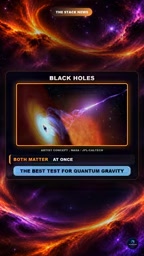
The Holographic Principle is the key background for understanding "gravity can be encoded on the boundary" in this article. It was first proposed by Gerard 't Hooft and Leonard Susskind in the 1990s, with the core claim being: all physical information within a region of space can be fully encoded on the boundary of that region, just as all the information of a three-dimensional object can be stored on a two-dimensional holographic plate. The AdS/CFT correspondence proposed by Maldacena in 1997 gave the most concrete realization of this idea: a gravitational theory in anti-de Sitter space (AdS) is equivalent to a conformal field theory (CFT) on its boundary. This "bulk-boundary" duality allows physicists to use the gravity-free quantum field theory on the boundary to calculate gravitational phenomena in the bulk, and the thermodynamic properties of black holes are an important test object for verifying whether the duality holds.
The First Problem: A Calculation Left Dormant for 23 Years
The first problem can be imagined like this: think of this kind of universe as a giant bowl. At lower temperatures, the bowl is filled with particle gas; as the temperature rises, it turns into a black hole. In 1983, Stephen Hawking and Don Page proved that this transition happens abruptly, like water boiling.
But their mathematics only holds when this universe is large. When the universe shrinks, space becomes fuzzy, and no one can perform gravitational calculations there. The quantum side, however, can still be calculated. In 1999, physicists also found a similar transition on the quantum side, but did not know whether it was abrupt or smooth. In 2003, a team built a computational framework that could have settled the question—it required thousands of terms, but was never completed.
Claude assembled a research group made of its own copies to push this calculation forward. The result showed: the transition is abrupt. The same transition appears at both extremes, suggesting that the mechanism of black hole formation may be built into quantum theory. Weeks later, another physicist used Claude to independently advance to the same stage and obtained the same answer using a different method—a powerful cross-validation.
When the universe shrinks, space becomes fuzzy, making gravitational calculations difficult. (Image: When it shrinks,)
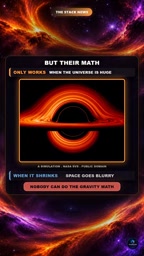
The Hawking-Page transition is a thermodynamic phase transition in AdS space discovered by Stephen Hawking and Don Page in 1983: at low temperatures, the dominant configuration in AdS space is thermal gas (no black hole); when the temperature exceeds a critical value, the configuration with a black hole has greater entropy and becomes dominant. The analogy with water boiling refers precisely to this first-order phase transition—the transition is abrupt, not continuous. This phase transition was later understood in the AdS/CFT framework as a "confinement-deconfinement" phase transition in the boundary conformal field theory. The 1999 quantum-side discovery mentioned in the article refers precisely to signs of a similar transition appearing in the boundary field theory as well; and the reason the 2003 computational framework was difficult to complete is that in the strongly coupled regime it required handling thousands of terms of perturbative expansion or numerical summation, an enormous manual computational burden—which is exactly where Claude's agents could play a role.
The Second Problem: How Heavy Can the Lightest Black Hole Be?
The second problem required a new approach: in a simplified universe with only two spatial dimensions, how heavy can the lightest black hole be? Since 2009, physicists had been lowering the upper bound on this weight, and a previous Claude agent had failed in 61 parallel attempts.
The turning point was that Claude discovered a pattern in the numbers that physicists had overlooked, and borrowed the "spectral curve" tool from mathematics. It found the exact value and proved that this method could not push it any lower in this version. A computer proof checker called Lean verified the result.
This is precisely the unique value of AI in physics research: not replacing physical intuition, but catching clues in massive numerical patterns that humans easily miss, and then using formal tools to nail down the conclusions. (Image: physicists have lowered a ceiling on that weight,)
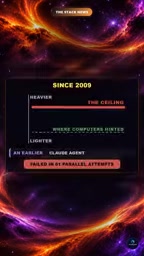
The spectral curve is a core tool in mathematical physics, originally appearing in integrable systems theory, used to encode the relationships among Hamiltonians, conserved quantities, and conserved charges. In duality research between string theory and gauge field theory, spectral curves are often used to exactly solve strongly coupled problems—they package complex quantum corrections into the geometric data of an algebraic curve, thereby transforming calculations that originally required order-by-order expansion into analytic problems on the curve. By borrowing this tool, Claude essentially mapped the black hole mass spectrum in the two-dimensional gravity model to discrete points on a curve, thereby bypassing term-by-term numerical approximation and directly obtaining the exact value while proving that the lower bound could not be pushed any further.
What Do These Results Mean?
Neither result describes our own universe, but both advance the exploration of quantum gravity and finally provide an answer to a calculation that had been unresolved for 23 years. Even more noteworthy is the methodological signal: background agents, repeated calculations, validation against known results, formal proof checking—this workflow is already close to rigorous scientific collaboration, rather than one-off question answering.
Of course, this does not mean AI can already do physics independently. The problems were posed by humans, the direction was judged by humans, and the results also need to be understood and digested by human physicists. But the outline of "AI as research infrastructure" is becoming clearer.
Lean is an interactive theorem prover led by Microsoft Research, and also a functional programming language. It is based on dependent type theory and requires every step of a proof to be mechanically checked by the kernel, so once it compiles, the conclusion is "proved" in the formal sense. Lean's most famous application in the mathematics community is Lean's mathlib library and the 2023 project formalizing Fermat's Last Theorem. In the context of this article, Lean's role is not to discover new results, but to transform the numerical conclusions obtained by Claude into formal proofs that can be verified line by line by machine, thereby ruling out the possibility of numerical error or logical leaps—this is also a key link in the "AI participates in scientific research" workflow that distinguishes it from ordinary numerical experiments.
FAQ
Which two problems did Claude solve? First, verifying whether the transition from particle gas to black hole in a holographic universe is abrupt, corresponding to a calculation left dormant for 23 years; second, determining the upper bound on the weight of the lightest black hole in a simplified two-dimensional universe.
Can these results describe the real universe? No. Both results are based on simplified models, but they provide new evidence and methods for quantum gravity research.
What did Lean verify? Lean is a computer proof checker that verified the formal proof in the second problem that the weight upper bound cannot be lowered any further.
One-line Summary
Claude's agents solved two open problems in black hole physics in six weeks, one of which had been left dormant for 23 years.
Paragraph Summary
Anthropic's Claude Fable 5.2 ran through background agents for about six weeks and solved two open problems in black hole physics. The first was verifying whether the transition from particle gas to black hole in a holographic universe is abrupt, corresponding to a calculation left dormant for 23 years after a framework was built in 2003; the conclusion is that the transition happens abruptly, and another physicist independently obtained the same answer using a different method. The second was determining the upper bound on the weight of the lightest black hole in a simplified two-dimensional universe; Claude discovered an overlooked pattern in the numbers and borrowed the spectral curve tool to obtain the exact value, and the result was verified by the Lean proof checker. Both results are based on simplified models and do not describe the real universe, but they demonstrate the outline of a new methodology with AI as research infrastructure.
Related articles

Prompt Engineering for Beginners: From Writing Prompts to Engineering Thinking
Starting from the essence and four functions of prompts, this article systematically explains the six-step process, four success criteria, learning value, and practical limitations of prompt engineering to help you build a complete understanding.

Anthropic Launches Nasdaq IPO: AI Giant's Listing and Risk Disclosures
Anthropic officially launches its Nasdaq IPO under ticker ANT, with market valuation expected to potentially exceed SpaceX's record. The prospectus devotes nearly 100 pages to AI risks, while first-half revenue grew over 14x but net losses widened sharply, reigniting the AI bubble debate.

Rust cURL Clone Uses 4,832 unsafe Blocks—Is the Memory Safety Myth Broken?
A Rust cURL clone uses 4,832 unsafe keywords, challenging Rust's memory safety narrative. We analyze what unsafe really means, compare Fil-C, and examine rewrite motives.