Claude Design vs Lovable: In-Depth 5-Dimension Comparison — Which Is Better for UX Design?

A 5-dimension head-to-head comparison of Claude Design vs Lovable for UX design
A UX designer tested Claude Design and Lovable with the same prompt, comparing the two AI website builders across five dimensions: style fidelity, typography, animations, responsive design, and copywriting quality. Results show Lovable excels at style fidelity, effectively mimicking the reference website's visual style, while Claude Design tends to generate its own clean, understated aesthetic, largely ignoring the reference screenshot's visual direction.
Article
Anthropic's release of Claude Design has caused quite a stir in the design community. As an AI design tool directly integrated into the Claude ecosystem, can it truly challenge existing AI website builders? A UX designer tested both Claude Design and Lovable using the same prompt, conducting a detailed comparison across five dimensions: style fidelity, typography, animations, responsive design, and copywriting quality. The results delivered both pleasant surprises and notable failures.
Background: The Technical Route Debate in AI Website Builders Claude Design represents Anthropic's attempt to extend its large language model capabilities into the UI/UX design domain, embodying the emerging "Design-as-Prompt" paradigm. Unlike traditional design tools (such as Figma and Sketch), AI website builders use natural language understanding to directly generate runnable front-end code, skipping intermediate steps like wireframes and prototypes. Lovable (formerly GPT Engineer) is one of the pioneers in this space, focusing on converting natural language descriptions into complete React applications, powered by code generation capabilities from large models like GPT-4. The two represent two distinct approaches in current AI design tools: the former emphasizes deep integration with the large model ecosystem, while the latter focuses more on engineering-quality code output.
Test Method: Same Prompt, Two Tools Go Head-to-Head
The tester wrote a relatively simple prompt asking the AI to generate a personal website with pages including a self-introduction and hobbies showcase, along with a screenshot of a reference website whose visual style they wanted the AI to emulate. This same prompt was given to both Claude Design and Lovable, putting them in a fair head-to-head competition under identical conditions.
The two resulting websites had drastically different styles — which in itself is quite telling.
Style Fidelity: Lovable Takes the Lead
The reference website's overall style was lively, bold, passionate, and energetic. Looking at the results, Lovable at least attempted to mimic the reference website's visual style — you can clearly see it used the reference as a template for inspiration.
Claude Design, on the other hand, completely "did its own thing," generating a design that more closely resembles Anthropic's own design aesthetic — clean and understated, but with absolutely no connection to the given reference style. Many users online have also complained that Claude Design's generated designs all look "cookie-cutter."
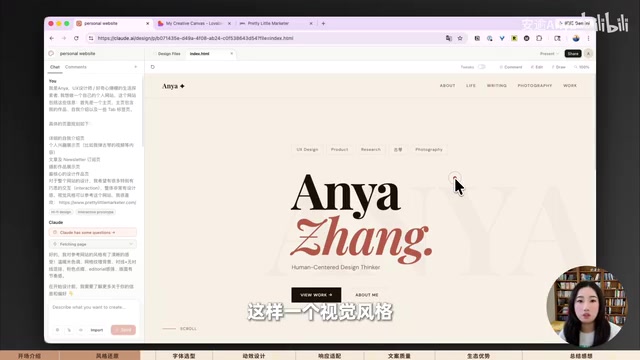
Interestingly, Claude Design's system prompt explicitly states: "Claude performs better when creating or editing interfaces based on code rather than screenshots."
Related articles
 Product Reviews
The Programmer's Desk Setup Guide: Building a Workspace That Feels Like Home
Discover how programmers build productive, comfortable workspaces. From multi-monitor setups to ergonomic design, explore the desk philosophy that drives focus and flow.
 Product Reviews
Qoder vs Cursor Real-World Comparison: Which $20/Month AI IDE Is Better?
Hands-on comparison of Qoder vs Cursor AI IDEs: Agent autonomy, human interaction count, and architecture decisions. Qoder needed only 2 interactions vs Cursor's 8.
 Product Reviews
Cursor Cloud Agent Demo: Eliminating Bottlenecks Across the Entire Software Development Lifecycle
Deep analysis of Cursor's Cloud Agent demo showing how cloud VMs, automated test artifacts, and a full-chain control plane systematically eliminate human bottlenecks across the software development lifecycle.