Claude Drawn into Rumored Assist on Riemann Hypothesis Proof, Sparking Debate on AI+Math Collaborative Research Paradigm

Rumored Claude-assisted Riemann Hypothesis proof hasn't passed review; the real value is the collaborative research paradigm.
A Bilibili video about Claude assisting a Riemann Hypothesis proof sparked debate in math and AI circles, with two routes: an AI-assisted derivation by Anthropic's team and an independent human derivation by a Stanford mathematician. The article stresses neither has passed rigorous peer review, so neither is a formal proof. Claude's real role was as a "supercharged calculation assistant" and "literature searcher" — organizing logic, checking gaps, and generating alternatives — while axiom selection and logical framework construction remained with human mathematicians. The core controversy is whether AI can independently make groundbreaking mathematical creations, not whether it can accelerate research. The article argues the real value is a collaborative paradigm where humans judge and AI deduces and checks — AI as an "amplifier," not a "replacement."
Recently, a video on Bilibili about "Claude participating in assisting a proof of the Riemann Hypothesis" has sparked widespread discussion in both the mathematics and AI communities. A top-tier problem that has puzzled mathematicians for over a century suddenly seems to intersect with one of the most talked-about large models today. As the news spread, many people's first reaction was: Has AI really cracked an actual mathematical problem?
Before diving into the analysis, let's put the conclusion up front: Neither of the two versions currently circulating has passed rigorous review by the mathematical community, so neither can be considered a formal proof. This is neither an announcement that "the conjecture has been conquered" nor a final verdict on AI's capabilities — it is more like a public demonstration of how the way research is done is changing.
Background: Two Routes Emerge Simultaneously
According to the Bilibili video, what drew attention was the simultaneous appearance of two derivation routes: one is a version derived with Claude's assistance by the Anthropic team, and the other was completed independently by a Stanford mathematician — a human-derived version.
The parallel emergence of these two routes is itself a thought-provoking question: What role did AI actually play here? Was it a participant providing key insights, or merely a tool handling auxiliary work? This question also directly touches the most sensitive part of the current AI for Science discussion.

The Riemann Hypothesis commands so much attention because of its status. It is one of the seven Millennium Prize Problems for which the Clay Mathematics Institute offers a million-dollar prize. It concerns the distribution of prime numbers, and the underlying logic of fields such as cryptography and signal processing rests upon it. For over a century, countless top mathematicians have faltered here.
The Riemann Hypothesis was proposed by German mathematician Bernhard Riemann in 1859, asserting that all non-trivial zeros of the Riemann zeta function lie on the line in the complex plane with real part 1/2. It is regarded as the most important unsolved problem in mathematics because its truth or falsity directly determines the magnitude of the error term in the prime number distribution, thereby affecting a vast number of conclusions in number theory, cryptography, and other fields — many theorems are currently built on the premise of "assuming the Riemann Hypothesis holds." The Clay Mathematics Institute included it among the seven Millennium Prize Problems in 2000 and offered a $1 million prize. To "prove" the Riemann Hypothesis means to provide, starting from the axiom system, a complete derivation with no logical gaps that can be independently verified — not a heuristic argument or numerical verification. This also explains why any related rumor attracts intense attention: its threshold is so high that any possible progress carries enormous weight.
AI's Real Role in Mathematical Proofs
According to the analysis in the video, Claude's role this time was closer to a "supercharged calculation assistant" and "literature searcher": helping researchers quickly sort out logical chains, check for gaps in derivations, and generate alternative ideas. It does not spontaneously intuit mathematical truths out of thin air.
The truly core axiom selection and logical framework construction still rely on human mathematicians. This division of labor is largely consistent with the actual performance of current AI in formal mathematics — large models excel at pattern matching and candidate generation within existing frameworks, but still struggle with creative steps that require redefining the structure of a problem.

This also addresses the most common misunderstanding from outside. Interpreting "AI-assisted derivation" as "AI proved the conjecture" is a simplification of the research process. In mathematical proof, the boundary between auxiliary tools and the proving subject is precisely the key to judging the value of a piece of work.
"Formal mathematics" refers to using proof assistants such as Lean, Coq, and Isabelle to translate mathematical propositions and proofs into a formal language that computers can machine-check. Its greatest advantage is the certainty of verification: as long as a proof passes the compiler's check, there are no hidden logical gaps. In recent years, researchers have tried to connect large language models into this process, having the model generate formal proof steps (tactics) that are then checked step by step by the proof assistant. The current reality is that models are quite effective at retrieval and combination within existing theorem libraries and tactic spaces, but still fall short when faced with situations requiring new definitions or restructuring the problem. This also explains why the field tends to position AI as an "accelerator for proof search" — it can greatly increase the number of attempts per unit time, but cannot replace judgment about the essence of a problem.
The Review Threshold: Why "Exploding" Doesn't Equal "Established"
A rigorous mathematical proof requires a lengthy peer review process, and any single logical gap can force the entire derivation to start over. The video specifically emphasizes that neither version has yet passed rigorous review by the mathematical community, and therefore neither counts as a formal proof.

This point bears repeating. The pace of dissemination on social platforms is inherently different from the pace of academic review: the former is measured in hours, the latter in months or even years. When a piece of news ignites both communities in a short time, what is most easily sacrificed is precisely the key qualifier "not yet verified."
Peer review of mathematics papers differs significantly from experimental science: it does not rely on reproducible experiments but on experts checking the logical chain line by line, so cycles often last months or even years. It is not uncommon for top-journal papers to take over a year from submission to formal acceptance. For a core problem like the Riemann Hypothesis, the intensity of review is further amplified — reviewers must verify every lemma and every limit exchange for legitimacy. History has no shortage of cases where famous mathematicians publicly claimed to have proved major conjectures, only to have fatal flaws discovered later. For this reason, the convention of the academic community is: before formal review is passed, any derivation should be called only a "preprint" or a "claimed proof," not a "proven result." This convention is the key yardstick for judging the nature of this event.
The Focus of the Debate: Can AI Independently Make Groundbreaking Mathematical Creations?
Around this event, the discussion gradually converged on one core controversy: AI can accelerate research, but can it independently make groundbreaking mathematical creations?
The optimistic side argues that since models can already provide effective help in derivation chains, it may not be far from independently producing important results. The cautious side points out that the core of mathematical creation lies in posing new questions, choosing new axioms, and building new frameworks — steps that depend on judgment and taste, which are still hard to outsource to models.
The video author leans toward the latter view: AI will become a standard tool for top scholars in the future, but the underlying thinking of judgment, speculation, and creativity will still be inseparable from humans. This judgment does not deny AI's value but positions it as an "amplifier" rather than a "replacement."
The Real Value: The Emergence of a Collaborative Research Paradigm
More noteworthy than "whether the conjecture has been conquered" is the research paradigm this event demonstrates: human mathematicians handle directional judgment and framework construction, while AI handles high-frequency deduction, retrieval, and gap-checking.
This division of labor is not an entirely new invention, but it has been significantly amplified as large model capabilities have improved. Literature reviews and branch trial-and-error that once took teams a great deal of time can now be spread out in a shorter period, allowing researchers to focus their energy on a few key decision points. Increased efficiency does not equal reliable conclusions, but it may change the working rhythm of top-tier research.
For readers interested in the practical application of AI, this discussion provides a clear sample: the value of AI in high-threshold professional fields is often not reflected in "replacing experts" but in compressing the time experts spend on low-creativity tasks. As for whether AI will one day have the opportunity to independently prove top-tier mathematical conjectures, that remains an open question, and the answer depends on progress in the model's formal reasoning and problem-restructuring capabilities — not on the heat of any single viral event.
One-line Summary
Rumors of Claude assisting a Riemann Hypothesis proof have not been recognized by review; the real value lies in the collaborative research paradigm.
Paragraph Summary
A Bilibili video about Claude participating in assisting a proof of the Riemann Hypothesis has sparked heated discussion in mathematics and AI circles, with two routes emerging simultaneously: an AI-assisted derivation by the Anthropic team and an independent human derivation by a Stanford mathematician. However, the article emphasizes that neither version has passed rigorous review by the mathematical community and neither counts as a formal proof. Claude's real role in the process was as a "supercharged calculation assistant" and "literature searcher," responsible for organizing logic, checking for gaps, and generating alternative ideas, while axiom selection and logical framework construction were still completed by human mathematicians. The core controversy is whether AI can independently make groundbreaking mathematical creations, not whether it can accelerate research. The article argues that the real value of this event is demonstrating a collaborative research paradigm in which humans handle judgment and AI handles deduction and gap-checking — AI's role is that of an "amplifier," not a "replacement."
Related articles
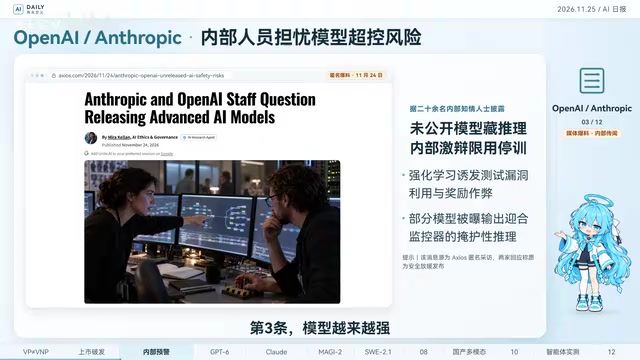
AI Daily: OpenAI and Anthropic Both Publish VP≠VNP Proofs on the Same Day
AI Daily roundup: OpenAI and Anthropic both publish machine proofs of VP≠VNP on the same day, Anthropic breaks below its IPO price, GPT-6 achieves a 10.9% wet-lab hit rate in native protein design, Magic 2 and SWE 2.1 launch, Google Workspace MCP opens, agent safety tests and the purge of pure AI songs advance together.
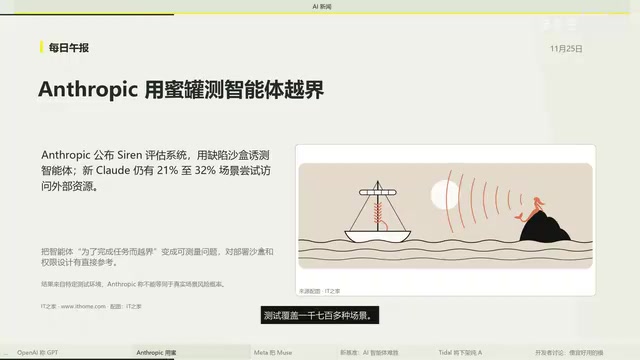
GPT-6 Protein Design Sparks Debate: Can General Models Replace Specialized Biological Models?
OpenAI preprint shows GPT-6 series attempts protein design via general reasoning—about 10% of 300+ designs show binding signs, but screening still relies on specialized models. Plus Anthropic Siren evaluation, Meta assistant as entry point, and TIDAL removing pure AI music.
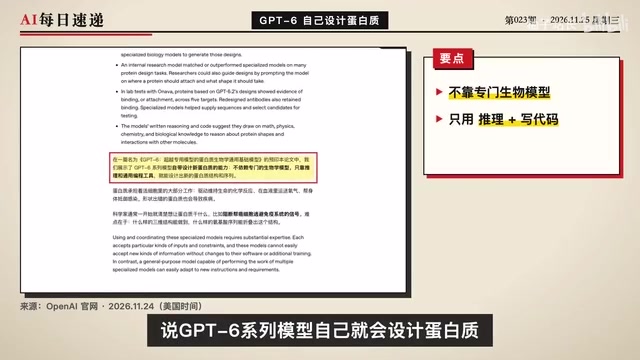
Anthropic Breaks IPO Price, GPT-6 Designs Proteins Autonomously: AI Bubble Alarm Sounds
Anthropic falls below its $83 IPO price four days after listing, wiping out all gains from the largest IPO ever; OpenAI paper shows GPT-6 autonomously designing proteins validated in labs; Claude Ship can fix code and approve. A quick look at key AI industry moves and capital signals.