Anthropic Breaks IPO Price, GPT-6 Designs Proteins Autonomously: AI Bubble Alarm Sounds
AI capabilities keep expanding, but Anthropic breaking its IPO price and Nvidia's pullback show capital is starting to demand returns.
The article summarizes a set of sharply contrasting signals: on the capital side, Anthropic—the largest IPO in history—fell below its $83 offering price just four trading days after listing, down 6.5% in a single day and wiping out all gains, while Nvidia also fell nearly 6% amid executive remarks and sector valuation pressure, reflecting a shift from "telling growth stories" to "calculating returns." On the technology side, things are accelerating—GPT-6 series autonomously designs proteins using only reasoning and coding and sends them to labs for validation, Claude Ship lets AI fix its own code and even approve merges, and ChatGPT agent Dots will get its own email address. Elsewhere, Ant Group open-sourced a health model predicting risks for over 100 diseases, Tidal announced deletion of about 29 million AI songs, and the New York Times warned that new Photoshop may quietly flag AI. The article concludes that the technology curve and capital curve are not synchronized, and this misalignment is the true portrait of today's AI industry.
Anthropic Breaks IPO Price, GPT-6 Designs Proteins Autonomously: AI Bubble Alarm Sounds
Sentiment in the AI capital markets is turning sharply. Anthropic, the largest IPO in history, fell below its offering price just four trading days after listing; on the same day, OpenAI dropped a paper showing GPT-6 autonomously designing proteins that have entered the lab, while Nvidia came under pressure from executive remarks and a sector pullback. Technology is still racing ahead—but the money is starting to hesitate.
Anthropic Falls Below Offering Price: Why the Largest IPO in History Gave Back All Its Gains in Four Days
According to Bilibili's AI Daily Express program, Anthropic opened at a peak of $111.5 on its Thursday listing but declined steadily afterward, closing at $81.9 on Tuesday—a single-day drop of 6.5% and its first break below the $83 offering price. Within four trading days, all gains since listing were wiped out.
Explanations for the decline vary: some argue investment banks priced the opening too high and exhausted expectations, while others point to a broader AI sector correction, with Nvidia's recent turmoil further weighing on sentiment. The more fundamental doubt is this—AI companies continue burning cash at scale, and when profitability will materialize is becoming a question investors cannot avoid.
This is not one company's predicament but a signal that the entire AI narrative is shifting from "telling growth stories" to "calculating returns."
IPO breaking issue price and offering price: An IPO (Initial Public Offering) is when a company first issues shares to the public to raise capital. The offering price is the initial share price set by underwriting banks before listing based on valuation, roadshow feedback, and market demand; the stock then floats freely from that base on the first trading day. "Breaking issue" means the secondary-market price falls back below the offering price, usually indicating the market's recognition of the company's valuation falls short of the IPO pricing. For tech companies, banks sometimes deliberately underprice to leave "upside" for the first day; conversely, if priced too high, first-day gains are brief and may quickly reverse, as with Anthropic. So "wiping out all gains in four days" is not just a sentiment indicator—it reflects a gap between offering pricing and genuine market expectations.
GPT-6 Series Designs Proteins Autonomously—and They Actually Reached the Lab
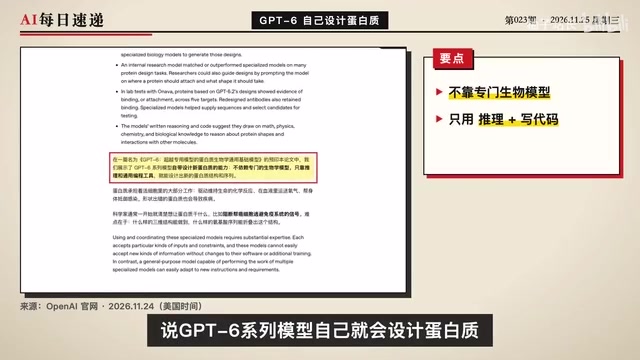
A paper published by OpenAI shows that GPT-6 series models, without any specialized biology model, can autonomously design proteins using only reasoning and coding abilities—and the results have actually been sent to labs for validation.
According to the program, of the 300+ small proteins designed by GPT-6.2, 35 successfully bound to their targets, including targets related to cancer immunity. Objectively, sequence generation and screening still relied on specialized models, and the hit rate was lower than professional tools—so this is more an early signal: general reasoning models are beginning to touch specialized scientific research, but they have not yet replaced domain-specific tools.
Protein design and binding hit rate: Proteins fold from amino acid sequences into specific three-dimensional structures, and their functions (such as catalysis, recognition, binding) depend heavily on structure. Traditional protein design requires specialized models (such as domain tools based on structure prediction and sequence generation) to sample sequences and evaluate folding. "Small proteins" here typically refer to proteins with fewer amino acids and relatively simple, easy-to-synthesize structures suitable for experimental validation. "Successfully bound to target" means the designed protein achieves sufficient affinity with the specified target molecule—the most critical step in drug and diagnostic reagent design. "Hit rate" is the proportion of successful experimental validation. 35 out of 300+ is about 10%; though lower than the higher hit rates typical of professional tools, for a general reasoning model not specifically trained, it shows it can already produce usable candidates in real scientific workflows.
Claude Ship Lets AI Fix Its Own Code and Click Approve Itself
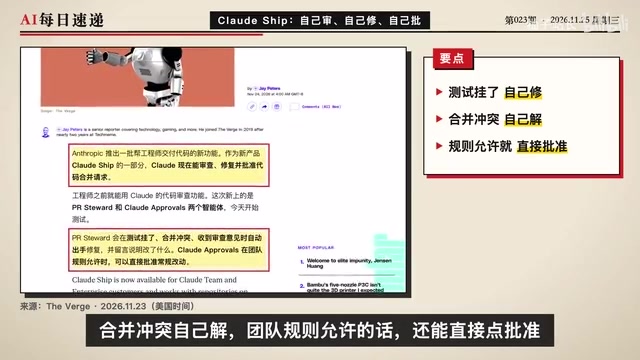
Anthropic also made product moves, launching Claude Ship. According to the program, Claude can now not only review code but also fix it autonomously after test failures, resolve merge conflicts on its own, and—where team rules permit—directly click approve.
This means AI coding assistants are moving from "giving suggestions" to "making decisions." For developers, the efficiency gains are obvious, but permission boundaries and review responsibilities become questions that must be answered.
ChatGPT Agent Dots Will Have Its Own Email Address
The program also mentioned a first-hand tip: Dots, the agent in ChatGPT, will have its own email address. A hidden email button was spotted in the interface, and an OpenAI employee responsible for Dots confirmed on Twitter that testing has begun.
The idea is that users could eventually CC Dots to help schedule meetings, or even have it take a receipt and negotiate a refund. However, the feature is not officially live and no timeline has been announced. An agent having an independent identity is a key step from a conversational tool to "handling affairs"—email is just the starting point.
Agents and independent identity: An agent refers to an LLM application that can autonomously break down tasks, call tools, and execute multi-step operations, distinct from a chat assistant limited to one question and one answer. Giving an agent its own email essentially grants it an "identity" recognizable by external systems: email can bypass the user's own account to directly complete actions requiring identity verification, such as registration, appointments, and customer service communication. Technically, this advances agents from "acting on the user's behalf" to "negotiating externally in their own name," but it also raises new issues around authorization scope, spam governance, and liability. Email is the starting point because it is one of the most universal digital identity credentials.
Nvidia All-Hands Meeting: Jensen Huang Apologizes and Denies Trump Helped Him Return
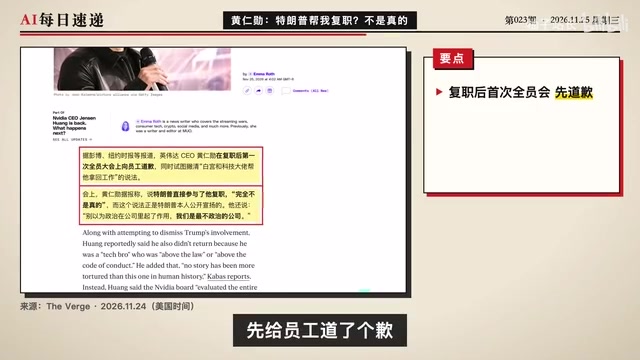
According to the program, Jensen Huang apologized to employees at his first all-hands meeting after returning to his role, and stated explicitly that claims "Trump helped him return" are completely untrue. He also called Nvidia the least honest company—a claim Trump himself has been repeating everywhere. Nvidia shares fell nearly 6% on Tuesday.
The entanglement of executive remarks with political narratives, combined with sector valuation pressure, constitutes a short-term disturbance for the current AI hardware leader.
Ant Group Open-Sources Health Prediction Model: Your Wristband May Know Where You Feel Unwell Before You Do
Domestically, Ant Group open-sourced a health prediction model called Linked Center Pulse, which can predict the risk of 50 diseases within the next six years based on physiological signals such as ECG and EEG; using only two simple sensors—ECG and respiration—it can also predict more than 100 diseases.
If such models reach consumer-grade wristbands, health monitoring will shift from "recording data" to "early warning," with significant implications for chronic disease management and early intervention. Of course, there is still a gap between predicted risk and actual diagnosis, and deployment scenarios and accuracy need continued observation.
Tidal Fully Bans AI Music: 29 Million Tracks to Be Deleted
Music platform Tidal announced a full ban on AI-generated music starting December 9, with roughly 29 million AI tracks expected to be deleted. Data disclosed by the program shows that 43% of songs uploaded in the past three months were AI-made, while 96% of AI songs were never listened to even once.
The coexistence of exploding supply and scarce demand is the direct motivation for content platforms to tighten rules on AI-generated content.
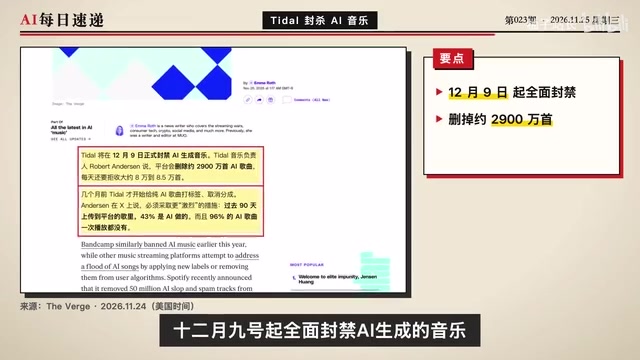
The platform governance challenge of AI-generated content: Generative music tools have driven the cost of producing songs in bulk to near zero, causing extreme supply-side inflation. Tidal's data (43% of new songs in the past three months were AI-made, 96% unlistened) reveals a typical structure of "supply explosion, demand scarcity": massive content represents storage and moderation costs for platforms while generating almost no play revenue or copyright value. A full ban is an extreme governance path—more thorough than labeling, throttling, or revenue-sharing thresholds, but harder to enforce, since identifying AI music itself has accuracy problems and mistakenly deleting human works would spark controversy. The decision also reflects content platforms' trade-offs among copyright, recommendation ecosystems, and creator relations.
New York Times Warns Photographers: New Photoshop May Quietly Flag AI
One final practical reminder: The New York Times has asked its partner photographers not to use the latest version of Photoshop, because its AI features may activate without the user's awareness, causing original photo data to be flagged as AI-generated. Before using the new version, check the relevant settings.
Conclusion: Technology Accelerates, Capital Brakes
Taken together, today's information paints a rather fractured picture: on one side, GPT-6 autonomously designs proteins that reach the lab, Claude fixes code and clicks approve on its own, and agents get email addresses—AI capability boundaries keep expanding; on the other, Anthropic breaks its issue price and Nvidia pulls back, as capital markets begin demanding return on investment.
The technology curve and the capital curve are not synchronized, and this misalignment is itself the most authentic portrait of the AI industry today.
Related articles
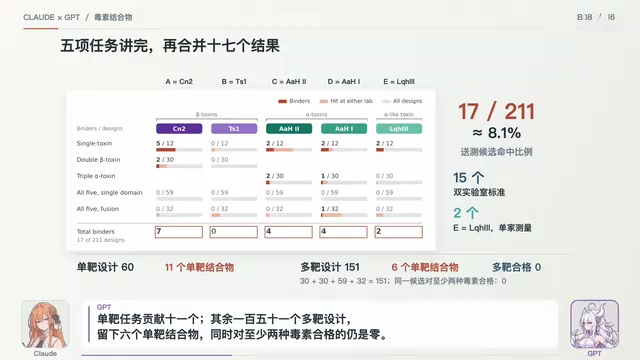
Claude Designs Scorpion Venom-Neutralizing Proteins: With 17 Binders, How Far Are We From an Antidote?
Anthropic's Claude helped design scorpion venom-neutralizing proteins: only 17 of 211 candidates passed, multi-target coverage failed, and channel function and animal testing remain absent.
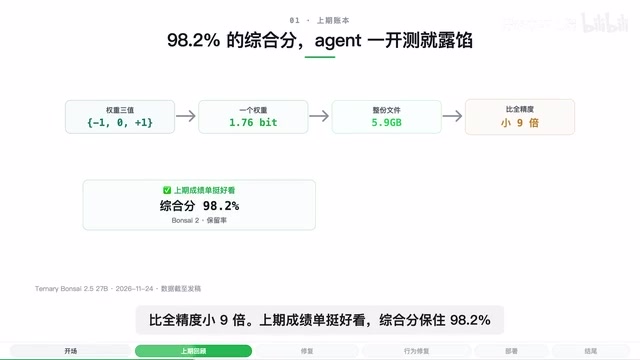
Fitting a 27B Model into 5.9GB: Ternary Bonsai 2.5 Fixes Its Agent Weaknesses
Prism ML releases Ternary Bonsai 2.5: a 27B model in just 5.9GB, with ternary quantization compressing weights to 1.76 bits. The new version focuses on fixing Agent capabilities, raising Tao3Bench Verify to 75.6 and Upworld from 51.2 to 90.5, hitting 291 tokens/s on a single A700, open-sourced under Apache 2.0.
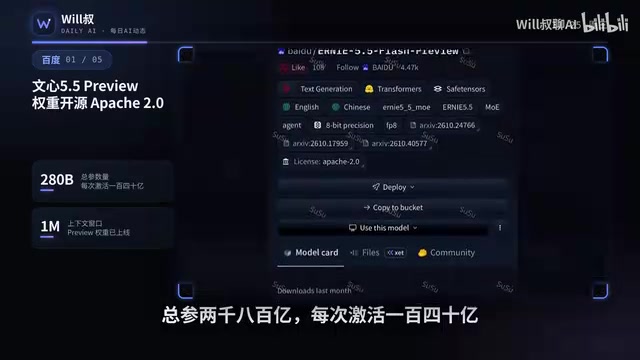
GPT-6-Designed Proteins Validated in Lab; ERNIE 5.5 Preview Open-Sourced
GPT-6 designed proteins using reasoning and code alone, with lab binding evidence across five targets; Baidu open-sourced ERNIE 5.5 Flash Preview under Apache 2.0 with 280B parameters and 1M context.