Claude Duet Hands-On: The Most Proactive AI Assistant, But Grok Bot Still Leads
Claude Duet is the most proactive agent out of the box with strong artifacts, but lacks browser takeover and local skills—Grok Bot still leads.
Anthropic launched Claude Duet, a standalone personal AI agent tied to your Claude account that automatically scans email and calendar every three hours for work it can do—the most proactive agent out of the box. Its key differentiator is HTML artifacts: one sentence generates morning briefs, email triage, YouTube dashboards, and sponsorship revenue boards, with scheduled auto-updates. But as a research preview, Duet has two major gaps: no way to view or control its cloud browser (leaving Uber bookings stuck on CAPTCHA) and no access to local custom skills. In the comparison, the author still ranks Grok Bot first, praises Muse's design and business-call feature, notes ChatGPT Dots' ecosystem advantage, and predicts Anthropic will keep iterating and eventually fold Duet into the main Claude app.
Title
Claude Duet Hands-On: The Most Proactive AI Assistant, But Grok Bot Still Leads
Article Content
Anthropic has finally launched its own personal AI agent product—Claude Duet. After getting early access, I spent a good amount of time diving deep into it and compared it side by side with the major personal agents on the market: Grok Bot, Muse, ChatGPT Dots, and others. Let me give you the verdict upfront: out of the box, Duet is the most "proactive" agent, and its product polish is quite high—but it's still missing a few key capabilities, and Grok Bot remains my daily go-to.
What Duet Is: A Standalone App Positioned as a 24/7 Assistant
Duet has its own standalone mobile app, plus a dedicated interface within Claude's web version. Anthropic positions it as a 24/7 assistant that helps you get work done.
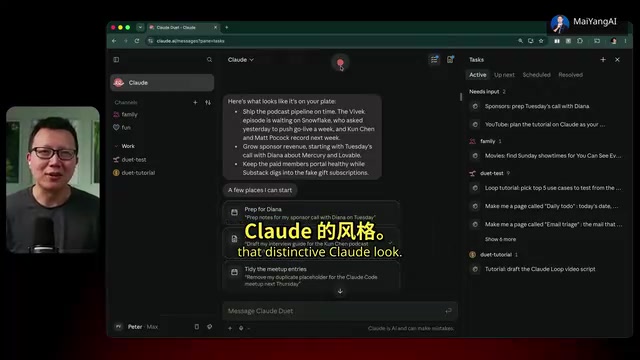
The most pleasant part of the onboarding experience: Duet is directly tied to my Claude account, so I didn't need to reconnect email, calendar, or other apps. On the first conversation, it immediately read my emails, calendar, and connected apps, then proactively suggested a few places where it could help—like preparing for a call with sponsor Diana, drafting talking points for a podcast interview with my friend Kun, and cleaning up some Meetup entries.
That "it just finds work to do without being taught" experience is something I've rarely seen in similar products.
Tasks and Channels: A Workflow Like Claude Projects
Duet's core organizing unit is the "task." When you click a suggestion, it creates a task—essentially a sub-thread under the main conversation thread. In the task folder, I can see in-progress tasks, upcoming tasks, scheduled tasks (routines that run daily or weekly), and completed tasks. The logic is very close to Claude Projects.
In the left navigation bar, Duet doesn't let you customize the main thread and avatar the way Muse and Grok Bot do—the main interface is just an animated little dot, and Anthropic clearly wants to preserve Claude's visual identity. But you can create standalone channels and customize channel icons (like a pencil or a house) and colors. This approach leans utilitarian—less entertaining than Muse's animated avatars—but it fits Duet's work-oriented positioning. Channels can also be grouped and dragged around for management.
Interestingly, Anthropic chose to release Duet as a fully standalone app. This fits its usual playbook: launch as a research preview, iterate and validate, then merge back into the main app—the same path Cowork and Chat took before.
Claude Projects is a project-organization feature Anthropic previously introduced in Claude, allowing users to create separate workspaces for different topics, each with custom instructions, uploaded documents, and independent conversation history. Duet's "task" system follows this same hierarchical logic: the main conversation thread acts as a project overview, sub-threads correspond to specific tasks, and scheduled tasks resemble automated routines within a project. This design lets users manage an agent's long-term work with a project-based mindset rather than starting from scratch each time.
Where the Proactivity Comes From: A Check Every Three Hours
Duet is the most proactive among similar products, and the reason is concrete: it ships with a scheduled check task by default. Looking at the history, this task runs every three hours from 9 AM to 10 PM, automatically scanning email, calendar, and connected apps to find work it can do on your behalf.
It reports like a chief of staff: "Good morning Peter, here's a sponsorship collaboration you and Diana are working on, a Mercury payroll video that needs to go live, and prep for Friday's podcast recording with Nate."
Personally, though, I feel five checks a day is a bit too frequent—once in the morning and once in the afternoon would be more reasonable. Fortunately, you can just tell Duet to adjust the schedule.
The Killer Feature: HTML Artifacts
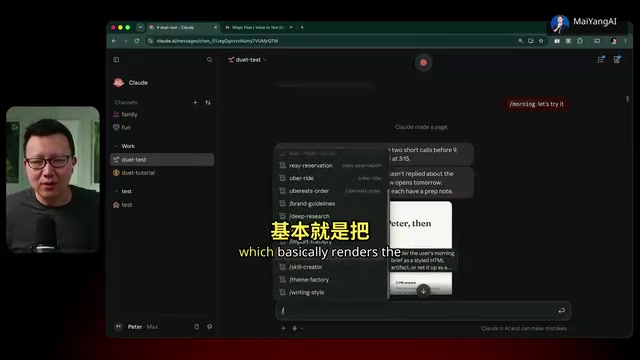
What really sets Duet apart is the artifacts it can generate. Typing a slash brings up various skills, among which the "Morning Brief" skill renders your morning briefing as a styled HTML page. I tried it once, and the result carried Claude's signature aesthetic—it even thoughtfully noted "two short calls before nine, then the whole day is free," and added a sun icon, as if encouraging me to go soak up some sun after my meetings.
Another useful skill is "Learn my writing style." It read 33 emails I'd sent, 1 Slack message, 47 DMs, and 11 documents, then summarized a writing guide: get to the point, skip the pleasantries, organize a string of requests into numbered lists, use lowercase for internal team communication, and polish wording together with partners. This style guide can then be used directly for drafting emails.
Combined with the daily to-do list and email triage artifacts, I can basically rely on Claude for email replies. I review important emails myself—it drafts first, I revise, then send; for less important ones, I'm fine letting it send directly.
Artifacts is a feature Claude introduced earlier, referring to standalone interactive content blocks (such as code, web pages, or charts) that the model generates during a conversation, which users can preview, edit, and reuse in a side panel. Duet extends this into "artifact" skills: the agent not only generates content but can render it as a styled HTML page using specific skill templates (like morning briefs or data dashboards), with support for scheduled updates and email delivery. This turns artifacts from one-off outputs into persistently running workflow components.
Data Dashboards: Generated from a Single Sentence
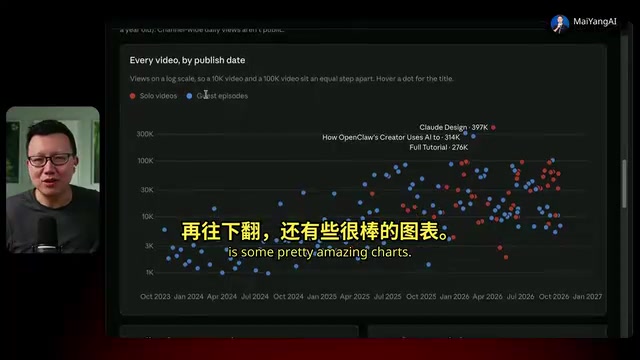
More complex artifacts also take just one sentence. I said to Duet: "Can you make a dashboard and analysis of my YouTube data?" and attached my channel link, without writing any fancy prompts. It went through a year of my published videos and public data and produced a report: subscriber count, number of uploads, performance of each video ordered by publish time, better-performing keywords (personal AI agents, model showdowns, Claude-related videos), and the relationship between video length and performance.
It also surfaced patterns I hadn't summarized myself: personal AI agent videos are my breakout genre; solo videos outperform interview videos unless the guest can deliver a hands-on demo.
The sponsorship revenue dashboard works the same way—I used mock data, and it showed booked revenue, pending conversations, signed deals, and offered insights: a large chunk of revenue is concentrated in Q4, but sponsorship bookings for next year are insufficient, and three sponsors account for the vast majority of revenue. Of course, these dashboards can also have scheduled tasks that auto-update weekly and get emailed out.
There's another fun use case: my kids and I built an "AI Exploration Club" with a little robot and animated text—click it and you get the first lesson on "what is a chatbot." Anthropic's models really do have an edge in motion and animation. That said, the content is text-heavy and not engaging enough for kids; it needs more prompting to strengthen the visual presentation.
The Shortcomings Are Obvious Too: No Visible Browser, Missing Local Skills
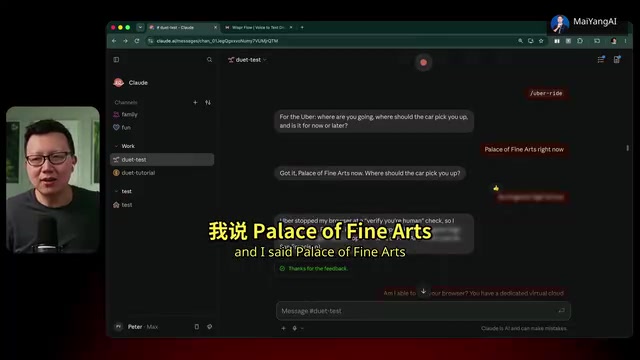
I have to be honest: Duet is still a research preview. The most direct shortcoming showed up when I asked it to call an Uber. The skill library has a default "Uber ride" skill, and I gave it the pickup point and destination (Palace of Fine Arts), but it got stuck on Uber's CAPTCHA—Duet couldn't click through the verification.
What's more troublesome is that I couldn't find any entry point to view or operate Duet's browser. Other personal agents typically let you take over the browser and manually complete actions that require a human, like CAPTCHAs or signatures. From what I understand, Duet's product manager is working on this feature and it should arrive soon—but for a personal agent running on a cloud computer, interacting with the browser is almost a must-have.
The second shortcoming: Duet's skill library can't see the skills on my local computer. Anthropic will very likely launch a desktop version of Duet, at which point this problem will be solved.
Cloud browser refers to a personal agent running in a remote virtual machine, accessing web pages, filling out forms, or performing actions through a headless browser. Since the agent doesn't directly control the user's local browser, when it encounters CAPTCHAs or steps requiring signature confirmation, it often can't complete them autonomously. The common industry practice is to provide a "takeover" entry point, letting the user temporarily operate the agent's browser window manually and then hand back control—exactly the capability Duet currently lacks and competitors generally have.
Side-by-Side Comparison: Why Grok Bot Still Ranks First
I reviewed the personal agents I've used, and here's my conclusion:
Grok Bot: Still my top choice—I use it like an employee. The free X integration is great for market research. The downside is its own email feature doesn't work well—if you @ it in an email, it won't respond—and Grok Bot isn't free.
Muse: Free and the most design-forward, possibly the most beautiful of all personal agents, with Duet close behind. Its killer feature is being able to call US businesses on your behalf—I had it contact Davey Tree Expert about tree removal in my backyard and call to negotiate my cable bill, saving a ton of time. The main issue is that it doesn't use frontier models like Opus or Astra; while Muse Wonder performs well, there's still a gap in model capability.
ChatGPT Dots: Its biggest advantage is living inside ChatGPT, with access to Memory and existing conversation threads. The problem is it had many bugs at launch—though it's improved a lot since, it's still slower and less usable than just opening a "chief of staff" thread directly in ChatGPT.
Claude Duet: The most proactive out of the box, quite mature in product polish, and Claude's visual style is very appealing. But what it lacks are exactly the two key capabilities mentioned earlier—no visible browser and no easy way to add your own skills.
A Promising Start Worth Looking Forward To
Claude Duet is currently available as a research preview, with Pro and Max subscribers needing to wait in a queue. My take: Anthropic will keep strengthening Duet and eventually turn it into a feature within Claude's main apps (desktop, web, mobile)—just as it did with Cowork and Chat.
Given that Claude is my primary model and work environment, with a lot of accumulated memory about how I work, once Duet exits research preview and becomes robust enough, I'll likely use it much more often. For now, this is a pretty solid start.
Related articles
Learn AI Agent Development for Free: Build a Minimal Conversational Agent from Scratch
Based on Xiao Fu Ge's free Bilibili course, this lesson covers the five-stage AI Agent learning path, OpenAI protocol integration, a lightweight Java project, and building a minimal conversational agent.

Zero-Code AI God Sandbox: Is This Reddit User's Wild Idea Feasible?
A Reddit user wants 3-4 AI agents to play gods in a sandbox world for friends to interact with. Is this zero-code idea technically feasible? We break down the barriers.
Is Claude the AI That Refuses to Be a "Yes-Man"? A Reddit Discussion
Reddit discusses whether Claude is the least "yes-man" LLM. This article analyzes Claude's honesty design, comparisons with other models, and users' real attitudes toward AI people-pleasing.