Claude Duet Proactive Agent Launches: AI Confirms With You Before It Starts Working for You
Anthropic launches proactive agent Claude Duet, with multiple updates pushing AI into continuous workflows.
This article rounds up a batch of AI product and model updates: Anthropic launches proactive agent app Claude Duet, powered by Opus 5.5, which can observe and organize information in the background and alert users, but must confirm before acting on their behalf; it is currently open to US Pro and Max users. On the API side, prompt caching is set to 12 hours, while product-side session caches are retained longer, reducing the cost of resuming after interruption. Claude Security continuous scanning is in public beta for Enterprise users, automatically rescanning after code changes. Recursive releases Flint, a local coding MoE model with 40 billion parameters, only 2.5 billion activated per inference, and up to 512K context. Cloud API gets its first formal version update since 2023. Also included are Rockbot's iterable reports and dashboards, Mistral's voice toolkit, and Google Cloud's enterprise private preview.
Anthropic has launched a new app called Claude Duet. Unlike the conversational assistants of the past that "answer when you ask," Duet is positioned as a "proactive agent": it continuously observes, organizes information, alerts you when something needs your attention, and can also carry out tasks you assign. But before it actually takes any action on your behalf, it comes to you first for confirmation.
According to Bilibili's "Green Duck AI Daily," Claude Duet is powered by Opus 5.5 and can quickly connect to various apps, compile briefings, and monitor activity around the clock. The app is initially available to Pro and Max users in the US, with a waitlist, and supports iOS, Android, and the Claude web client.
The Key Step for Proactive Agents: Confirm Before Acting
The word "proactive" has been overused in AI products, but there's a notable constraint in Claude Duet's design: it confirms with the user before taking action on their behalf.
This detail looks minor, but it actually determines the product form. An agent that can automatically send messages, change schedules, and submit forms for you—without a confirmation step—would be hard for users to truly trust with tasks. Duet separates "observation and reminders" from "executing actions": the former can happen automatically, while the latter must get the user's go-ahead. This is a necessary precondition for proactive agents to move from demos into daily use.
Compared with other agent products on the market, most are still stuck in the single-turn mode of "user initiates, AI executes." Duet tries to turn interaction into something continuous and ambient. Whether users accept it depends on whether its reminders are restrained enough—an assistant that pops notifications all day will quickly get turned off.
Caching Strategy: 12 Hours and Longer Context Continuity
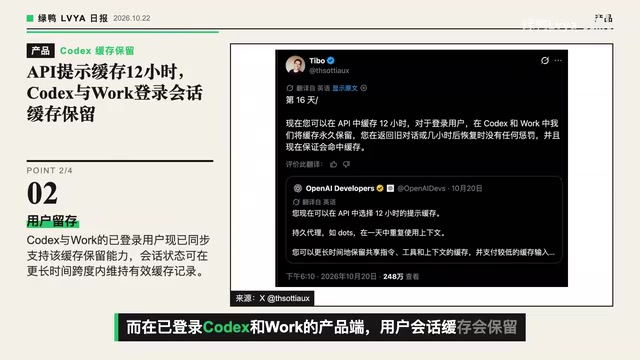
On the API side, Claude's prompt caching duration is set to 12 hours. On the Codex and Claude product side, session caches for logged-in users are retained even longer.
According to the official notes, in the new version, when users return to an old session or resume a session after several hours, they can hit the cache, thereby reducing the penalty for cache misses. For scenarios where you switch back to an old session after several hours to continue working, the existing cache can be reused directly.
This change has fairly direct significance for long-task workflows. In the past, when developers did multi-turn debugging or long document processing, coming back after a while often meant rebuilding context from scratch—slow and expensive. With a longer cache window, the cost of "interrupt—resume" drops noticeably, and agent-type applications benefit especially, since they inherently run in the background for long periods.
Prompt Caching refers to precomputing and storing the key-value state of repeated prefix content in a conversation or document (system prompts, long documents, codebase context, etc.) on the server side, so that subsequent requests that hit the cache can reuse it directly and avoid recomputation. Its benefits show up in two ways: first, it reduces time to first token; second, it greatly reduces billing caused by repeated input. Caches usually have a time-to-live (TTL) and must be rewritten after expiration, so the length of the cache window directly determines whether "interrupt—resume" scenarios are worthwhile. For agent-type applications, long-running background operation with intermittent requests is the norm, and cache hit rate often affects overall cost and experience more than single-inference speed.
Claude Security Continuous Scanning Enters Public Beta
The existing Claude Security has received a continuous scanning feature update, now in public beta for Claude Enterprise users.
After connecting a code repository, it first performs an initial in-depth scan and then automatically rescans after subsequent code changes land. This design lets teams using Enterprise edition integrate continuous code scanning into their daily development process, rather than treating it as a once-a-quarter action.
The value of security scanning depends heavily on frequency and coverage. A one-time scan can only find existing problems, while every code merge may introduce new risks. Automatic rescans tie security checks to the CI process, which is the right approach; during the public beta, the actual false positive rate and scan duration will be key points for teams to evaluate.
Continuous Scanning is a common practice in the application security (AppSec) field, distinct from one-time or quarterly penetration testing and code audits. It embeds checks such as static analysis and dependency vulnerability detection into the code commit and merge process, incrementally rescanning whenever code changes land, so newly introduced risks are discovered before or shortly after merging into the main branch. Its value and its noise are two sides of the same coin: the higher the frequency, the fuller the coverage, but if false positives cannot be effectively suppressed, developers will gradually ignore alerts. Therefore, when evaluating such tools, false positive rate, single-scan duration, and impact on the CI pipeline are usually more critical than "how many problems it can find."
Reports and Dashboards: Still Editable After Generation
Rockbot supports directly generating reports, memos, and dashboards, and they can still be edited or updated after generation.
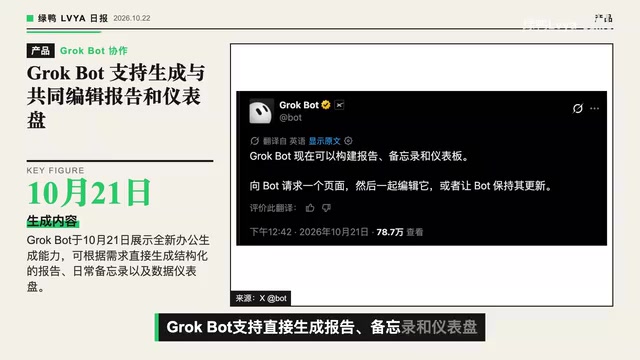
This means it is not a one-off output. After users receive a preliminary report or dashboard, they can continue modifying and iterating based on the existing content to follow up on subsequent content adjustment needs.
This capability sounds ordinary, but it has a significant impact on real workflows. AI-generated content is often abandoned because editing it is more laborious than writing it yourself—messy formatting, rigid structure. If the generated result is itself an editable, evolvable baseline version, its utilization rate will be much higher.
Local Coding Model Flint: 40 Billion Parameters, Only 2.5 Billion Activated
Recursive released a local coding MoE model called Flint, with a total of 40 billion parameters and only 2.5 billion activated per inference.
It supports a maximum context length of 512K, with the official recommendation of 256K for daily use. According to official test results, the model runs at over 125 tokens/second on M4 Pro and can reach similar or higher speeds on devices such as GB10 (the original text's description of specific hardware is ambiguous; refer to official data).
Sparse activation is the core selling point of this type of model: a large total parameter count ensures the upper limit of capability, while a small number of activated parameters per inference controls inference cost and makes it runnable on local hardware. The official scenario is running coding tasks on local hardware. For teams that don't want to send code to the cloud, such models are a realistic option, but actual coding ability still depends on community evaluations.
MoE (Mixture of Experts) is a model architecture: the network contains multiple parallel "expert" subnetworks plus a routing module, and each forward inference only routes the input to a few of those experts for computation, with the remaining parameters not participating. This allows the total parameter count to be very large to carry broader knowledge and stronger capability, while the compute cost per inference is proportional only to the activated parameters. Compared with dense models of the same scale, MoE often achieves better results at the same inference cost, at the price of memory still needing to hold all parameters and more complex training and routing tuning. Recently, many coding models aimed at local deployment have adopted this approach to balance capability and speed on consumer-grade hardware.
Cloud API Gets Its First Official Version Update Since 2023
Cloud API has launched a new dated version, October 21, 2026. This is the official first formal version update since 2023, with plans to update more frequently afterward. The old version, June 1, 2023, has not yet been deprecated.
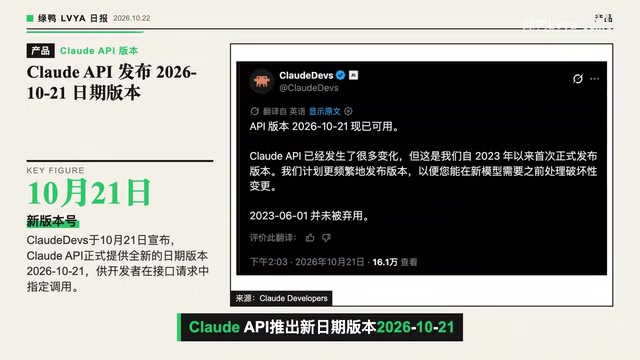
For developers calling the API, the change in version cadence is worth noting. An interface version that stays unchanged for a long time feels stable, but it also accumulates a batch of improvements that cannot move forward. More frequent updates mean you need to plan API versions more proactively and pay attention to deprecation announcements.
Mistral's Voice Toolkit
Mistral's Voxtral 3 includes speech transcription, TTS, and a Voice Agent SDK, while also offering EU hosting and self-deployment options. Teams that need to integrate speech transcription, speech synthesis, or develop voice agents can directly use the accompanying SDK and choose EU hosting or self-deployment according to their needs.
The EU hosting option has practical significance for compliance-sensitive industries; voice data often involves personal privacy, and hosting location and deployment method directly affect whether approval can be obtained.
Two More Items: Enterprise Private Preview and New Model Releases
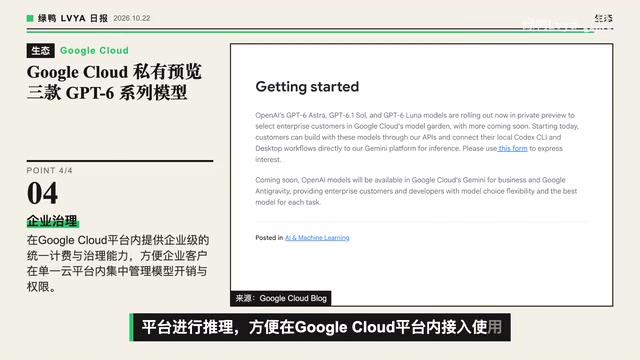
Google Cloud announced a private preview of three models for some enterprise customers. Enterprise customers can not only call them via API but also access the Gemini platform for inference through local Codex CLI or Desktop workflows.
Connecting model access with existing development toolchains is a standard play for cloud vendors competing for enterprise developers; the key lies in whether latency, quotas, and billing after integration are transparent.
Overall, the common direction of this round of updates is to move AI from "answering questions" to "continuously participating in workflows": agents run in the background, caching backstops long sessions, scanning follows code changes, and generated artifacts can be iterated. Individually, none of these changes is sensational; only together do they constitute a usable workflow experience.
(Information in this article is based on a single source, the "Green Duck AI Daily" video; some product names and parameters are compiled by transliteration, and official announcements should be taken as authoritative.)
Background Supplement
A background concept can help in understanding this batch of updates: the context window refers to the total number of tokens a model can process at one time, determining how much conversation history, documents, or code it can "see" simultaneously. In long-task workflows, once context exceeds the window it must be truncated or summarized, leading to information loss; caching mechanisms are a means of further reducing repeated processing costs within the window. Flint's support for 512K context and Claude's long-session caching essentially address the same problem—keeping the model coherent across long, multi-turn tasks without frequently rebuilding state. This is also the engineering foundation of the "continuously participating in workflows" direction.
One-line Summary
Anthropic launches proactive agent Claude Duet, with multiple updates driving AI into continuous workflows.
Related articles
Domestic AI Coding Plans Compared: How to Choose Between Zhipu, Kimi, and MiniMax
Compare Zhipu GLM Coding Plan, Kimi Code, and MiniMax M-Plan on pricing, points/quota rules, and model changes, plus scenario-based selection advice.

JetBrains Open-Sources AI IDE ThinkRail: Multi-Workspace Parallelism and Spec-Driven Development
ThinkRail is an open-source agentic IDE from the JetBrains Innovation Hub built on Pi, featuring multi-workspace parallelism, Git worktree isolation, spec-driven development, and diff review. Completely free under Apache 2.0.

Higgsfield: How AI Video Is Moving from the 1-Minute to the 10-Minute Era
Higgsfield shares AI video breakthroughs from 1 minute to over 10 minutes, covering Astra's text rendering, external tool use for 3D modeling, voice-to-movie, and productivity gains for small creative teams.