Claude Enters U.S. Government at a 40% Discount: Inside Anthropic's OneGov Agreement

Anthropic brings Claude to all levels of U.S. government at a 40% discount via USGSA's OneGov agreement.
Anthropic announced it is expanding its partnership with the U.S. General Services Administration (USGSA) to bring Claude AI services to federal, state, local, tribal, and territorial government agencies under the OneGov agreement framework, offering discounts of up to 40%. The agreement's core is standardizing procurement and leveraging USGSA's centralized procurement framework to lower AI access costs for governments at multiple levels. The article argues that the government market is a high-value AI scenario, but compliance requirements such as data sovereignty, audit trails, and content safety filtering create barriers; the 40% discount reflects intensifying competition in which vendors trade price for share, while warning agencies to be wary of single-vendor dependence. If proven effective, the model could become a replicable template for AI vendors entering the public sector.
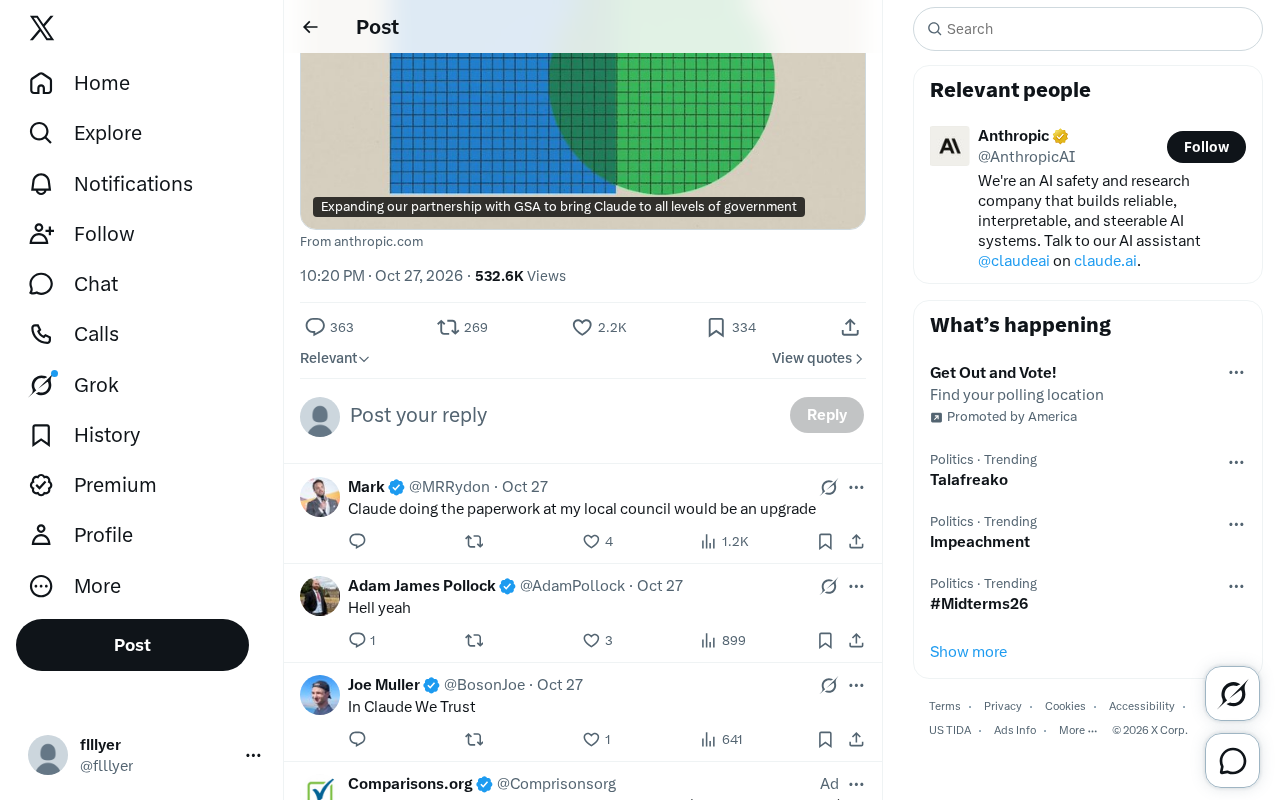
Anthropic announced this week via its official account that it is expanding its partnership with the U.S. General Services Administration (USGSA) to bring Claude AI services to federal, state, local, tribal, and territorial government agencies under the new OneGov agreement framework, offering discounts of up to 40%. This move marks a new phase in the commercialization of generative AI in the public sector and reflects the intensifying competition among AI vendors for the government market.
The OneGov Agreement: More Than Just a Discount
According to information Anthropic has made public, the core of the OneGov agreement is to standardize the procurement process for Claude, enabling government agencies at different levels to quickly access AI capabilities under unified terms. A 40% discount is unusual in enterprise-level AI procurement, especially considering that government customers typically have stricter requirements around data security, compliance, and procurement cycles.
The agreement's coverage extends from federal agencies all the way to tribal and territorial governments, meaning that even local governments with limited resources can access frontier AI models at a lower barrier to entry. For small and mid-sized government units long constrained by budgets and technical capacity, this centralized procurement model may significantly lower the initial cost of AI adoption.
The U.S. General Services Administration (GSA) is the central agency for federal government centralized procurement and asset management. Its contract frameworks (such as the Multiple Award Schedule) are often referenced or directly adopted by state, local, and even tribal governments. Through the GSA's centralized procurement channels, a vendor's compliance review, security assessment, and pricing terms need only be completed once before they can be reused by multiple government agencies, greatly shortening procurement cycles. The OneGov agreement further consolidates on this logic, standardizing the procurement of AI services so that governments at different levels do not have to negotiate separately, thereby reducing administrative costs and improving procurement transparency.
Why the Government Market Has Become a Battleground for AI
Government agencies are a high-value scenario for AI deployment: document processing, policy analysis, public service Q&A, translation, and multilingual support are all in enormous demand and highly repetitive. But this market also imposes unique requirements on vendors—data sovereignty, audit trails, content safety filtering, and long-term stability are all indispensable.
Anthropic's choice to enter through USGSA's existing procurement framework rather than negotiating state by state and city by city is an efficiency-first strategy. As the center of federal government procurement, the USGSA's contract terms are often referenced or even directly adopted by state and local governments. Securing the OneGov agreement is equivalent to obtaining a "pass" that covers multiple levels of government.
Data sovereignty means that data storage, processing, and access must comply with the laws and policy requirements of the country or jurisdiction in which they occur. Government data typically also involves sensitive information classification, in-country storage, and access permission controls. Audit trails require systems to fully record every data access, model invocation, and output so that they can be reviewed and accounted for after the fact. Content safety filtering involves real-time screening of model outputs to prevent the generation of illegal, discriminatory, or confidential information. Together, these requirements form the compliance threshold for government AI procurement and constitute the technical barriers vendors must overcome to enter the public sector.
The Competitive Logic Behind the Discount
A 40% discount is uncommon in the AI industry, especially for a frontier model like Claude. This pricing strategy sends at least two signals: first, Anthropic is willing to trade short-term profit for long-term share of the government market; second, competition in government AI procurement is intensifying, and vendors need to build moats through both pricing and compliance advantages.
From the public sector's perspective, low-cost access reduces the cost of trial and error, but agencies also need to be wary of dependence on a single vendor. The migration cost of AI services is not low: once a government agency becomes deeply tied to a particular model in its processes and staff training, the cost of later switching vendors may far exceed the procurement savings initially achieved.
Vendor lock-in refers to the phenomenon in which customers find it difficult to switch vendors because migration costs are too high. In AI services, lock-in effects arise at multiple levels: the way a model's API is invoked, the prompts and workflows built around a specific model, employee usage habits, and accumulated fine-tuning data and evaluation benchmarks. Once a government agency embeds Claude into its daily document processing and public service workflows, switching models means retraining staff, rebuilding applications, and going through security review again. Therefore, although low-cost access can reduce initial costs, the long-term total cost of ownership and the risk of dependence on a single vendor need to be factored into procurement decisions.
What It Means for the AI Industry
Anthropic's agreement with USGSA provides a reference template for AI vendors entering the public sector: partnering with centralized procurement agencies to rapidly expand coverage through standardized agreements and price incentives. If this model proves effective, other AI vendors are likely to follow with similar government cooperation agreements.
For the developer ecosystem, large-scale adoption by government customers may also drive the development of compliance tools, audit solutions, and industry applications built around Claude. The government scenario's high demands for transparency and explainability will, in turn, push AI products to invest more in safety and controllability.
Anthropic has not yet disclosed a specific implementation timeline for the OneGov agreement or the list of covered agencies, and the conditions and duration of the 40% discount remain to be further clarified. But one thing is certain: AI is entering government workflows faster than many people expected.
One-line Summary
Anthropic is bringing Claude to all levels of U.S. government at a 40% discount through USGSA's OneGov agreement.
Paragraph Summary
Anthropic announced it is expanding its partnership with the U.S. General Services Administration (USGSA) to bring Claude AI services to federal, state, local, tribal, and territorial government agencies under the OneGov agreement framework, offering discounts of up to 40%. The core of the agreement is to standardize the procurement process and use USGSA's centralized procurement framework to lower the cost of AI access for governments at multiple levels. The article argues that the government market is a high-value scenario for AI deployment, but compliance requirements such as data sovereignty, audit trails, and content safety filtering create barriers; the 40% discount reflects intensifying competition in which vendors trade price for share, while also warning government agencies to be wary of dependence on a single vendor. If this model proves effective, it could become a replicable template for AI vendors entering the public sector.
Related articles

DeepSeek Harness Quick Start Guide: From Installation to 5 Real-World Cases
What is DeepSeek Harness? Based on a Bilibili tutorial, this article covers how this AI Agents software works, installation and setup, four working modes, and five real-world cases: a 3D racing game, official website, music player, science animation, and self-developed plugin—plus token money-saving tips.

Breaking Down DeepSeek's Super-agent Architecture: How Router+Worker Solves the Multi-Session Management Bottleneck
An analysis of DeepSeek's Super-agent paper: how the Router+Worker two-tier architecture uses Fast Pass, Chain of Recall, and storage-compute separation to solve multi-AI-session management bottlenecks, and how much it truly alleviates the human attention bottleneck and what engineering trade-offs it makes.

19K Stars in 5 Days: Why DeepSeek's Open-Source AI Programmer Went Viral
DeepSeek's open-source AI programmer hit 19K GitHub stars in 5 days. Why it went viral: the agent boom, AI writing its own code, and the shift from Q&A tools to AI employees.