Claude Fable 5.2 Released: Three Major Capability Leaps and a Pricing Shock

Anthropic releases same-origin dual models Fable 5.2 and Mythos 5.2, pressuring OpenAI with faster, cheaper, and comprehensively superior capabilities.
Anthropic has launched Claude Fable 5.2 and Mythos 5.2, which share an underlying architecture. The latter, retaining full cybersecurity capabilities, is available only to enterprise and security customers, while the former reins in sensitive capabilities and is released to the public. Fable 5.2's output speed is about 30% faster than the previous generation, priced below OpenAI Astra, and offers a premium fast mode. In benchmarks, it surpasses Opus 5.5 on agentic coding, turns chart recognition from a weakness into a lead, and completes equivalent tasks with fewer tokens. Anthropic disclosed that over 90% of internal code changes are written by Claude, and the model once coordinated over a thousand sub-agents to produce a runnable OS prototype in eight days, with capabilities extending to circuit board design and robotics control.
Anthropic has launched Claude Fable 5.2 and Mythos 5.2. The former is available to the public, while the latter is reserved for enterprise and cybersecurity customers. According to a breakdown in a Bilibili creator's Portuguese-language commentary video, this release is more than a routine iteration—it simultaneously raises the ceiling on inference speed, coding agents, multimodal understanding, and hardware/robotics control, while directly pressuring OpenAI with lower inference costs.
Same Origin, Two Models: The Split Between Fable 5.2 and Mythos 5.2
The two models share the same underlying architecture; the difference lies in the intensity of safety trimming. Mythos 5.2 retains full cybersecurity and penetration-related capabilities, which Anthropic considers too risky to release to the public, making it available exclusively to Big Tech and cybersecurity firms. Fable 5.2 reins in these sensitive capabilities and targets ordinary developers and enterprise users.
This "same-origin dual release" approach means that the public's Fable 5.2 does not cut back on general intelligence—what is reduced is mainly offensive security capability. For the vast majority of coding, research, and automation tasks, this imposes no practical loss.
"Safety trimming" refers to capability-level restrictive fine-tuning of the same base model, rather than retraining a smaller model. Common practices include refusal training, targeted weakening on domain-specific data, and deployment-side policy filtering. Anthropic adopts a "same-origin dual release" strategy: the underlying weights and inference capabilities remain consistent, with differentiated handling only for offensive security capabilities (such as exploit development and penetration testing instructions). This approach is not uncommon in the industry—OpenAI and Google have also adopted tiered access for high-risk capabilities—but splitting the same model generation into a public version and an enterprise version while explicitly disclosing the scope of trimming represents a relatively transparent approach. The cost is that safety alignment may be partially bypassed by jailbreak techniques, so the enterprise version typically also comes with contractual constraints and usage monitoring.
Speed and Cost: Faster Inference, a Lower Barrier
According to the video, Fable 5.2's output generation speed is about 30% faster than Fable 5.1, with noticeably shorter inference wait times. On pricing, both input and output token prices are lower than OpenAI's Astra. The creator stated directly in the video that "OpenAI is going to be in trouble," and speculated that OpenAI may respond by the end of Q4.
The model also offers an optional fast mode that further dramatically increases token generation speed, with a corresponding price increase. This design clearly borrows from OpenAI's product strategy with Astra—trading price for speed and pricing latency-sensitive workloads separately.
Benchmarks: From Chasing Opus to Surpassing It
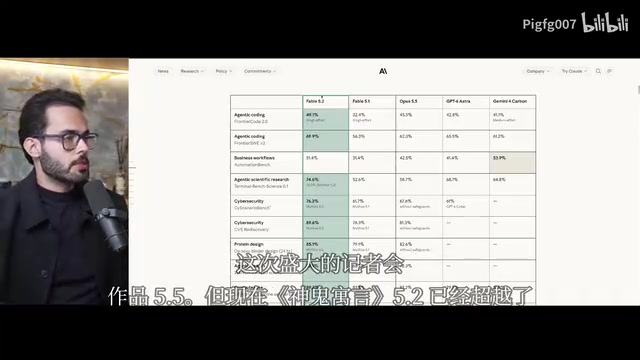
Previously, Anthropic faced an awkward internal situation: Opus 5.5 was more cost-effective in actual use than Fable 5.1, so the new model received praise but failed to gain traction. Fable 5.2 attempts to put an end to this problem.
On agentic coding tasks, Fable 5.2's score jumped significantly compared with Fable 5.1 and is higher than Opus 5.5. The comparison given in the video is that Fable 5.2 has crossed Opus 5.5's level on codebase refactoring and complex engineering tasks.
Performance in other dimensions is similarly comprehensive:
- Scientific research: scores significantly higher than comparison models
- Protein design: reaches a high level
- Agentic search: leads Opus 5.5 and another competitor
- Computer use: surpasses Opus 5.5, Astra, and Gemini 4 Carbon
One detail worth mentioning is chart recognition capability. The Claude series had previously been weak in visual chart understanding—Fable 5.1 and Opus 5.5 both scored poorly, while GPT-Astra and Gemini 4 Carbon were clearly stronger in this area. Fable 5.2 has now surpassed all competitors, which the creator called "one of the big leaps."
Efficiency: Fewer Tokens for the Same Work
At the default medium effort level, Fable 5.2 consumes fewer tokens than Fable 5.1 to complete complex tasks. In the Frontier Code evaluation, Fable 5.2 at the high effort level achieved results close to Opus 5.5 at its highest effort level, at roughly half the per-task cost.
The higher "ultra" level achieved the highest score among all tested models. However, the video also points out a counterintuitive phenomenon: pushing the effort level to maximum actually reduces efficiency, with per-task cost rising sharply, while the ultra level offers clearly better value. This shows that the model's capability curve is not linear—blindly throwing compute at it is not cost-effective.

"Effort level" is a reasoning budget control mechanism for reasoning models, essentially regulating the number of tokens or search depth the model uses for internal thinking before generating an answer. Higher levels make the model more inclined to develop longer chains of thought and try more solution paths, thereby improving success rates on difficult problems, but latency and cost rise accordingly. The article's statement that "the capability curve is not linear" corresponds precisely to the optimal allocation of inference compute: for a fixed task distribution, there is a cost-effectiveness inflection point, beyond which marginal returns diminish or even turn negative (for example, overthinking introduces erroneous paths or redundant verification). Therefore, in actual deployment, effort levels are typically selected dynamically based on task difficulty rather than always maxed out.
Internal Practice: How Anthropic Uses It
Anthropic disclosed a set of internal data: over 90% of code changes are now written by Claude, with human oversight. The team uses Fable 5.2 to fix stubborn bugs in minutes, optimize performance across all services, and complete high-value software projects that were previously slower and more expensive.
A concrete case: an agent team used an early version of Fable 5.2 to migrate a critical production service from Python to Rust; after migration, the service became more efficient, more reliable, and startup speed improved by an order of magnitude.
Another experiment the creator called "crazy": engineers asked Fable 5.2 to design an operating system prototype starting from an empty folder. The model coordinated over a thousand sub-agents working continuously for eight days, writing, testing, and reviewing code, ultimately producing a runnable system—with its own kernel, disk/keyboard/network drivers, persistent file storage, window system, login interface, installer, and cloud feature integration, capable of booting on a laptop.

"Sub-agents" refer to subordinate agent instances orchestrated by a master model, each with its own independent context and tool permissions. The master agent is responsible for task decomposition, result aggregation, and conflict resolution, while sub-agents execute specific stages such as coding, testing, and review in parallel, forming a collaboration structure similar to an engineering team. This multi-agent orchestration can break through the limits of a single context window and break long tasks into verifiable small steps, but it also brings coordination overhead, error propagation, and risk of cost overruns. In the case of "over a thousand sub-agents working continuously for eight days," the key lies in the master layer's strict definition of sub-task boundaries and acceptance criteria; otherwise, the larger the parallel scale, the more serious the rework.
From Software to Hardware: Circuit Boards and Robots
Fable 5.2's capability boundary extends into the physical world. Anthropic partnered with a circuit board design manufacturer, using a single prompt to have the model design and manufacture three usable electronic devices: a home voice assistant hub, a USB speakerphone, and a portable virtual pet. The model wrote specifications, drew circuits, designed enclosures, and the final devices worked properly.
In robotics control, Fable 5.2 demonstrated substantially improved capability over its predecessor, even on tasks it was never explicitly trained on. In the demo, a robot controlled by Fable 5.2 solved a Rubik's cube, unscrewed a bottle cap, and drew a robot. On a public benchmark for controlling a dual-arm simulated robot based on camera images, Fable 5.2 surpassed other cutting-edge models running on the same hardware, as well as most systems built specifically for robotics control.
The creator's assessment of the robot-drawing segment was rather teasing—"it looks like a two-year-old drew it"—but also acknowledged that today's crude demo might become something else tomorrow.
The "vision-language-action model" (VLA) is the mainstream paradigm in robotics control today: the model takes camera images and language instructions as input and directly outputs joint actions or end-effector commands, bypassing traditional hand-engineered modeling and motion planning pipelines. Its advantage is that it can generalize to tasks it was not explicitly trained on, because the pretraining phase absorbs a large amount of visual and semantic priors; its weakness is that precise force control and long-horizon stability still fall short of specialized controllers. The article's statement that it "surpasses specialized systems on a public benchmark for controlling a dual-arm simulated robot based on camera images" reflects precisely the progress of the VLA approach in generalization, but the gap between simulated environments and real hardware (the sim-to-real gap) remains a major obstacle to deployment.
Ecosystem Validation and Competitive Landscape
Early testers include companies such as Vercel, Shopify, Datadog, Unity, Uber, and Oracle, with feedback centering on one point: Fable 5.2's coding capabilities transfer smoothly to all kinds of tasks.
For developers, the core signal of this release is that the focus of competition among frontier models is shifting from "whose score is higher" to "who can complete more real work per unit cost." Fable 5.2 advances simultaneously on speed, price, token efficiency, and task success rate, and combined with its capability expansion from code to hardware, it transmits pressure directly to OpenAI. The creator announced plans to produce a hands-on comparison of Fable 5.2 with other models, which will reveal the real differences beyond paper scores.
Related articles
Human-in-the-Loop QA Workflow: Adding Test Gates to Coding Agents
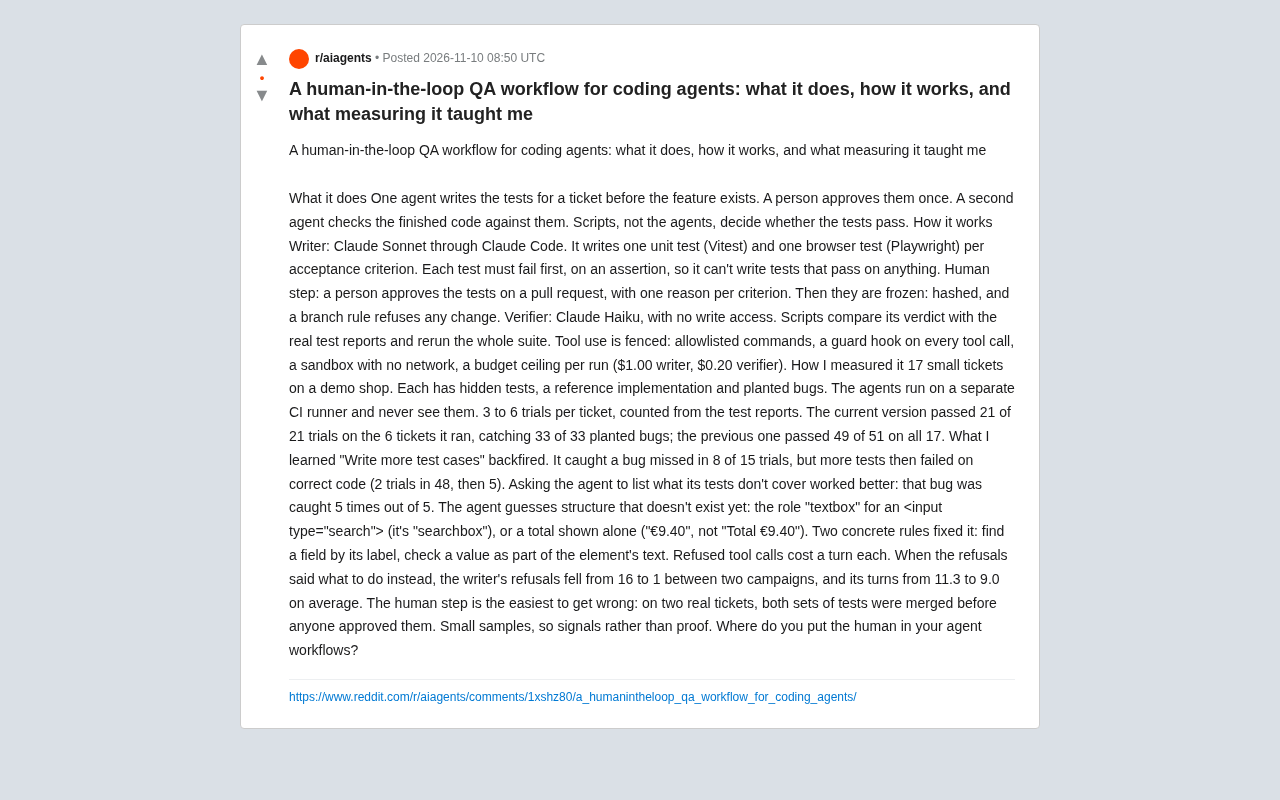
A Reddit developer shares a human-in-the-loop QA workflow for coding agents: agents write tests first, humans freeze them, scripts adjudicate. Across 17 tickets, more tests increased false positives—listing uncovered scope proved more effective.
MiniMax Open-Sources H3-Image: An Open-Weights Image Model Built on H3
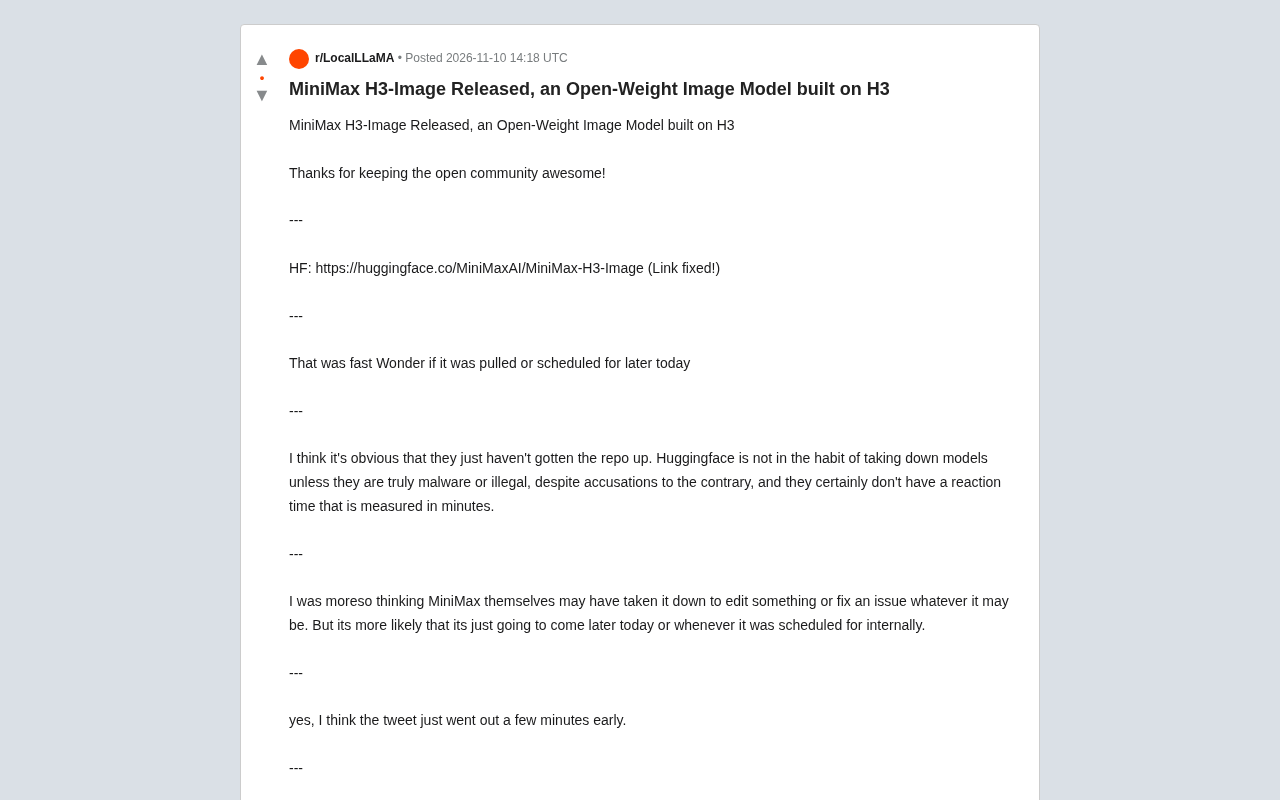
MiniMax releases H3-Image, an open-weights image model built on the H3 video model. The community is watching its image editing, text-to-image quality, and the deployment burden of its 32B text encoder, with potential competition against Qwen Image 2.1.

Reddit Turns User Discussions into AI Product Reviews
Reddit launches AI product reviews that aggregate community discussions into pros and cons summaries for 10,000 products, helping consumers research before holiday shopping. This analysis examines data value, accuracy concerns, and commercialization boundaries.